
Introduction
The 19th century marked a profound transformation in the soul of Russian art, as the creative focus shifted from the rigid constraints of academicism toward a deeply emotive and nationalistic expression. This era was defined by a powerful movement to capture the essence of the Russian spirit, whether through the vast, melancholic expanses of the landscape, the dramatic intensity of psychological portraiture, or the vibrant storytelling of folk traditions. As the country navigated rapid social changes and cultural shifts, its painters developed a unique visual language that blended European technical mastery with a distinct, local sensibility.
What unites these masters is a shared commitment to truth—be it the truth of the natural world or the truth of the human condition. From the luminous, atmospheric studies of nature to the grand, romanticized historical scenes, these artists sought to document a changing world with unprecedented depth. Their works do not merely depict scenes; they evoke the very atmosphere of a bygone era, capturing the light of the steppes and the shadows of the imperial salons.
Today, these painters remain vital because they represent the foundation of a rich, diverse artistic heritage that continues to influence modern aesthetics. Their ability to translate complex emotions into brushstrokes and color continues to resonate with contemporary viewers across the globe. In the following sections, we will guide you through the lives and legacies of ten essential figures, including the masters of light and landscape such as Ivan Shishkin and the evocative visionaries like Mikhail Vrubel, whose works define the pinnacle of this golden age.
Nicholas Roerich
 The Polovetzky Camp - Nicholas Roerich
Born in 1874, Nicholas Roerich represents the late 19th-century transition into a profound Symbolism that would define his visionary career. His inclusion in this group of 19th-century Russian painters is rooted in his formative years in Saint Petersburg, where he simultaneously mastered law and fine arts at the Imperial Academy of Arts. This rigorous academic foundation allowed him to evolve from a disciplined student into a leader of the "World of Art" society, where he revolutionized theatrical design through sweeping, mythological landscapes.
A visitor recognizes a Roerich masterpiece by its ethereal, luminous atmosphere and a sense of spiritual quietude. His brushwork often employs delicate, layered washes that suggest a dreamlike translucency, favoring soft, organic lines over harsh edges to achieve a deep sense of atmospheric perspective. In his representative work, The Polovetzky Camp, this technique is masterfully displayed. The canvas captures a twilight gathering where warm ochres and deep golds bleed into cool teals, bathing the nomadic structures in a low-key, glowing light. The result is a serene, tranquil composition that feels as though the world is holding its breath between the heat of the day and the chill of the night.
Ivan Shishkin
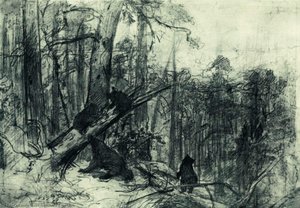
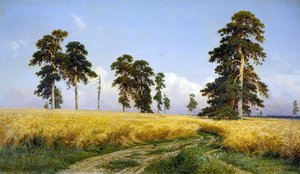
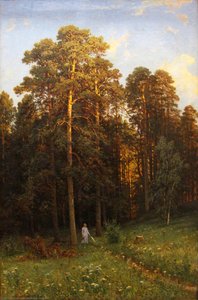
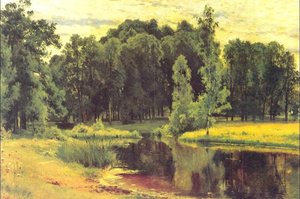
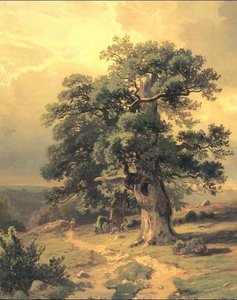
A true master of the 19th century Russian landscape, Ivan Shishkin possessed an unparalleled ability to translate the vast, untamed spirit of the forest into tangible reality. His works are instantly recognizable by their profound botanical precision and a sense of monumental scale that makes the viewer feel small amidst the ancient timber. Through a meticulous application of oil paint, he captured the intricate textures of bark, the soft diffusion of light through dense canopies, and the complex layering of forest floor vegetation, often utilizing a sophisticated range of tonal values to evoke a contemplative, sometimes melancholic, atmosphere.
Born in 1832, Shishkin’s journey from a merchant family in Yelabuga to the heights of the Saint Petersburg Imperial Academy of Arts defines the peak of Russian realism. After studying under Professor Sokrat Vorobyov and earning a prestigious gold medal, his imperial scholarship allowed him to refine his vision through travels in Germany and Switzerland. His masterpiece, Morning in a Pine Forest (1886), stands as a definitive testament to his legacy. In this work, Shishkin utilizes a masterful command of light and shadow to transform a serene woodland scene into a profound exploration of nature's enduring majesty.
Alexej von Jawlensky
 Tanagra Figure with Lampion - Alexej von Jawlensky
Born in Torzhok in 1864, Alexej von Jawlensky represents the profound evolution of Russian artistic training into the avant-garde. His journey began within the rigorous academic traditions of Saint Petersburg, where he studied under the influence of the great realist Ilya Repin. This foundational period in the late 19th century provided the classical discipline that he would eventually deconstruct to become a master of Expressionism. His transition from the structured military life and Russian academies toward the experimental freedom of Munich marked a pivotal shift in his creative identity.
Jawlensky’s work is characterized by a move away from literal representation toward a spiritual, distilled essence of form. His 1900 work, Tanagra Figure with Lampion, serves as a compelling testament to this transition. In this piece, he explores the tension between strength and vulnerability, utilizing simplified shapes and a focus on emotional resonance that anticipates his later, iconic mystical explorations. By stripping away the superfluous, he transformed the visual language of his Russian upbringing into a modern, emotive dialogue between light and shadow.
Lovis Corinth
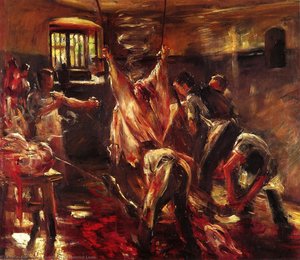 In the Slaughter House - Lovis Corinth
Born in 1858 in the Prussian province of East Prussia, Lovis Corinth represents a vital link in the evolution of European art. His inclusion in the study of 19th century Russian painters stems from his birth within the vast imperial territories of the era, a period where the artistic boundaries between the Prussian, German, and Russian spheres were deeply intertwined through shared academic traditions and the movement of masters across the continent.
Corinth’s journey was defined by a relentless pursuit of stylistic truth, moving from the meticulous realism of Munich to the dramatic intensity of the Baroque masters in Antwerp. This synthesis of influences allowed him to bridge the gap between Impressionism and Expressionism. His 1893 masterpiece, In the Slaughter House, serves as a profound testament to this transition. In this work, Corinth moves beyond mere naturalism to capture the raw, visceral energy of labor. Through thick, expressive impasto and a palette of deep reds and earthy ochres, he transforms a scene of industrial butchery into a dramatic exploration of physical exertion and human industry, marking him as a pivotal figure in the late 19th-century aesthetic revolution.
Karl Bryullov
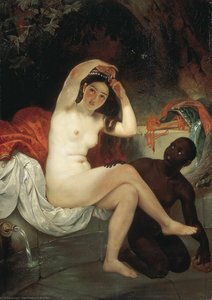 Bathsheba - Karl Bryullov
A central figure in the evolution of 19th century Russian painters, Karl Bryullov bridged the gap between classical academic training and the burgeoning emotional intensity of Romanticism. Born in Saint Petersburg in 1799, his journey took him from the Imperial School for the Arts to the vibrant art scene of Rome, where he spent over a decade refining a style that would captivate Europe. His ability to infuse historical narratives with profound psychological depth allowed him to transcend mere illustration, making him a cornerstone of the Russian artistic identity during this transformative century.
His 1832 masterpiece, Bathsheba, exemplifies this mastery. In this work, Bryullov moves beyond the rigid constraints of his early education to explore a moment of intimate, almost voyeuristic tension. Through a sophisticated use of light and shadow, he sculpts the figures from the darkness, capturing the delicate luster of skin and the soft textures of silk. This technical brilliance, combined with the dramatic emotional resonance seen in his famous The Last Day of Pompeii, established Bryullov as a titan of the era, capable of balancing monumental grandeur with the most fragile human vulnerabilities.
Mikhail Vrubel
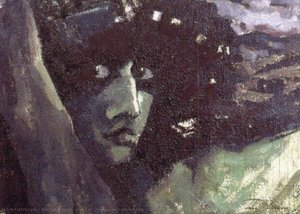 Head of Demon with mountains - Mikhail Vrubel
In Head of Demon with mountains (1890), the viewer is met with a piercing, heavy gaze that pulls the observer into a dark, intimate encounter. This work exemplifies the intense, unsettling energy that defined the career of Mikhail Vrubel, a pivotal figure among 19th century Russian painters. His unique approach to form and line, developed during his studies at the Imperial Academy of Arts under Pavel Chistyakov, moved away from the strict realism of his era toward a profound, idiosyncratic vision.
Vrubel’s style was significantly transformed by his work on the 12th-century murals at St. Cyril's Church in Kiev and his travels to Venice. These experiences inspired a palette of saturated, jewel-like tones and a technique that mimicked the faceted appearance of mosaic tesserae. Using a painting knife to apply bold, impastoed strokes, he created crystalline surfaces that felt more like stained glass than traditional oil on canvas. His fascination with folklore and the supernatural led him to explore themes of isolation and myth, often through a Symbolist lens. By blending the textures of Oriental art with a restless, fragmented brushwork, Vrubel carved a distinct space in the Russian artistic landscape of the 1800s.
Konstantin Makovsky
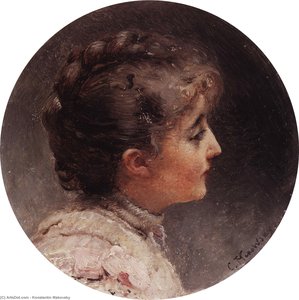 Portrait of Lady Vivien - Konstantin Makovsky
Konstantin Makovsky stands as a luminous figure among 19th century Russian painters, a master who bridged the gap between academic rigor and the soulful narratives of the Peredvizhniki movement. His work is instantly recognizable through its theatrical compositions, exquisite textures, and a profound ability to capture the psychological depth of his subjects. Whether depicting historical drama or the intimate details of Russian life, Makovsky’s brushwork possesses a rhythmic grace, often utilizing a soft, glowing light that elevates even the most realistic genre scenes into something poetic.
Born in 1839 into a family of immense creative talent, his artistic foundation was laid at the Moscow School of Painting, Sculpture, and Architecture under the guidance of masters like Karl Bryullov. This training instilled in him a romantic sensibility that would define his career. His technical precision is perhaps most elegantly captured in his 1900 work, Portrait of Lady Vivien. In this piece, he employs a sophisticated palette of creamy, rosy browns to create an atmosphere of quiet prestige and romantic reverie. Through meticulous attention to the luster of pearls and the delicate play of light on skin, Makovsky transforms a portrait into a profound study of introspection and elegance.
Viktor Vasnetsov
 Christ Almighty - Viktor Vasnetsov
A visitor can immediately recognize a work by Viktor Vasnetsov through his unique ability to blend gritty realism with a mystical, fairytale atmosphere. His brushwork often captures the ethereal quality of light, whether it is the celestial glow surrounding a divine figure or the soft, melancholic shadows of a forest. Vasnetsov was a central figure of the 19th century Russian painters, a period in which he transitioned from the realist tendencies of the Peredvizhniki movement toward a profound Symbolism rooted in national identity.
Born in 1848, Vasnetsov’s artistic journey took him from the theological studies of a seminary to the prestigious Imperial Academy of Arts in St. Petersburg. He became a master of the Russian Revival, drawing deep inspiration from byliny—the epic oral poems of folklore. His canvases frequently depict heroic bogatyrs and legendary characters, imbuing them with a sense of spiritual resilience. In his 1896 masterpiece, Christ Almighty, this fascination with the divine is palpable; the composition uses celestial clouds and stars to elevate the subject into a realm of profound reverence and awe. Through his depictions of mythology and historical epics, Vasnetsov transformed the folklore of his homeland into a visual language of sublime beauty.
Grigory Gagarin
 Portrait of Major M.L.Dubelt - Grigory Gagarin
A prominent figure in 19th century Russian painters, Grigory Gagarin (1810–1893) occupied a unique position at the intersection of high diplomacy and fine art. Born into the noble Rurikid princely family of Saint Petersburg, his artistic development was shaped by private instruction from the celebrated master Karl Briullov. This academic foundation allowed him to navigate the sophisticated social circles of Europe, serving as a diplomat in Paris, Rome, and Constantinople, while simultaneously capturing the essence of the diverse cultures he encountered.
Gagarin’s oeuvre is particularly noted for its ethnographic depth, offering a visual record of the Caucasus and surrounding regions. His fascination with regional identity is evident in works such as Circassian Woman and A Priest from Armenia. His technical precision is masterfully displayed in the Portrait of Major M.L. Dubelt, a work of Academic Realism. In this piece, the meticulous rendering of the officer's heavy military uniform and the use of atmospheric perspective to depict distant mountains demonstrate a profound ability to balance formal dignity with naturalistic detail. Through his illustrations of the works of Alexander Pushkin and his evocative portraiture, Gagarin remains a vital link to the cultural and social landscape of 19th century Russia."
Konstantin Korovin
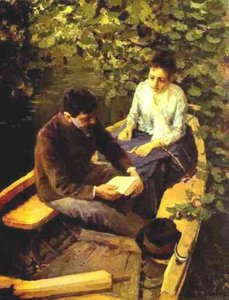 In a Boat (Portrait of the Artist Maria Yakunchikova and Self-Portrait) - Konstantin Korovin
Konstantin Korovin stands as a pivotal figure among 19th century Russian painters, representing the vibrant transition from rigid academicism to the sensory freedom of Impressionism. Born in 1861, his artistic journey began at the Moscow School of Painting, Sculpture and Architecture, where he studied under masters such as Vasily Perov and Alexei Savrasov. His evolution was deeply influenced by his time with Vasily Polenov, which eventually led him to the influential Abramtsevo Circle, a sanctuary for the era's most progressive creative minds.
Korovin’s work is defined by an extraordinary ability to capture the ephemeral qualities of light and atmosphere. His representative masterpiece, In a Boat (Portrait of the Artist Maria Yakunchikova and Self-Portrait), painted in 1888, exemplifies this mastery. In this serene composition, he moves beyond mere representation to embrace the tactile, atmospheric nuances of the Russian landscape. By utilizing lush, organic framing and a sophisticated play of color, he captures a fleeting moment of intimacy amidst the ripples of a river. Through his innovative brushwork and devotion to the play of light, Korovin helped redefine the visual language of his nation during this transformative century."
Conclusion
The masters of this era collectively defined a visual language that transitioned from the romanticism of Bryullov to the profound, spiritual landscapes of Shishkin and the evocative symbolism of Vrubel. Whether through the sweeping vistas of the Russian wilderness or the intimate, psychological depth of their portraiture, these artists captured the soul of a nation in flux. From the light-drenched impressions of Korovin to the mythic storytelling of Vasnetsov, their diverse contributions created a rich tapestry of color and emotion that continues to resonate across borders.
At Mus3ums.com, we invite you to bring this storied legacy into your own living space. Our artisans specialize in creating museum-quality, hand-painted oil reproductions that honor the specific brushwork and tonal depth of these 19th-century masters. You can explore our full collection to find the perfect piece for your home and experience the enduring beauty of these Russian masterpieces through the tactile richness of real oil on canvas.


