


Introduction
The 20th century marked a seismic shift in the global art landscape, as the center of gravity moved from the traditional academies of Europe to the vibrant, restless energy of the United States. This era was defined by a radical departure from classical representation, driven by a spirit of experimentation that sought to capture the frantic pace of modern life, the complexities of the subconscious, and the raw power of abstraction. From the sun-drenched landscapes of the Impressionist influence to the bold, graphic language of Pop Art, these artists redefined what a canvas could communicate.
As the century progressed, American art became a battleground for new ideologies. The movement spanned from the delicate, organic forms of early modernism to the chaotic, gestural energy of Abstract Expressionism and the playful, consumerist critiques of the mid-century. This period was not merely about changing styles; it was about a fundamental reimagining of the artist's role in a rapidly industrializing and socially evolving world. The works produced during these decades challenged the very definition of beauty and meaning, forcing viewers to engage with art in entirely new, often provocative, ways.
Today, these painters remain essential because they established the visual vocabulary of the modern age. Their influence is felt in every corner of contemporary design, media, and fine art, serving as the foundation for how we perceive color, form, and identity in the present day. To study them is to understand the roots of modern visual culture.
The following selection explores ten pivotal figures who shaped this transformative century, ranging from the masters of light and landscape to the icons of the avant-garde.
Andy Warhol
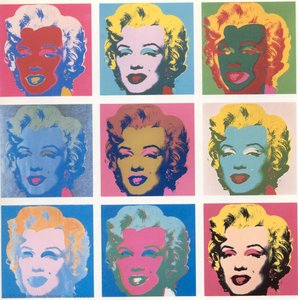 Marilyn Diptych - Andy Warhol
A central figure of the 20th century American painters, Andy Warhol transformed the visual language of the United States by bridging the gap between fine art and mass production. Born in 1928 in Pittsburgh, Pennsylvania, his work emerged from a fascination with the industrial grit of his upbringing and the glossy, manufactured allure of Hollywood celebrity culture. His aesthetic is instantly recognizable by its departure from traditional painterly textures, opting instead for the flat, vibrant, and often jarring colors of commercial printing. By utilizing the silkscreen process, Warhol mimicked the repetitive nature of consumerism, effectively turning the artist's hand into a mechanical tool of mass media.
His 1962 masterpiece, Marilyn Diptych, serves as a profound exploration of fame and mortality. Through the repetition of Monroe's image, Warhol captures the tension between the vivid, artificial glamour of stardom and the fading, melancholic reality of the individual. This work exemplifies how he utilized the iconography of pop culture to reflect the shifting social landscape of mid-century America, cementing his legacy as a definitive icon of the Pop Art movement.
Winslow Homer
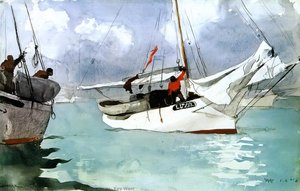 Fishing Boats, Key West - Winslow Homer
Winslow Homer stands as a foundational figure whose influence bridged the gap into the 20th century, shaping the trajectory of American Realism. Although his career began in the 19th century, his profound impact on the visual language of American art resonated deeply into the 1900s, establishing a standard for how the American landscape and spirit were captured on canvas. His work provided a vital link for the generations of painters who would define the 20th century in the United States, moving from meticulous detail toward a more atmospheric, impressionistic sensibility.
His mastery of light and the elemental forces of nature is beautifully exemplified in Fishing Boats, Key West. Created in 1903, this work captures a tranquil maritime scene through a delicate balance of muted blues, whites, and grays. The composition utilizes fluid, loose brushwork to convey the movement of water and the soft, cloudy sky, reflecting an impressionistic approach to light. Through such works, Homer’s legacy of observing the natural world with both discipline and poetic grace remains a cornerstone of the American artistic tradition.
James McNeill Whistler
 Charles Lang Freer - James McNeill Whistler
In the portrait Charles Lang Freer, the subject emerges from a somber, indistinct background, his presence defined by a penetrating gaze and a heavy, contemplative atmosphere. The work exemplifies the artist's mastery of tonal harmony, where the boundaries between the sitter and his surroundings dissolve into a carefully constructed arrangement of color and shadow. Using a limited palette of deep browns, ochres, and sienna, the painting prioritizes the essence of the subject through energetic, spontaneous brushwork and thick impasto strokes that create a profound sense of three-dimensional depth.
Born in Massachusetts, James McNeill Whistler was a pivotal figure whose influence extended into the 20th century, bridging the gap between late 19th-century traditions and the modern era. His journey took him from the Imperial Academy of Arts in St. Petersburg to the studios of Paris, where he studied under Gleyre and absorbed the principles of French Realism. As a leader of the Aestheticism movement, he became renowned for his "Nocturnes," focusing on atmospheric beauty and the evocative power of light. His ability to transform a canvas into a study of mood and color remains a cornerstone of American art history.
Jasper Johns
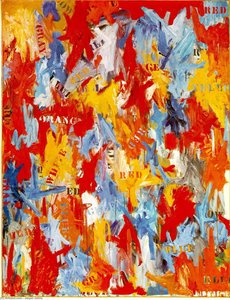 False Start - Jasper Johns
A pivotal figure in the evolution of American modernism, Jasper Johns emerged from the mid-century shift that redefined the visual language of the United States. Born in 1930 in Georgia and raised in South Carolina, his journey from the American South to the bustling art scene of New York City defines the mid-20th-century artistic trajectory. After studying at the Parsons School of Design and serving in the United States Army in Japan, Johns returned to New York, where his work began to bridge the intense, emotional landscapes of Abstract Expressionism with the burgeoning iconography of Pop Art.
His 1959 masterpiece, False Start, serves as a profound exploration of this transition. The canvas is a chaotic yet harmonious dance of color and form, utilizing thick, tactile impasto brushstrokes that emphasize the physical act of creation. Through overlapping layers of red, yellow, blue, and white, Johns creates a sense of depth and rhythmic energy. By transforming everyday symbols and spontaneous gestures into monumental subjects, he secured his place as a cornerstone of 20th-century American painting, influencing generations of artists to look closer at the intersection of symbol and substance."
Roy Lichtenstein
A central figure of the mid-century American art scene, Roy Lichtenstein redefined the boundaries of fine art by looking outward at the glossy, mechanical surfaces of mass culture. Born in Manhattan in 1923, he emerged as a leading pioneer of the Pop Art movement, a radical departure from the heavy, emotional brushwork of the Abstract Expressionism that preceded him. His work is instantly recognizable by its deliberate detachment and the appropriation of "lowbrow" imagery from comic books and commercial advertising.
A visitor can identify a Lichtenstein at a glance through his meticulous recreation of industrial printing techniques, most notably the Ben-Day dot system. These tiny, precisely placed dots, combined with bold black outlines and a primary color palette, transform ephemeral print language into monumental compositions. His 1963 masterpiece, Whaam!, serves as a definitive example of this style, utilizing the visual shorthand of aviation and comic panels to create a stylized, almost clinical representation of conflict. By elevating the everyday pulse of the street to the gallery wall, this American painter of the 20th century challenged how media shapes our perception of reality.
William Merritt Chase
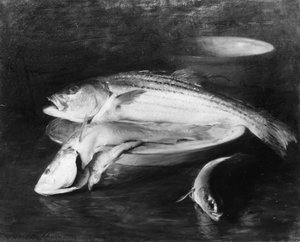 Fish - William Merritt Chase
A master of light and texture, William Merritt Chase stands as a pivotal figure in the evolution of American art. Although his career began in the late 19th century, his profound influence and continued stylistic mastery defined the aesthetic landscape for 20th century American painters. His ability to bridge the gap between rigorous academic realism and the fluid spontaneity of Impressionism allowed him to shape the visual language of a burgeoning American art scene.
Chase’s technical journey took him from the disciplined environments of the National Academy of Design to the prestigious Academy of Fine Arts in Munich. This international training instilled in him a deep respect for composition and the dramatic interplay of shadow. This expertise is vibrantly realized in his 1910 work, Fish. In this still life, Chase moves beyond mere representation to capture a sense of vitality through loose, expressive brushwork. The painting utilizes a sophisticated tonal range, where the silvery scales of the bass emerge from a dark, atmospheric background. Through such works, Chase transformed the simple subject of a still life into a profound study of light and texture, leaving an indelible mark on the history of American painting."
Georgia O'Keeffe
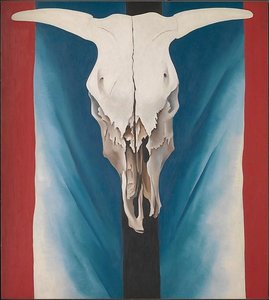 Cow's Skull Red, White, and Blue - Georgia O'Keeffe
A central figure in the evolution of 20th century American painters, Georgia O'Keeffe redefined the boundaries of modernism through her profound connection to the natural world. Born in 1887 in Wisconsin, her journey from a rural farmhouse to the vibrant art scenes of Chicago and New York City shaped a vision that was uniquely her own. Under the guidance of Arthur Wesley Dow, she moved away from the rigid constraints of academic realism, learning to prioritize personal expression through the delicate balance of line and color.
Her work often explores the intersection of life and mortality, a theme poignantly captured in her 1931 masterpiece, Cow's Skull Red, White, and Blue. In this piece, she achieves a striking synthesis of meticulous detail and bold abstraction, placing a highly textured, realistic skull against a stark, geometric backdrop of vibrant color. This ability to transform organic forms into powerful, symbolic compositions allowed her to become a pioneer of the American modernist movement, influencing how subsequent generations viewed the relationship between the subject and the canvas.
Mary Cassatt
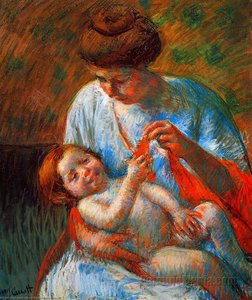 Baby Lying on His Mother s Lap, reaching to hold a scarf - Mary Cassatt
A central figure in the evolution of American modernism, Mary Cassatt bridged the gap between traditional academic rigor and the revolutionary spirit of Impressionism. Although her career began in the late 19th century, her influence and continued practice through the early decades of the 20th century solidified her status as a defining American painter of the era. Born in Pennsylvania and trained at the Pennsylvania Academy of the Fine Arts, she later refined her technical mastery in Paris under Jean-Léon Gérôme and through disciplined study at the Louvre. Her work is distinguished by its ability to elevate the domestic sphere into a realm of profound psychological depth.
In her evocative work, Baby Lying on His Mother s Lap, reaching to hold a scarf (1914), Cassatt demonstrates the serene mastery that characterized her later years. This piece serves as a tender meditation on maternal bonds, utilizing the soft, airy color palettes associated with late Impressionism to capture a fleeting, intimate moment. Through visible brushwork and a sophisticated handling of light, she transforms a quiet, everyday interaction into a timeless study of human connection, securing her legacy among the most significant artists from the United States.
Jackson Pollock
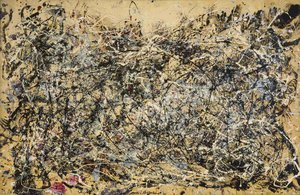 Number 1, 1949 - Jackson Pollock
A viewer can recognize a Jackson Pollock at a glance through the sheer, kinetic energy of his surfaces. Moving away from the easel, he revolutionized the medium by laying canvases on the floor, utilizing a radical "drip" technique that transformed the act of painting into a physical performance. His works are characterized by a complex, non-representational web of splatters, swirls, and interlacing lines that lack a traditional focal point, creating an all-over composition that invites the eye to wander endlessly through a chaotic yet rhythmic landscape of color and texture.
Born in 1912 in Wyoming, Pollock’s journey through the American West and his subsequent studies at the Art Students League in New York City—where he trained under Thomas Hart Benton—cemented his place as a central figure of 20th century American art. His evolution from rhythmic, narrative-driven studies to the raw spontaneity of Abstract Expressionism defines the mid-century shift in the United States art scene. His monumental work, Number 1, 1950, serves as a definitive testament to this era, capturing the existential intensity and explosive movement that characterized the post-war American avant-garde.
Childe Hassam
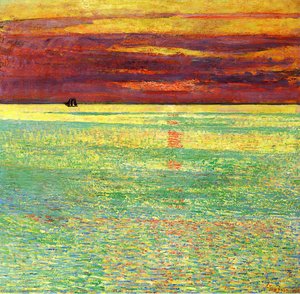 Sunset at Sea - Childe Hassam
A visitor can instantly recognize a work by Childe Hassam through his masterful command of light and his vibrant, rhythmic brushwork. His canvases often pulse with the energy of a nation in transition, utilizing a loose, gestural application of paint that captures the fleeting essence of a moment. Whether depicting the bustling textures of urban life or the tranquil expansiveness of the coastline, his palette is characterized by a sophisticated interplay of light and atmosphere, often employing thick, tactile strokes that lend a sense of movement to the surface.
As a leading figure of American Impressionism, Hassam’s career spanned the turn of the century, cementing his place among the 20th century painters from United States through his profound influence on the nation's visual identity. Born in Boston in 1859, he evolved from a disciplined draftsman into a premier chronicler of light, remaining active in his craft until his death in 1935.
His 1911 masterpiece, Sunset at Sea, serves as a quintessential example of his ability to harmonize color. In this serene seascape, the warm oranges and reds of a setting sky contrast beautifully with the cool turquoise and blue tones of the water, creating a balanced, luminous composition that epitomizes the Impressionist spirit.
Conclusion
The evolution of 20th-century American art represents a profound shift from the delicate Impressionist sensibilities of Whistler and Cassatt to the bold, disruptive energy of Pop Art icons like Warhol and Lichtenstein. Whether through the expressive, rhythmic drips of Pollock or the ethereal, floral abstractions of O'Keeffe, these artists collectively redefined the visual language of a nation, moving from traditional landscapes into the heart of modernism and abstraction. Each master contributed a unique layer to this cultural tapestry, ensuring that the American aesthetic would forever be recognized for its diversity, scale, and emotional depth.
At Mus3ums.com, we invite you to bring these transformative movements into your own living space. Our artisans specialize in creating museum-quality, hand-painted oil reproductions that capture the authentic texture and soul of these masterpieces. You can explore our full collection to find the perfect piece and experience the timeless beauty of these legendary painters through our bespoke, handmade artistry.


