
Introduction
The 20th century marked a profound metamorphosis for Spanish art, as the nation’s creative spirit transitioned from the luminous, traditionalist naturalism of the previous era into a radical, avant-garde explosion that redefined global visual language. This period was characterized by a tension between deep-rooted cultural archetypes—the stark landscapes of Castile and the intense light of the Mediterranean—and a relentless drive toward abstraction, surrealism, and structural deconstruction. As the century progressed, Spanish creators moved beyond mere representation, using the canvas to explore the subconscious, the geometry of form, and the very essence of modern existence.
From the dreamlike, melting realities of the surrealists to the fractured, revolutionary planes of cubism, these artists dismantled old perspectives to build entirely new ways of seeing. Their work was not merely a local phenomenon but a central pillar of the international modern movement, influencing how the world perceived color, space, and the human figure. Today, their influence remains palpable in contemporary design and fine art, serving as a bridge between classical mastery and the limitless possibilities of the modern age.
This exploration traverses the diverse legacies of these masters, tracing the evolution of a movement that began with the mastery of light and culminated in the most daring intellectual shifts of the century. We begin by examining the profound impact of ten essential figures who shaped this golden age of Spanish creativity.
Pablo Picasso
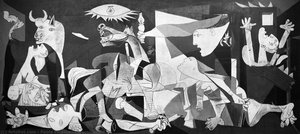 Guernica - Pablo Picasso
A central figure of the 20th century Spanish painters, Pablo Picasso redefined the boundaries of modern art through his relentless experimentation and technical mastery. Born in Málaga in 1881, his artistic journey began under the disciplined guidance of his father, a painter who recognized the boy's extraordinary aptitude for form and figure. By his teens, Picasso was already demonstrating a precision that surpassed his instructors in Barcelona, a talent that would eventually lead him to co-found the Cubist movement.
His work often channeled deep personal and historical gravity, a trait evident in his monumental masterpiece, Guernica. Created in 1937, this profound work responds to the devastation of the Spanish Civil War, utilizing a monochromatic palette of black, white, and grey to depict a fragmented, chaotic scene of suffering. Through the use of sharp, angular lines and distorted perspectives, Picasso deconstructed traditional representation, presenting multiple viewpoints simultaneously. This revolutionary approach to space and form solidified his legacy as a pioneer who transformed the visual language of the 20th century, influencing generations of artists to look beyond the surface of reality.
Salvador Dalí
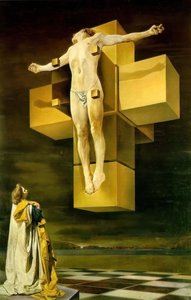 Crucifixion - Salvador Dalí
A titan of the Surrealist movement, Salvador Dalí remains one of the most iconic figures among 20th century Spanish painters. Born in Figueres in 1904, his creative journey was deeply influenced by the landscape of the Empordà region and a complex sense of identity shaped by his family history. Dalí’s work famously translated the irrationality of the subconscious into hyper-detailed, dreamlike imagery, moving from early Surrealist explorations to a later phase known as "nuclear mysticism." This unique evolution saw him merging profound religious themes with the scientific advancements of the atomic age, a hallmark of his mid-century evolution.
His technical mastery is vividly captured in his 1954 work, Crucifixion. In this striking piece, Dalí departs from traditional iconography to present a transcendent vision of Christ suspended within a geometrically constructed hypercube. This juxtaposition of spiritual suffering and four-dimensional geometry exemplifies his ability to reconcile the metaphysical with the modern scientific era. Through his meticulous use of oil on canvas, Dalí transformed the canvas into a window through which the complexities of the universe and the depths of the human psyche could be explored.
Joan Miró
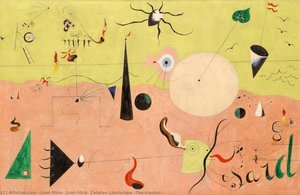
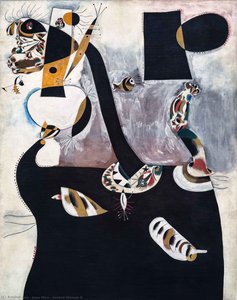
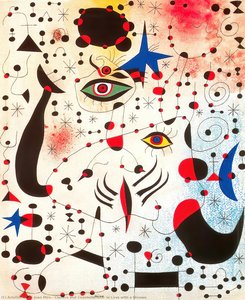 Ciphers and Constellations, in Love with a Woman - Joan Miró
In 1941, Miró produced Ciphers and Constellations, in Love with a Woman, a work that exemplifies his mature Surrealist language. This piece, part of his celebrated “Constellations” series, moves beyond mere representation to offer a cosmic dance of symbolic forms. Through a dynamic interplay of abstract shapes, lines, and vibrant colors, the artist invites viewers into a dreamlike realm where recurring motifs, such as watchful eyes, suggest a profound sense of awareness and mystery.
A central figure of the 20th century Spanish painters, Joan Miró (1893–1983) developed a visual vocabulary that resisted easy categorization. Born in Barcelona to a family of watchmakers, his early exposure to meticulous craftsmanship informed a restless, experimental energy. While his roots were in the Catalan landscape, his evolution led him toward a unique form of poetic abstraction. He navigated the tension between the organic and the geometric, often turning inward to explore the subconscious. His work remains a testament to the era's avant-garde spirit, bridging the gap between biomorphic abstraction and a refined, mystical symbolism that continues to challenge the boundaries of artistic expression."
Joaquín Sorolla
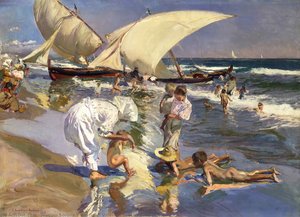 Valencia beach in the morning light - Joaquín Sorolla
Joaquín Sorolla stands as a luminous pillar of the 20th century Spanish painters, a master whose career bridged the transition from the late 19th century into the modern era. Born in Valencia in 1863, Sorolla’s journey was shaped by early tragedy and a profound connection to the Mediterranean light. After receiving foundational training in his hometown under mentors like Cayetano Capuz and José Benlliure, he moved to Madrid in 1890, where his ambition led him to tackle monumental historical and social subjects. His work is defined by a profound mastery of Luminism, capturing the ephemeral dance of sunlight with a vitality that remains unparalleled.
His representative masterpiece, Valencia beach in the morning light (1908), exemplifies why his influence persisted well into the 20th century. In this work, Sorolla moves beyond mere representation to capture the very essence of the atmosphere. Through his expert use of en plein air techniques, he translates the shimmering reflections of the sun on wet sand and the rhythmic movement of the tide into a sensory experience. The painting is a symphony of color and light, demonstrating the technical brilliance that secured his legacy among the most significant Spanish artists of his time.
Juan Gris
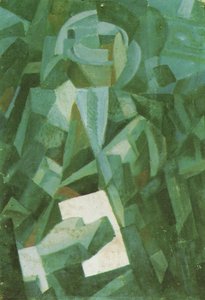
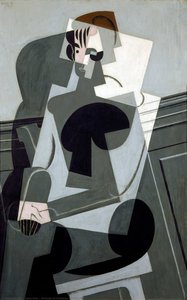 Portrait of Madame Josette Gris - Juan Gris
A pivotal figure among 20th century Spanish painters, Juan Gris brought a unique structural logic to the avant-garde movements of his era. Born in Madrid in 1887, his early training at the Madrid School of Arts and Sciences in engineering provided a mathematical foundation that would later define his visual language. After studying under José Moreno Carbonero, he transitioned from his original identity as José Victoriano González-Pérez to the name Juan Gris, a shift that mirrored his departure from technical studies toward the radical art scene of Paris.
Living in the famous Bateau-Lavoir, Gris became a master of Synthetic Cubism, distinguishing himself through a disciplined approach to geometric abstraction. While many of his contemporaries focused on deconstructing form, Gris utilized overlapping planes and sharp, rhythmic lines to reconstruct reality. His 1916 work, Portrait of Madame Josette Gris, serves as a profound example of this mastery, utilizing a sophisticated, almost monochromatic palette of grays and subtle tones to explore the interplay of fragmented shapes. Through his ability to marry technical precision with creative intuition, he remains a cornerstone of the Spanish contribution to modernism.
Mariano Fortuny
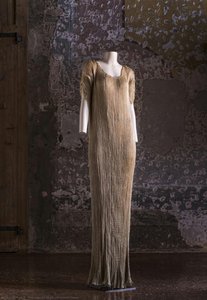 Delphos Dress - Mariano Fortuny
A true polymath of the visual arts, Mariano Fortuny represents the sophisticated intersection of Spanish heritage and international modernism. Born in 1871, he was the son of the genre painter Mariano Fortuny y Marsal, a lineage that provided him with the formal training necessary to navigate the transition from traditional canvas to the avant-garde designs of the 20th century. While his roots were firmly Spanish, his creative soul was shaped by a move to Paris and a lifelong residence in Venice, where he transformed from a trained painter into a visionary of textile and stage design.
His inclusion in the canon of 20th century Spanish painters is defined by his ability to translate the painterly manipulation of light and texture into the realm of material design. His most iconic achievement, the Delphos Dress, stands as a masterpiece of this era. Inspired by the classical grace of ancient Greek statuary, the garment utilizes a revolutionary pleating technique to create a fluid, shimmering silhouette. This work exemplifies the decadent elegance of the period, turning silk into a medium of sculptural movement that remains a benchmark of artistic innovation.
Cristóbal Balenciaga Eizaguirre
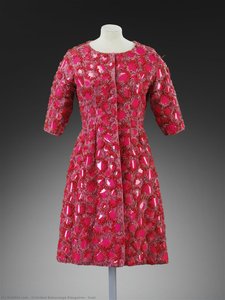 Coat - Cristóbal Balenciaga Eizaguirre
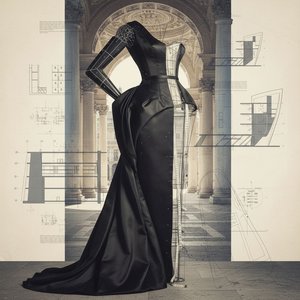
While primarily celebrated as a titan of high couture, Cristóbal Balenciaga Eizaguirre occupied a unique space in the 20th century Spanish artistic landscape, bridging the gap between sculptural fashion and fine art. Born in 1895 in Getaria, his creative evolution throughout the 1900s mirrored the avant-garde spirit that defined Spanish modernism. His work was never merely about clothing; it was an exploration of form and volume that resonated with the era's radical shifts in perspective.
His artistic sensibilities are captured in diverse movements, from the experimental approach of his study for Song of Songs IV to the surrealist undertones of Acrobat. In his post-impressionist oil on canvas, Tree Roots, one observes a profound ability to translate the essence of nature into a visual language of texture and line. This mastery of structure is most evident in his 1961 work, Coat, where the garment transcends utility to become a piece of architectural sculpture. By deconstructing the traditional silhouette, Balenciaga Eizaguirre applied the same revolutionary spirit found in the most daring 20th century Spanish painters, treating fabric as a medium for profound, sculptural expression.
Oscar Dominguez
 The Sewing Machine - Oscar Dominguez
Born in 1906 in Tenerife, Oscar Dominguez stands as a vital figure among 20th century Spanish painters, representing the profound psychological depth of the Surrealist movement. His artistic journey was shaped by a childhood illness that altered his physical structure, an experience that infused his vision with a sense of the uncanny and the fragile. After moving to Paris at age 21, he moved beyond his early abstractions to become a central figure in the Surrealist circle, famously meeting André Breton and Paul Éluard.
His technical mastery is best exemplified by his pioneering use of decalcomania, a method of creating spontaneous, organic textures that mirror the subconscious. In his 1943 work, The Sewing Machine, this fascination with texture and the irrational reaches a peak. The piece presents a weathered, metallic relic, where tarnished gold and bronze tones create a somber, dreamlike atmosphere. Through eroded forms and a monochromatic palette, Dominguez captures a sense of decay and memory, transforming a simple object into a haunting fragment of a lost, mystical narrative.
Julio Romero de Torres
 Manola - Julio Romero de Torres
A central figure in the landscape of 20th century Spanish painters, Julio Romero de Torres brought a profound, mystical sensibility to the art of his era. Born in 1874 in Córdoba, his work represents a sophisticated bridge between the traditional realism of his father, Rafael Romero Barros, and the burgeoning Symbolist and Art Nouveau movements that defined the early 1900s. His aesthetic is instantly recognizable through its melancholic atmosphere, sinuous lines, and a palette that often favors deep, moody tones contrasted with soft, luminous highlights.
In his representative work, Manola, created around 1905, we see the artist's mastery of the human silhouette. The piece captures a woman in profile, her form defined by a dark bodice and the fluid, organic drapery of a shawl. The composition uses a subtle interplay of forest greens, pale yellows, and muted grays to evoke a sense of quiet rebellion and rhythmic movement. Through his meticulous technique and ability to infuse Andalusian archetypes with a modern, dreamlike quality, Romero de Torres remains a vital voice in the evolution of Spanish modernism.
Ramon Casas
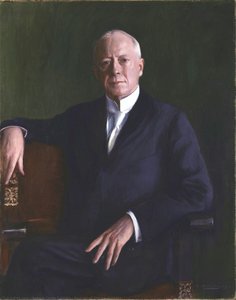 Portrait of Charles Deering - Ramon Casas
A central figure of the Catalan Modernisme movement, Ramon Casas i Carbó left an indelible mark on the artistic landscape of the 20th century. His career, which spanned the transition from the late 19th century into the early 1900s, exemplifies the sophisticated evolution of Spanish art during this era. Having abandoned formal schooling at age eleven to study under Joan Vicens, Casas developed a technical mastery that allowed him to navigate between the precision of Realism and the atmospheric light of Impressionism.
His ability to capture the social fabric of Barcelona is perhaps most elegantly realized in his 1914 work, Portrait of Charles Deering. This oil on canvas serves as a profound study of status and character, utilizing a restrained palette of deep blues and whites to convey a sense of quiet authority. Through such works, Casas bridged the gap between traditional portraiture and the modern sensibilities that defined 20th century Spanish painters. His depictions of both the elite and the vibrant scenes of daily life ensure his place as a cornerstone of Spanish art history, reflecting the cultural dynamism of a nation in transition.
Conclusion
The 20th century was a transformative era for Spanish art, defined by a profound tension between the traditional mastery of light and the radical deconstruction of form. From the surrealist dreamscapes of Dalí and the whimsical abstraction of Miró to the structural revolutions led by Picasso and Gris, these artists collectively redefined the visual language of modernity. Whether through the luminous impressionism of Sorolla or the intricate, symbolic narratives of Romero de Torres, this group of creators proved that Spanish identity could be both deeply rooted in heritage and fearlessly avant-garde. Their diverse contributions—spanning Cubism, Surrealism, and Fauvism—ensure that their influence remains a cornerstone of global art history.
At Mus3ums.com, we invite you to bring this extraordinary legacy into your own living space. Our master artists specialize in creating museum-quality, hand-painted oil reproductions that capture the authentic texture, brushwork, and soul of these iconic masterpieces. Whether you are looking to honor the structural genius of a Cubist work or the ethereal light of a Spanish landscape, you can explore our full collection and find the perfect piece to transform your home into a private gallery.