
Introduction
The seventeenth century in the Netherlands marked a profound shift in the history of art, as the focus of patronage moved away from the divine and the monarchical toward the lived experience of the merchant class. This era, known as the Dutch Golden Age, saw a surge of creativity fueled by a prosperous republic that valued the beauty of the everyday. Unlike the grand, sweeping allegories of the Southern Baroque, these painters captured the quiet dignity of domestic interiors, the vastness of maritime expeditions, and the subtle play of light across a tabletop.
What unites these masters is a shared obsession with naturalism and the technical mastery of light and texture. Whether documenting a tranquil street scene or a dramatic seascape, these artists sought to render the world with an unprecedented level of precision and emotional depth. Their works reflect a society that found profound meaning in the tangible: the texture of a silk dress, the glint of a pewter goblet, or the atmospheric haze of a low-lying cloud.
Today, these painters remain essential because they pioneered a visual language of realism that continues to influence how we perceive the world around us. Their ability to transform a mundane moment into a timeless masterpiece allows us to connect with the human condition across centuries. In the following sections, we examine ten pivotal figures of this movement, from the masters of light and domesticity to the virtuosos of the sea, each representing a unique facet of this extraordinary period of artistic achievement.
Johannes Vermeer
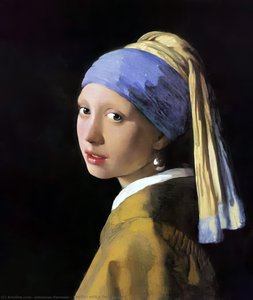 The Girl with a Pearl Earring - Johannes Vermeer
Johannes Vermeer stands as a preeminent master of the Dutch Golden Age, a period defined by the rise of a merchant class that favored intimate, domestic scenes over grand royal commissions. Born in Delft in 1632, Vermeer’s connection to the art world was deeply personal; his father was an art dealer and weaver, immersing the young artist in the tactile reality of fine textiles and the commerce of pigments. This upbringing in the heart of the Netherlands allowed him to capture the quiet prestige of everyday life with unparalleled luminosity.
His masterpiece, The Girl with a Pearl Earring, exemplifies the technical brilliance of this era. Rather than a formal portrait, this work is a tronie, focusing on the interplay of light and exotic costume. The subject is draped in a turban of deep ultramarine and golden yellow, her gaze caught in a moment of soft transition against a dark, mysterious void. Vermeer’s mastery is most evident in the pearl itself, rendered with an incredible economy of brushstrokes that transform simple glazes into a glowing, teardrop-shaped gem. Through his meticulous layering of oil, he achieved a sense of profound realism and mystical light that remains a hallmark of the Dutch Golden Age.
Jacob van Ruisdael
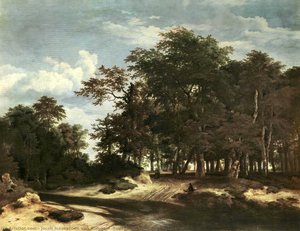
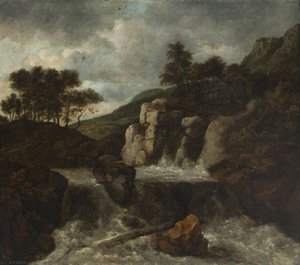
In The Large Forest, the viewer is immediately drawn into a realm of captivating natural majesty. This expansive woodland scene, defined by a majestic, mature tree with sprawling branches, invites a sense of peaceful solitude and contemplative introspection. Through masterful technique, the artist employs fine brushwork and layered glazing to capture the tactile realism of rough bark and soft foliage, while light filters through the canopy to create dappled patterns on the forest floor.
Jacob van Ruisdael stands as a preeminent figure of the Dutch Golden Age, a movement that celebrated the everyday landscapes and atmospheric wonders of the Netherlands. Born in Haarlem in 1628, Ruisdael was immersed in a lineage of craftsmanship, being the son of Isaack van Ruisdael and the nephew of the prominent landscape artist Salomon van Ruysdael. It is believed he received his formal training under his uncle, absorbing the nuances of the Dutch landscape before joining the Haarlem painters' guild in 1648. His later move to Amsterdam allowed him to engage with the commercial heart of the Dutch Republic, further cementing his reputation as a master of dramatic, atmospheric landscapes that define the era's artistic identity.
Gerrit Dou
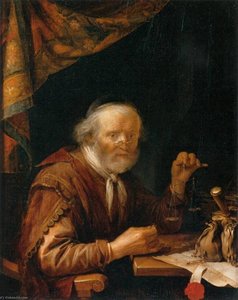 English The Moneylender Français Le peseur d'or - Gerrit Dou
A pioneer of the Leiden fijnschilder style, Gerrit Dou represents the pinnacle of technical precision within the Dutch Golden Age. His mastery of the era's characteristic focus on intimate, everyday scenes was deeply informed by his upbringing; the son of a glazier, he possessed an innate understanding of how light interacts with glass and surface. After honing his skills in the workshops of engravers and glassmakers, Dou entered the studio of Rembrandt between 1628 and 1631. This formative period allowed him to absorb the master's revolutionary use of light and shadow, which he would later refine into a much more meticulous, small-scale aesthetic.
His work is defined by an almost obsessive devotion to detail, often achieved through the use of magnifying lenses to capture textures that defy the naked eye. In his 1664 masterpiece, The Moneylender, Dou demonstrates this extraordinary capability. The painting serves as a profound meditation on morality and commerce, utilizing dramatic chiaroscuro to sculpt the elderly subject's features. Through his ability to transform mundane domesticity into high art, Dou remains a vital figure of the Dutch Golden Age, influencing generations with his ability to render the tactile reality of the seventeenth century.
Gabriel Metsu
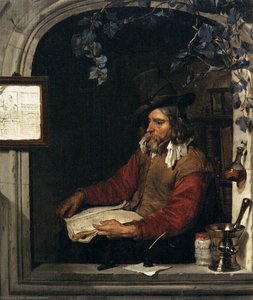 The Apothecary (The Chemist) - Gabriel Metsu
A versatile master of the Dutch Golden Age, Gabriel Metsu (1629–1667) distinguished himself through an extraordinary refusal to be confined to a single genre. While many of his contemporaries specialized in specific subjects, Metsu moved fluidly between history painting, portraiture, and intimate genre scenes. His roots in the artistic milieu of Leiden, where his father worked as a painter and textile designer, provided a foundation for his meticulous observation of the material world. This ability to capture the quiet nuances of domestic life is a hallmark of the Dutch Golden Age, a period defined by art commissioned by merchants to celebrate everyday reality rather than royal grandeur.
His technical prowess is perhaps most vividly realized in The Apothecary (The Chemist), a work that exemplifies his ability to blend portraiture with still life. In this composition, Metsu employs a delicate touch to render the textures of rich fabrics and the soft glow of light streaming through an arched window. Through the masterful use of clair-obscur, he creates a sense of profound depth and contemplation, transforming a scholarly study into a window into the intellectual and domestic soul of seventeenth-century Holland.
Pieter de Hooch
Born in Rotterdam in 1629, Pieter de Hooch emerged as a preeminent master of the Dutch Golden Age, a movement defined by its shift away from grand royal narratives toward the profound beauty of everyday life. His artistic journey began with a disciplined education in Haarlem under the landscape painter Nicolaes Berchem, a period that instilled in him the meticulous observation and spatial precision essential to the Dutch Golden Age style. As his career progressed through Rotterdam, Delft, and Amsterdam, de Hooch became a specialist in the quiet rhythms of the domestic sphere.
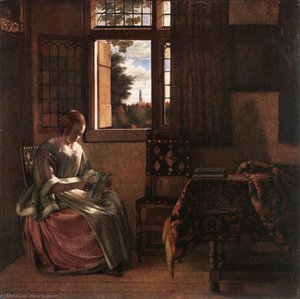
He is celebrated for his unparalleled ability to organize interior spaces, often utilizing a sophisticated "see-through-doorway" technique to create a sense of depth and architectural order. His representative work, Woman Reading a Letter (1664), serves as a testament to his mastery of light and intimacy. In this piece, he captures a moment of profound stillness, using soft, natural light to elevate a private, mundane act into a scene of contemplative grace. Through his focus on the sanctity of the home, de Hooch remains a vital figure among the painters from the Netherlands during this transformative era.
Gerard ter Borch
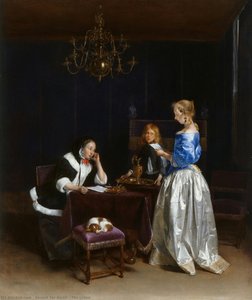 The Letter - Gerard ter Borch
Gerard ter Borch stands as a cornerstone of the Dutch Golden Age, a period defined by a shift away from grand mythological narratives toward the intimate, lived experiences of the Dutch Republic. His mastery of genre painting allowed him to capture the psychological nuances of everyday life, a hallmark of the movement. Born in Zwolle in 1617, ter Borch was shaped by a familial artistic lineage, receiving early instruction from his father before refining his craft in the urban centers of Amsterdam and Haarlem. His technical evolution took him from the studios of masters like Pieter de Molijn to the royal courts of Europe, where his ability to render texture and light earned him knighthood from Philip IV in Madrid.
His representative work, The Letter, exemplifies the exquisite realism and domestic tranquility central to this era. In this composition, ter Borch demonstrates his unparalleled ability to manipulate light and shadow, creating a profound sense of intimacy. The painting showcases his signature ability to render tactile surfaces—the sheen of silk and the softness of fabric—with a precision that elevates a simple domestic moment into a sophisticated meditation on human connection and communication.
Willem van de Velde the Younger
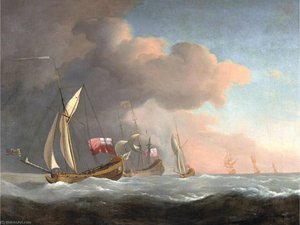 English Royal Yachts at Sea in a Strong Breeze, in Company with a Ship Flying the Royal Standard - Willem van de Velde the Younger
Born in Leiden in 1633, Willem van de Velde the Younger represents the pinnacle of maritime specialization within the Dutch Golden Age. While his father, Willem van de Velde the Elder, focused on the monochrome precision of nautical draughtsmanship, the younger Van de Velde elevated the genre by translating these rigorous studies into atmospheric oil masterpieces. His training, which began under his father's guidance and expanded through an apprenticeship with Simon de Vlieger, allowed him to master the complex interplay of light and water that defines this era of Dutch art.
A viewer can instantly recognize his hand through the sophisticated handling of oil paint, which moves beyond mere documentation to capture the spirited movement of the sea. His work is characterized by a luminous quality and a profound understanding of atmospheric perspective, often influenced by the light-drenched skies seen in the works of Jan van de Cappelle. In his monumental work, English Royal Yachts at Sea in a Strong Breeze, in Company with a Ship Flying the Royal Standard, he demonstrates this technical virtuosity. The canvas captures a dramatic seascape where towering clouds and crashing waves meet the meticulous, realistic rendering of rigging and naval architecture, embodying the power and prestige of 17th-century maritime life.
Jan van Goyen
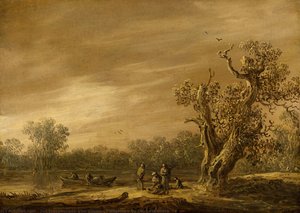 Fishermen by the Lakeshore - Jan van Goyen
A true master of the Dutch Golden Age, Jan van Goyen (1596–1656) redefined the landscape genre through a revolutionary focus on atmosphere and tonal harmony. While many of his contemporaries sought dramatic color, Van Goyen pioneered a more restrained, realistic approach. A visitor can instantly recognize his hand by the subtle, monochromatic palette—dominated by earthy browns, muted greens, and soft grays—and his ability to capture the fleeting essence of the Dutch sky and water.
Born in Leiden and trained under Esaias van de Velde in Haarlem, Van Goyen became a prolific force in the seventeenth-century Netherlands, producing an immense body of work that emphasized the quiet beauty of the natural world. His mastery of atmospheric perspective allowed him to create a sense of infinite space within riverbanks and dunes. This is beautifully exemplified in his 1651 work, Fishermen by the Lakeshore, where he uses delicate tonal variations to depict a moment of profound tranquility. His influence was so significant that he mentored notable artists like Jan Steen, ensuring his legacy of serene, light-drenched landscapes remained a cornerstone of the movement.
Willem van de Velde the Elder
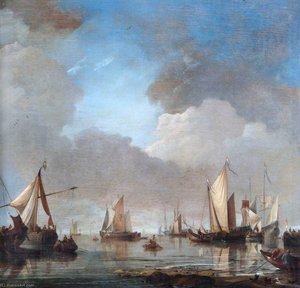 Large Ships and Boats in a Calm - Willem van de Velde the Elder
Willem van de Velde the Elder stands as a preeminent figure among Dutch Golden Age painters, a movement defined by its celebration of maritime commerce and the everyday realities of the Dutch Republic. Born in Leiden around 1611, his perspective was shaped not by an academy, but by the lived experience of a skipper's son. This intimate connection to the sea allowed him to transcend mere imitation, capturing the authentic tension between timber, wind, and tide that characterized the era's naval dominance.
His mastery is most evident in his pioneering use of penschilderij, or pen painting. This meticulous technique involved using ink to achieve a level of precision in rigging and hull construction that traditional oils often lacked. In his representative work, Large Ships and Boats in a Calm (c. 1660), this technical virtuosity is on full display. The composition orchestrates a diverse fleet navigating a tranquil expanse, where the artist's ability to render the subtle interplay of light on water and the intricate details of sailing vessels creates a sense of serene majesty. Through such works, Van de Velde the Elder immortalized the very essence of the Dutch maritime spirit."
Nicolaes Maes
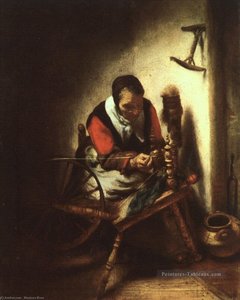 A Woman Spinning - Nicolaes Maes
Born in Dordrecht in 1634, Nicolaes Maes emerged as a significant figure within the Dutch Golden Age, a period defined by the celebration of mercantile prosperity and the intimate realities of everyday life. His artistic journey was profoundly shaped by his time in Amsterdam, where he entered the workshop of Rembrandt van Rijn around 1648. This apprenticeship was transformative, instilling in him a mastery of chiaroscuro—the dramatic interplay of light and shadow—that characterized much of his early, highly emotive work.
As Maes matured, he transitioned from the heavy, dramatic style of his mentor toward the refined genre scenes favored by the Dutch middle class. He became a specialist in capturing the quiet dignity of domesticity, focusing on the textures of daily existence. His 1655 masterpiece, A Woman Spinning, serves as a quintessential example of this evolution. In this work, Maes uses a focused, directional light to sculpt the figure of a woman, elevating a mundane task into a moment of profound contemplation. Through his meticulous attention to detail—from the intricate fibers of the yarn to the soft shadows of a private room—Maes provides a reflective window into the soul of 17th-century Dutch society.
Conclusion
The masters of this era collectively redefined the visual language of the seventeenth century, moving away from grand religious iconography toward the intimate, the domestic, and the atmospheric. From the quiet, light-drenched interiors of Vermeer and De Hooch to the sweeping, dramatic landscapes of Ruisdael and Van Goyen, these artists captured the soul of a nation through the subtle interplay of shadow and light. Whether through the meticulous detail of a genre scene or the vastness of a maritime vista, their shared legacy lies in their ability to find the extraordinary within the everyday.
At Mus3ums.com, we invite you to bring this profound sense of history into your own living space. Our artisans specialize in creating museum-quality, hand-painted oil reproductions that honor the specific textures and brushwork of these Dutch masters. You can explore our full collection to find the perfect piece and experience the timeless beauty of the Dutch Golden Age through a work of art crafted specifically for your home.