
Introduction
Born from the rigorous standards of the prestigious French academies during the 19th century, these painters defined an era of unparalleled technical mastery and aesthetic refinement. This movement, characterized by its pursuit of idealized beauty and polished realism, emerged as the official voice of the French art establishment, emphasizing precise drawing, smooth brushwork, and a profound command of human anatomy. The artists of this period sought to elevate the viewer through grand historical, mythological, and religious narratives, creating works that felt both timeless and monumental.
The cultural landscape of 19th-century France provided a fertile ground for this highly disciplined approach, where the salon system dictated the standards of excellence. These masters moved beyond mere imitation of nature, instead striving for a perfected version of reality that captured the grace and dignity of their subjects. Their influence extended across Europe, establishing a visual language of elegance that remains a cornerstone of Western art history.
Today, the legacy of these painters endures through the enduring power of their compositions and the sheer technical skill required to execute them. Their ability to evoke emotion through subtle light and flawless form continues to captivate modern audiences, serving as a testament to the heights of classical craftsmanship. By examining the lives and works of these masters, we gain insight into a golden age of French painting that continues to shape our understanding of beauty and technical perfection.
The following selection explores the diverse expressions of this movement, highlighting the profound impact of ten essential figures who defined the pinnacle of the Academic tradition.
William-Adolphe Bouguereau
 Lamour and Psyche Children - William-Adolphe Bouguereau
In L'amour et Psyché Children, we encounter a profound example of the tender, ethereal beauty that defined the career of William-Adolphe Bouguereau. This intimate oil on canvas reimagines the mythological lovers as young children, capturing a moment of innocent connection amidst a weightless, celestial atmosphere. The work exemplifies the artist's mastery of the human form, utilizing a controlled application of color to achieve skin tones that appear luminous and translucent against a frothy, dreamlike background.
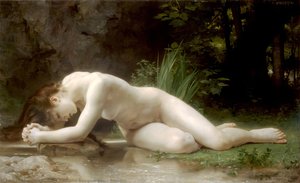
Born in La Rochelle in 1825, Bouguereau rose to prominence through the rigorous discipline of the École des Beaux-Arts. Under the mentorship of François-Edouard Picquenot, he developed the meticulous anatomical precision and technical perfectionism that place him at the very heart of the French Academic Art movement. His style is characterized by a highly polished realism, where the complexities of light and shadow are used to idealize his subjects. Whether depicting mythological figures or realistic genre scenes, his compositions often employ a structured, three-level perspective reminiscent of the Renaissance. Through his ability to bridge classical tradition with a romantic, glowing sensibility, Bouguereau remains a definitive figure of 19th-century academic excellence.
Jean-Léon Gérôme
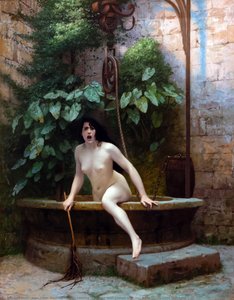
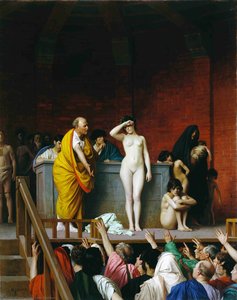
Jean-Léon Gérôme (1824–1904) stands as a formidable pillar of the French Academic Art movement, a style defined by its uncompromising technical precision and its devotion to the rigorous standards of the official art schools. His mastery of the medium was forged through intense discipline, from his early training in Vesoul to his formative years in the studio of Paul Delaroche. After traveling through the ancient ruins of Pompeii and the halls of the Vatican, Gérôme developed a visual vocabulary that allowed him to render historical and Orientalist scenes with a clarity that felt almost photographic. His commitment to the academic tradition was so profound that he eventually became a professor at the École des Beaux-Arts, defending the classical foundations of painting against the rising tide of modernism.
His capacity for dramatic allegory is masterfully captured in his 1896 work, Truth Coming from the Well Armed with Her Whip to Chastise Mankind. In this striking oil on canvas, Gérôme utilizes the polished, highly finished realism characteristic of the Academic style to personify a philosophical concept. By depicting Truth emerging from a well, he creates a powerful visual metaphor that bridges the gap between classical antiquity and the complex political tensions of the late 19th century.
Alexandre Cabanel
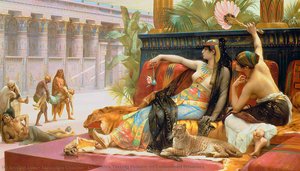 Cleopatra Testing Poisons on Condemned Prisoners - Alexandre Cabanel
Alexandre Cabanel remains a quintessential figure of the French Academic Art movement, celebrated for his ability to marry rigorous classical discipline with a profound, sensual grace. His work is instantly recognizable by its incredibly polished finish and smooth, almost invisible brushwork, which creates a luminous, porcelain-like quality in the skin of his subjects. This mastery of the human form, achieved through meticulous anatomical precision, allowed him to elevate historical and mythological narratives into scenes of quiet prestige and dramatic elegance.
Born in 1823 in Montpellier, Cabanel’s journey from the son of a carpenter to a master of the École des Beaux-Arts is a testament to his immense talent. After winning the prestigious Prix de Rome in 1845, his time at the Villa Medici in Rome deeply infused his style with the classical ideals of antiquity. His technical virtuosity is vividly captured in his monumental 1887 work, Cleopatra Testing Poisons on Condemned Prisoners. In this piece, Cabanel utilizes a theatrical composition and rich, dramatic lighting to explore themes of power and fatal curiosity, embodying the very essence of the academic tradition through its idealized figures and opulent, controlled grandeur.
Jules Lefebvre
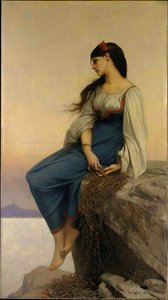 Graziella - Jules Lefebvre
Jules Lefebvre stands as a quintessential figure of the French Academic Art movement, a master whose work epitomizes the era's devotion to classical poise and technical perfection. Trained at the École nationale supérieure des Beaux-Arts under Léon Cogniet, Lefebvre achieved the prestigious Prix de Rome in 1861, a testament to his command over the rigorous standards of the official French academies. His paintings are instantly recognizable by their luminous treatment of the human form; he possessed a rare ability to render skin with an ethereal, inner glow that elevates his subjects beyond mere realism.
In his 1878 masterpiece, Graziella, Lefebvre demonstrates his capacity for blending narrative sentiment with academic precision. The work depicts a Neapolitan fisherman's daughter mending a net amidst a rugged, rocky shoreline. Through a delicate, harmonious color palette and soft, atmospheric light, he captures her reflective gaze as she looks toward the distant silhouette of Mount Vesuvius. Whether portraying mythological figures or contemporary women, Lefebvre’s brushwork remains meticulous, focusing on the subtle textures of fabric and flesh to achieve a sense of timeless, graceful elegance that defines the height of nineteenth-century academicism.
Thomas Couture
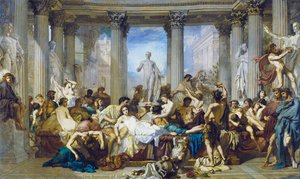 The Romans of the Decadence - Thomas Couture
In his monumental masterpiece, The Romans of the Decadence, Thomas Couture captures a world of opulent excess and moral decline through a lens of dramatic grandeur. This 1847 work, now held in the Musée d'Orsay, serves as a quintessential example of the Academic art movement. Through its large-scale composition and meticulous attention to historical detail, Couture utilized the highly polished realism and grand historical narratives that defined the official French academies of the 19th century.
Born in 1815 in Senlis, Couture was a pivotal figure who bridged the gap between Romanticism and Realism. While he mastered the rigorous techniques of the École des Beaux-Arts, he was also a rebel who established his own independent atelier, famously teaching the future master Édouard Manet. His style is characterized by a sophisticated use of tonal contrasts, where rich, dark hues are punctuated by striking highlights that illuminate the textures of luxurious fabrics and classical ruins. By choosing the "noble" genre of history painting to deliver a scathing social commentary, Couture solidified his place among the premier French academic painters, blending technical perfection with profound emotional intensity.
Jean-Louis Ernest Meissonier
 Departure of the Volunteers - Jean-Louis Ernest Meissonier
Jean-Louis Ernest Meissonier (1815–1891) stands as a master of meticulous realism, a hallmark of the French Academic Art movement. His work is instantly recognizable by its microscopic precision and a profound ability to reconstruct historical worlds with breathtaking fidelity. Unlike the broader strokes of later movements, Meissonier’s technique focuses on the tactile reality of textures, light, and atmosphere, often drawing inspiration from the intimate bourgeois scenes of the Dutch masters.
His place within the Academic tradition is defined by this rigorous devotion to polished, highly finished detail and historical accuracy. He specialized in capturing the essence of 18th-century life and military vignettes, elevating genre scenes into grand, narrative studies of human character. In his representative work, Departure of the Volunteers, this expertise is on full display. The painting captures a quiet, tense moment of transition, focusing on the physical weight and camaraderie of soldiers in a state of anticipation. Through his disciplined brushwork and ability to render the subtle urgency of a moment, Meissonier transformed historical snapshots into enduring masterpieces of academic precision.
Léon Bonnat
 Portrait of the count of Montalivet - Léon Bonnat
Léon Bonnat stands as a formidable figure within the French Academic Art movement, a style defined by its rigorous technical precision and its devotion to the idealized realism taught in the great academies. His mastery of the human form and his ability to capture profound psychological depth align him perfectly with the academic tradition of the 19th century. Much of his artistic identity was forged during his formative years in Madrid, where he spent his youth copying engravings of Old Masters, and later in Rome, where he studied the dramatic chiaroscuro of Spanish masters like Velázquez.
This profound influence of light and shadow is masterfully realized in his Portrait of the count of Montalivet. In this 1878 work, Bonnat moves beyond mere likeness to achieve a stark, somber naturalism. The subject is enveloped in a dark, atmospheric environment, with light falling precisely upon the face and hands to pull the figure from the shadows. Through this controlled, dramatic lighting and a muted palette of forest green and deep charcoal, Bonnat exemplifies the academic pursuit of capturing the gravity and internal stillness of the human soul.
Hugues Merle
 Children Playing in a Park - Hugues Merle
Hugues Merle stands as a quintessential figure of the French Academic movement, celebrated for his ability to infuse highly polished realism with profound sentimental narrative. Trained under the esteemed Léon Cogniet, Merle mastered the rigorous technical standards of the Parisian academies, focusing on precise draftsmanship and the meticulous rendering of light and texture. His work is defined by a dedication to the core tenets of Academicism, where classical ideals of beauty and composition meet a sensitive observation of the natural world.
Merle’s oeuvre often moves away from grand historical epics to explore the intimate, emotional depths of domestic life. He became renowned for his graceful portrayals of women and children, often bathed in a soft, ethereal light that emphasized themes of piety, virtue, and tenderness. His 1860 masterpiece, Children Playing in a Park, serves as a definitive example of his skill. In this work, he captures a quiet, unhurried moment of youth, using a lush, verdant landscape to anchor his figures within a study of light and form. Through such compositions, Merle transformed the ordinary into a realm of poetic stillness, securing his legacy within the 19th-century French tradition."
Guillaume Seignac
 Diana, the Huntress - Guillaume Seignac
Guillaume Seignac (1870–1924) stands as a quintessential figure of the French Academic Art movement, a master of the refined realism and anatomical precision taught in the prestigious academies of the late 19th century. His technical lineage is deeply rooted in the rigorous pedagogical traditions of the Académie Julian in Paris, where he studied under titans such as Gabriel Ferrier, Tony Robert-Fleury, and the legendary William-Adolphe Bouguereau. This elite training instilled in him a devotion to the classical ideals of grace and idealized beauty, hallmarks of the academic style.
Seignac’s work is particularly celebrated for its poetic handling of light and the tactile rendering of diaphanous drapery, which he used to bridge the gap between physical form and ethereal atmosphere. In his representative work, Diana, the Huntress, this mastery is on full display. The painting captures a moment of mythic stillness, where the goddess is rendered with a clarity of form that honors the classical tradition. Through a careful balance of shadow and light, Seignac transforms a scene of quiet observation into a symphony of texture, where the tension of the bow and the softness of the surrounding landscape coalesce into a singular, poised composition.
Émile Munier
 the rescue - Émile Munier
A master of sentiment and grace, Émile Munier (1840–1895) holds a distinguished place among French academic painters through his ability to blend technical perfection with a profound sense of ethereal beauty. His work is characterized by a highly polished realism and a romanticized approach to subject matter, a style deeply influenced by the teachings and aesthetic of William-Adolphe Bouguereau. Munier’s mastery of the academic tradition is most evident in his tender, idealized depictions of childhood and the spiritual presence of angels, rendered with the meticulous draftsmanship required by the prestigious Beaux-Arts standards.
Born in Paris to a family of artisans, Munier honed his foundational skills at the Gobelins Manufactory under Abel Lucas before achieving significant recognition through multiple medals at the Beaux-Arts. His canvases often serve as windows into a world of innocence and divine protection. In his evocative work, The Rescue, painted around 1894, he captures a moment of celestial guardianship. Through the use of soft light and rhythmic composition, he depicts children playing near the water's edge, watched over by protective angels. This seamless fusion of human vulnerability and divine grace exemplifies the peak of late 19th-century academicism.
Conclusion
The legacy of these masters lies in their unparalleled technical precision and their ability to elevate human emotion through polished, idealized realism. From the mythological grace of Cabanel and Bouguereau to the meticulous historical narratives of Gérôme and Meissonier, these artists defined an era of excellence that continues to captivate the modern eye. Whether through the soft, ethereal skin tones of Lefebvre or the dramatic, textured compositions of Merle, the French academic tradition offers a profound window into a world of elegance, storytelling, and supreme craftsmanship. Each painter contributed a unique layer to this movement, ensuring that the pursuit of perfection in form and light would remain a cornerstone of art history.
For those looking to bring this timeless elegance into their own living spaces, Mus3ums.com offers the opportunity to own these masterpieces through our museum-quality, hand-painted oil reproductions. You can explore our full collection to find the perfect piece and transform your home with the enduring beauty of French academic art.