
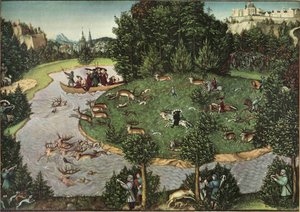
Introduction
The emergence of the Northern Renaissance in Germany marked a profound shift in the visual language of Europe, driven by a meticulous obsession with the natural world and the revolutionary mastery of oil pigments. Unlike the idealized forms favored in the Italian South, these German masters sought truth through an almost scientific precision, capturing the microscopic textures of fur, the glint of polished armor, and the delicate translucency of human skin. This era was defined by a convergence of profound religious fervor and a burgeoning humanism, as artists moved away from the stylized abstractions of the Middle Ages toward a deeply tactile, three-dimensional reality.
During this transformative period, the German territories became a crucible of intellectual and artistic innovation. The development of printmaking alongside painting allowed these complex visual ideas to circulate widely, forever altering the course of Western art. The works of this movement remain vital today because they represent the birth of individualistic portraiture and the elevation of landscape and still life to high art, offering a window into a world where the sacred and the secular were intricately intertwined.
To understand the foundations of modern European painting, one must look to the masters who defined this standard of excellence. The following profiles examine the lives and legacies of ten essential figures, including Albrecht Dürer, Hans Holbein the Younger, and Lucas Cranach the Elder, whose technical virtuosity continues to resonate through the centuries.
Hans Holbein the Younger
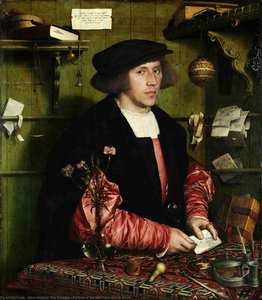
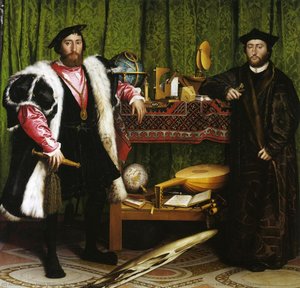 Double Portrait of Jean de Dinteville and Georges de Selve (also known as The Ambassadors) - Hans Holbein the Younger
A visitor recognizes the hand of Hans Holbein the Younger by an almost unsettling level of precision. His work is defined by a hyper-realistic clarity where textures—the heavy sheen of silk, the soft grain of fur, or the cold glint of polished metal—are rendered with such technical rigor that they transcend mere representation. His palette is controlled and sophisticated, using light and shadow to sculpt his subjects with a profound sense of presence and psychological depth.
Born in Augsburg around 1497, Holbein’s mastery is a testament to the German tradition of meticulous draughtsmanship. He was shaped by the technical discipline of his father, Hans Holbein the Elder, and his grandfather, later refining his craft through an apprenticeship in Basel under Hans Herbster. This lineage of precision is what places him at the heart of the Northern Renaissance movement; he utilized the era's advancements in oil painting to achieve a level of detail and symbolic complexity that became a benchmark for the period.
His 1533 masterpiece, Double Portrait of Jean de Dinteville and Georges de Selve (also known as The Ambassadors), serves as a definitive example of his genius. Through a dense arrangement of scientific instruments and a striking anamorphic skull, Holbein captures the intellectual and spiritual anxieties of a world in transition.
Albrecht Dürer
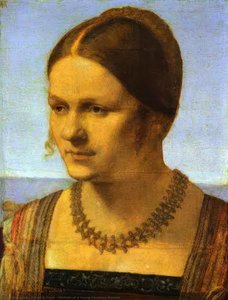 Portrait of a Young Venetian Woman - Albrecht Dürer
In his 1507 Portrait of a Young Venetian Woman, Albrecht Dürer captures a profound sense of quiet contemplation, bridging the gap between Northern precision and Italianate grace. This work serves as a testament to his ability to synthesize the meticulous detail of his German heritage with the soft, atmospheric tonal ranges he encountered during his pivotal travels to Italy. As a central figure of the Northern Renaissance, Dürer transformed the movement through his unparalleled mastery of both painting and printmaking, bringing a new level of intellectual depth to the era.
Born in Nuremberg in 1471 to a goldsmith, Dürer’s early life was steeped in the disciplined craftsmanship of metalwork. This rigorous foundation allowed him to achieve a level of technical perfection in his drawings and engravings that few of his contemporaries could match. His work is characterized by:
- Technical Precision: An extraordinary ability to render textures, from the softness of skin to the intricate details of fabric.
- Humanist Depth: A focus on the psychological complexity of his subjects, often imbuing them with a reflective, serene quality.
- Versatility: A seamless command over diverse media, including oil on panel, silverpoint, and the profound expressive power of the print.
Lucas Cranach the Elder
Lucas Cranach the Elder stands as a pivotal figure of the German Northern Renaissance, a movement defined by its mastery of oil paint to achieve astonishing detail and symbolic depth. As a visual strategist of the Reformation, Cranach transitioned away from traditional Catholic iconography toward a style that emphasized direct engagement with scripture. His work is instantly recognizable by its sharp, decisive lines and a sophisticated ability to construct persona through portraiture. Whether capturing the likeness of Martin Luther or depicting biblical narratives, his brushwork maintains a distinctive clarity that balances elegance with theological weight.
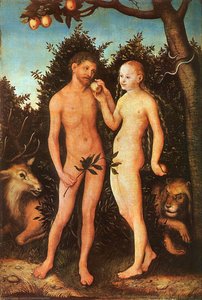
In his 1531 masterpiece, Adam and Eve, Cranach exemplifies the Northern Renaissance's obsession with the intersection of human anatomy and the natural world. The composition presents a harmonious arrangement of figures, wildlife, and botanical elements, inviting the viewer into the Garden of Eden. Through smooth, flowing lines and a keen understanding of light, he captures the tension of the Fall of Man, making the profound themes of temptation and original sin tangible through meticulous, descriptive detail.
Matthias Grünewald
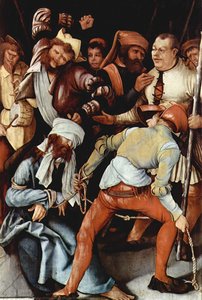 The Mocking of Christ - Matthias Grünewald
Matthias Grünewald stands as a profound voice within the German Northern Renaissance, a movement characterized by an obsession with microscopic detail and the spiritual weight of the human condition. While his contemporaries in the south often sought mathematical harmony, Grünewald embraced a visceral, jagged energy that prioritized emotional truth over idealized beauty. His work is defined by a refusal to look away from the raw realities of existence, using the medium of oil to articulate the deepest psychological and physical suffering.
This intense expressive power is vividly captured in his 1503 masterpiece, The Mocking of Christ. In this work, Grünewald demonstrates the hallmark of the Northern Renaissance through his meticulous attention to texture and light. He does not merely illuminate a scene; he uses light to pierce through the darkness, catching the rough fibers of binding ropes and the heavy, varied fabrics of the onlookers. The composition is densely packed, creating a sense of immediate, claustrophobic tension that forces the viewer to confront the humanity of the scene. Through his masterful control of a somber, earthy palette, Grünewald transforms religious narrative into a tangible, gripping experience of human vulnerability.
Hans Baldung Grien
 Madonna and Child - Hans Baldung Grien
A central figure of the German Northern Renaissance, Hans Baldung Grien (c. 1485–1545) brought a unique, often enigmatic intensity to the era's stylistic evolution. His journey began in the Free Imperial City of Schwäbisch Gmünd, but his artistic identity was truly forged in Nuremberg. As an apprentice to the legendary Albrecht Dürer, Baldung absorbed the meticulous draftsmanship and innovative printmaking techniques that defined the German master's workshop, eventually managing Dürer's studio during the latter's Venetian travels. This lineage allowed him to bridge the gap between the structured traditions of the Northern Gothic and the psychological complexity of the emerging Mannerist style.
Baldung is distinguished by his ability to blend technical precision with a vivid, sometimes unsettling imagination, often exploring themes of mythology, witchcraft, and profound religious devotion. His 1516 work, Madonna and Child, exemplifies this mastery. In this piece, he moves beyond mere iconography to present a tender, humanized encounter. Through sophisticated glazing and a masterful use of chiaroscuro, he achieves a luminous quality that makes the skin of the holy figures appear to glow from within, capturing a sense of maternal intimacy that remains a hallmark of his expressive, highly detailed approach to oil painting.
Martin Schongauer
 Madonna of the Rose Bower - Martin Schongauer
Martin Schongauer stands as a pivotal figure in the transition from the late Gothic era to the Northern Renaissance. Born around 1450 in Colmar, his artistic foundation was deeply rooted in the precision of goldsmithing, a craft learned from his father, Caspar. This technical mastery of fine detail became the cornerstone of his legacy, allowing him to bridge the gap between medieval ornamentation and the burgeoning realism of the Northern Renaissance movement. After training under Caspar Isenmann, Schongauer moved beyond the rigid structures of the past, developing a sophisticated style characterized by expressive figures and meticulous composition.
His contribution to the German Northern Renaissance movement is most evident in his revolutionary approach to printmaking. Through his 116 identified engravings, he introduced a level of technical complexity that influenced masters across Europe, including Michelangelo. His ability to translate the delicate textures of fabric and the nuances of light into print established a new standard for graphic art. In his 1473 painting, Madonna of the Rose Bower, Schongauer exemplifies this mastery, blending serene spiritual warmth with the lush, detailed naturalism that defines the era's aesthetic.
Albrecht Altdorfer
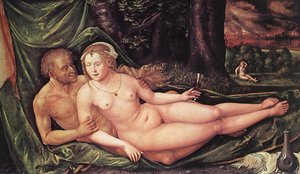 Loth and his Daughters - Albrecht Altdorfer
A pivotal figure of the German Northern Renaissance, Albrecht Altdorfer (1480–1538) transformed the artistic trajectory of his era by elevating the landscape from a mere backdrop to a central, expressive protagonist. Born in Regensburg into a family of artists, Altdorfer’s formative years near the Danube River fostered a profound connection to the natural world, a hallmark of the Northern Renaissance's obsession with meticulous detail and atmospheric depth. As a leading light of the Danube School, he moved beyond the late Gothic traditions to pioneer a revolutionary vision where nature itself becomes a living, breathing entity.
His mastery is perhaps most poignantly captured in Lot and his Daughters (1537). In this work, Altdorfer utilizes a dramatic, apocalyptic horizon and a colossal, gnarled tree to weave a narrative of human vulnerability against the overwhelming power of the elements. Through his ability to render the textures of bark and the shifting play of light, he bridged the gap between religious symbolism and a burgeoning realism. His legacy lies in this ability to imbue the wild, untamed landscapes of Germany with a sense of profound, often melancholic, emotional resonance.
Joos van Cleve
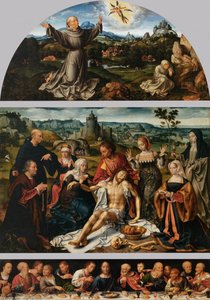 Altarpiece of the Lamentation - Joos van Cleve
The Altarpiece of the Lamentation (c. 1520) stands as a profound meditation on grief and faith, showcasing the technical sophistication that defined the era. In this work, the composition is masterfully divided into distinct zones, where angelic figures possess a dynamic movement that contrasts with the heavy, symbolic drapery of the central figures. Through the meticulous layering of glazes, the artist captures a lifelike luminosity and a palpable sense of divinity that elevates the scene from mere depiction to spiritual contemplation.
Born in Krefeld, Germany, Joos van Cleve (c. 1485–1540) represents a vital link in the Northern Renaissance movement. His origins in Germany and his subsequent flourishing in the artistic hub of Antwerp allowed him to synthesize the rigorous, detailed traditions of the Netherlandish masters with the sweeping, atmospheric grace of the Italian Renaissance. Having trained under Jan Joest, van Cleve mastered the complex alchemy of pigment and texture, a skill he applied to his signature portraits, religious scenes, and landscapes. His ability to blend the tactile reality of Northern Europe with idealized Southern grace makes him a quintessential figure of this movement, bridging the gap between late Gothic gravity and the burgeoning humanism of the sixteenth century.
Lucas Cranach the Younger
 Johann Wilhelm, Duke of Saxe-Weimar, son of Johann Friedrich I., died 1573 - Lucas Cranach the Younger
As the son of the legendary Lucas Cranach the Elder, Lucas Cranach the Younger (1515–1586) was born into the very heart of the German Renaissance. He did not merely inherit a workshop; he inherited a visual language that helped define the Northern Renaissance movement. By blending the meticulous precision he absorbed under the influence of Albrecht Dürer with a sophisticated command of color and chiaroscuro, he became a vital bridge between traditional craftsmanship and the shifting theological landscapes of 16th-century Wittenberg. His ability to use oil paint to capture the psychological weight of his subjects marks him as a master of this era.
In his portrait Johann Wilhelm, Duke of Saxe-Weimar, son of Johann Friedrich I., died 1573, this mastery is palpable. The work exemplifies the Northern Renaissance's obsession with tactile reality. Light carves the contours of the Duke's face, catching the delicate white lace of a ruff and the soft, bristling texture of a fur collar. A heavy gold chain rests against a dark, fur-lined cloak, its metallic links rendered with hard, precise edges that suggest both opulence and the somber gravity of Saxon court life. Through such works, Cranach the Younger transformed the portrait into a profound document of status and presence.
Bernhard Strigel
 Disrobing of Christ - Bernhard Strigel
A pivotal figure of the Swabian School, Bernhard Strigel (c. 1461–1528) represents the vital transition from Gothic traditions to the humanistic clarity of the Northern Renaissance. Born in Memmingen, Strigel’s artistic foundation was laid within a familial workshop under his father, Hans Strigel, and further refined through the influence of the esteemed master Zeitblom of Ulm. This rigorous training instilled in him a profound reverence for the textures of reality, allowing him to master the minute details—the sheen of a pearl or the soft glow of skin—that define the Northern Renaissance movement's obsession with observational precision.
Strigel’s ascent to European prominence was secured through the prestigious patronage of Emperor Maximilian I, who sought his ability to capture luminous likenesses and historical gravity. His Disrobing of Christ (c. 1520) stands as a cornerstone of his legacy, showcasing the masterful luminosity and meticulous detail that characterize his religious compositions. By blending the spiritual intensity of the Middle Ages with a new, nuanced command of color and form, Strigel cemented his status as a master who breathed life into the sacred narratives of his era.
Conclusion
The legacy of these German masters lies in their ability to marry profound spiritual intensity with an almost scientific obsession for the physical world. From the meticulous, razor-sharp precision of Albrecht Dürer to the emotive, dramatic landscapes of Albrecht Altdorfer, these artists transformed the Northern Renaissance into a period of unparalleled visual complexity. Whether through the delicate textures of a portrait or the sweeping narratives of a religious altarpiece, they captured the essence of human existence with a clarity that still resonates centuries later. Their collective contribution redefined the capabilities of oil and print, leaving behind a visual language of detail and light that remains a cornerstone of art history.
For those looking to bring this era of profound craftsmanship into a modern setting, Mus3ums.com offers a way to honor these masters. Our studio specializes in museum-quality, hand-painted oil reproductions that capture the tactile depth and soul of these historic works. We invite you to explore our full collection and find a piece of the Northern Renaissance to live with in your own home.


