
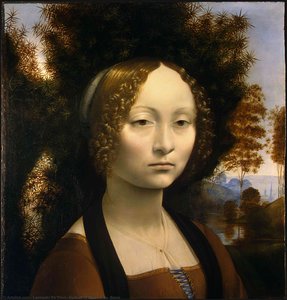
Introduction
The Italian High Renaissance represents a singular moment in human history where the pursuit of perfection reached its zenith. Emerging from the intellectual fervor of the late 15th century, this era saw a profound shift in how the world was perceived and captured on canvas. It was a period defined by a harmonious synthesis of anatomical precision, linear perspective, and a sophisticated mastery of light and shadow. Moving beyond the rigid symbolism of the Middle Ages, these masters sought to replicate the divine through the lens of humanism, creating compositions that achieved a sublime balance between naturalism and idealized beauty.
Centered in the cultural crucibles of Florence and Rome, this movement was fueled by a renewed fascination with Classical antiquity. The artists of this era did not merely paint figures; they orchestrated complex psychological narratives and architectural depths that transformed the two-dimensional surface into a window onto another reality. This era established the very foundations of Western aesthetic theory, setting the standard for grace, proportion, and the emotional power of the human form.
Today, the legacy of these masters continues to resonate through every corner of the visual arts. Their innovations in sfumato and chiaroscuro remain essential study for any artist, and their ability to convey profound spiritual and human emotion continues to captivate the modern imagination. To understand the High Renaissance is to understand the DNA of Western art itself.
The following selection explores the diverse voices that defined this golden age, from the divine geometry of Leonardo to the dramatic intensity of Michelangelo and the lyrical elegance of Raphael, alongside the masters who shaped the movement's evolution.
Leonardo da Vinci
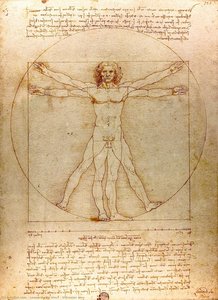 Vitruvian Man - Leonardo da Vinci
The Vitruvian Man stands as a profound testament to the intellectual rigor of the High Renaissance, capturing the era's obsession with the mathematical harmony of the human form. Through this iconic pen and ink study, Leonardo da Vinci bridged the gap between scientific inquiry and fine art, illustrating how the human body could be perfectly inscribed within the divine geometry of a circle and a square.
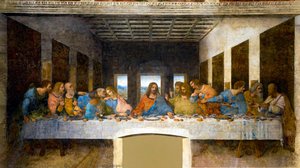
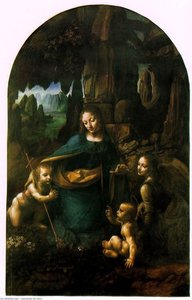
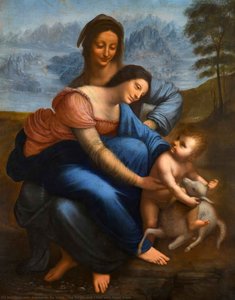
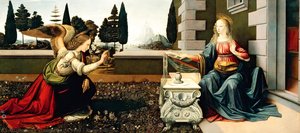
Born in 1452 near Vinci, Leonardo’s journey into the heart of the High Renaissance began in the Florentine workshop of Andrea del Verrocchio. It was here that he mastered the precision of disegno, developing a technical capability that allowed him to perceive the subtle interplay between muscle movement and the soft fall of light. His career, spanning the vital artistic centers of Florence and Milan, defines the High Renaissance through his pursuit of anatomical perfection and atmospheric depth. Whether serving Ludovico Sforza or exploring the mysteries of the natural world, his work is characterized by a seamless fusion of art and science. His mastery of light and shadow, combined with an unparalleled understanding of human proportion, ensures his place as a central figure in the Italian High Renaissance movement.
Michelangelo
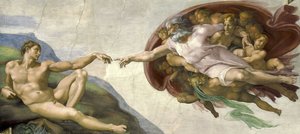 The Creation of Adam - Michelangelo
Michelangelo di Lodovico Buonarroti Simoni stands as a titan of the High Renaissance, a period defined by the perfect synthesis of anatomical precision, monumental scale, and spiritual depth. Unlike many of his contemporaries, Michelangelo’s approach to painting was deeply rooted in his identity as a sculptor. His mastery of the human form was not merely observational but visceral, born from a childhood spent amidst the grit of marble dust and a rigorous study of musculature under the influence of the Medici gardens. This sculptural sensibility allows his figures to possess a palpable, heavy presence, as if the pigment itself carries the weight of stone.
His work is instantly recognizable through its dramatic use of chiaroscuro and the intense, muscular tension that defines his subjects. In his masterpiece, The Creation of Adam, executed between 1508 and 1512 on the ceiling of the Sistine Chapel, this tension reaches a divine crescendo. The composition captures the profound, electric gap between the fingers of God and Adam, a moment of imminent life-giving contact. Through rapid, decisive fresco techniques, he transformed wet plaster into a stage for the epic struggle of the human soul, cementing his place as a central figure of the Italian High Renaissance.
Raphael
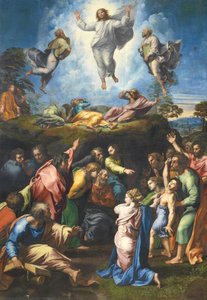 The Transfiguration - Raphael
Raphael’s The Transfiguration, completed in 1520, stands as a monumental achievement of the High Renaissance, encapsulating both artistic mastery and profound spiritual contemplation. This dramatic composition portrays the radiant Christ on Mount Tabor, flanked by Moses and Elijah, while below, the disciples struggle with a possessed boy. Through a masterful command of chiaroscuro, Raphael uses the interplay of light and shadow to bridge the ethereal divine realm with the terrestrial human experience.
Born in Urbino in 1483, Raphael became a central figure of the Italian High Renaissance, a movement defined by the perfect synthesis of balance, depth, and anatomical precision. His ability to navigate the monumental demands of papal commissions in Rome, alongside the intimate grace of his legendary Madonnas, exemplifies the era's peak of classical composition. His work is characterized by a fluid, graceful movement and a sophisticated use of color that set the standard for Renaissance ideals. Whether through his breathtaking Vatican frescoes or his complex religious narratives, Raphael’s legacy remains a testament to the harmonious beauty and intellectual refinement that define this golden age of Italian art.
Giorgione
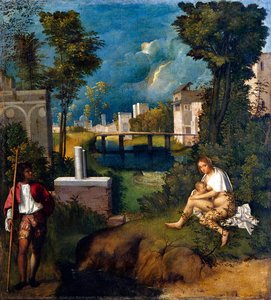 The Tempest - Giorgione
Giorgione stands as a pivotal figure of the Italian High Renaissance, specifically within the Venetian school, where he introduced a profound sense of poetic mystery and atmospheric depth. His brief but intense career, which ended with his death around 1510, fundamentally shifted the trajectory of Venetian art. Likely trained under the dominant master Giovanni Bellini, Giorgione moved beyond mere technical precision to embrace a moody, evocative style that prioritized the emotional resonance of light and landscape.
His contribution to the High Renaissance is defined by this ability to blend technical mastery with a sense of the sublime. His most celebrated work, The Tempest, exemplifies this approach, presenting a haunting, dreamlike scene that defies simple narrative. Through the use of rich oil glazes and a sophisticated command of color, he created landscapes that felt alive with tension and melancholy. This focus on the atmospheric qualities of nature and the psychological state of his subjects left an indelible mark on his contemporaries, setting the stage for the evolution of the Venetian masters who followed in his wake.
Titian
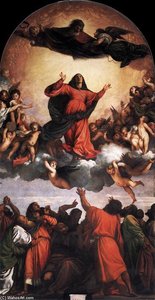 Assumption of the Virgin - Titian
Born in Pieve di Cadore around 1490, Tiziano Vecellio, known as Titian, emerged from the rugged Venetian Alps to redefine the visual language of the Italian High Renaissance. His journey began in the vibrant workshops of Venice, where he transitioned from the mosaic-influenced training of Sebastiano Zuccato to the poetic, lyrical styles of Gentile Bellini and Giorgione. This evolution from soft, ethereal tones to a muscular, dramatic command of light and shadow is what secures his place among the masters of the High Renaissance movement.
Titian’s genius lies in his mastery of colorito, a technique that prioritizes the expressive power of color and light over strict linear precision. His ability to layer thin glazes of pigment allowed him to achieve a luminous, tactile depth that transformed the canvas into a living, breathing entity. This is most spectacularly realized in his monumental work, Assumption of the Virgin. Completed in 1516, this masterpiece exemplifies the High Renaissance ideal of dynamic composition and emotional intensity, utilizing swirling movement and a bold, celestial palette to bridge the gap between the earthly and the divine.
Andrea del Sarto
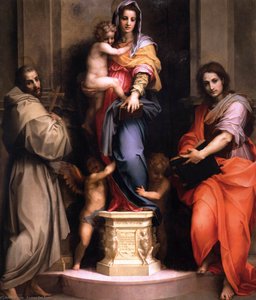 Madonna of the Harpies - Andrea del Sarto
Born in Florence in 1486, Andrea del Sarto’s journey to becoming a High Renaissance master began in the humble workshop of a goldsmith. The son of a tailor, he carried a meticulous attention to texture and detail throughout his career, eventually training under masters such as Piero di Cosimo. His technical precision earned him the reputation of a "painter without errors," a title reflecting his ability to achieve a perfect equilibrium between form and emotion.
Del Sarto is a quintessential figure of the High Renaissance in Italy because his work harmonizes the era's obsession with anatomical accuracy and balanced composition with a unique, vibrant approach to color. Unlike the smoky sfumato of Leonardo, Sarto utilized a warmer, more vivid palette that breathed life into the skin and drapery of his subjects. This mastery is epitomized in his 1517 masterpiece, <Madonna of the Harpies. In this work, he achieves a profound tension between the divine and the classical, placing the serene Virgin and Child atop a pedestal adorned with mythological harpies. This juxtaposition of sacred devotion and humanist antiquity perfectly captures the intellectual complexity and aesthetic grace that define the High Renaissance movement.
Luca Signorelli
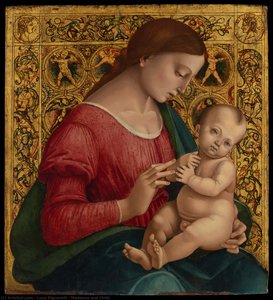 Madonna and Child - Luca Signorelli
A master of anatomical precision and dramatic narrative, Luca Signorelli stands as a vital bridge within the Italian High Renaissance. His work is characterized by a rigorous commitment to form and a sophisticated understanding of perspective, traits deeply influenced by his apprenticeship under the monumental Piero della Francesca. This lineage allowed him to infuse his compositions with the structural clarity and spatial depth that define the era's peak. His presence in the artistic centers of Florence, Siena, and Rome—including contributions to the Sistine Chapel—cemented his reputation as a painter of immense technical capability and humanist sensibility.
One can recognize Signorelli’s hand through his meticulous draftsmanship and the way he balances classical idealism with palpable human emotion. In his 1505 Madonna and Child, this duality is strikingly evident. The work moves beyond mere religious iconography to offer a profound meditation on tenderness and vulnerability. Through subtle modeling of flesh and the delicate, rhythmic folds of drapery, Signorelli achieves a sense of lifelike presence. His ability to harmonize complex anatomical details with a serene, atmospheric grace makes his oeuvre a testament to the intellectual and aesthetic heights of the High Renaissance.
Pietro Perugino
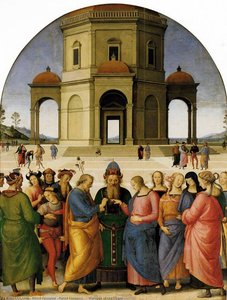 Marriage of the Virgin - Pietro Perugino
Pietro Perugino, born Vannucci, stands as a cornerstone of the High Renaissance in Italy, bridging the gap between the early Quattrocento and the peak of the sixteenth century. His mastery of perspective and idealized realism, inherited from his training under Piero della Francesca, allowed him to achieve the harmonious balance and spatial clarity that define the High Renaissance movement. His ability to blend mathematical precision with spiritual grace made him a pivotal figure in Florence, where his influence extended to luminaries like Raphael.
His technical sophistication is most profoundly realized in his 1504 masterpiece, Marriage of the Virgin. In this work, Perugino demonstrates the quintessential High Renaissance pursuit of order and symmetry. The composition is anchored by a majestic classical pavilion, where the figures are arranged with a rhythmic, geometric grace that evokes a sense of divine stability. Through the meticulous layering of glazes, he creates a luminous atmosphere that transcends mere representation, inviting a state of contemplative reverence. By harmonizing earthly architecture with ethereal light, Perugino exemplifies the era's shift toward profound, balanced, and humanistic depictions of the sacred.
Vittore Carpaccio
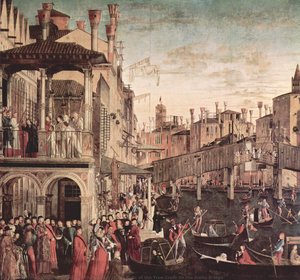 The Miracle of the Relic of the True Cross on the Rialto Bridge - Vittore Carpaccio
Vittore Carpaccio stands as a vital figure in the transition toward the High Renaissance, bridging the gap between the meticulous traditions of the early Venetian school and the grander narrative scales of the 16th century. Trained under the guidance of Gentile Bellini, Carpaccio developed a sophisticated command of color and composition that allowed him to document the vibrant pulse of Venice. While many of his contemporaries moved toward the idealized humanism that would define the peak of the High Renaissance, Carpaccio maintained a unique, almost romantic connection to medieval storytelling, blending the precision of Antonello da Messina with the rich, atmospheric light of the Venetian lagoon.
His mastery of perspective and architectural detail is most vividly captured in The Miracle of the Relic of the True Cross on the Rialto Bridge. In this work, he seamlessly intertwines the sacred with the secular, placing a divine miracle within a bustling, realistic marketplace. By juxtaposing the miraculous with the everyday commerce of the Rialto, Carpaccio demonstrated the era's growing ability to integrate complex human experiences with profound spiritual narratives, a hallmark of the evolving High Renaissance style.
Lorenzo Lotto
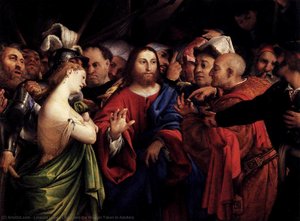 Christ and the Woman Taken in Adultery - Lorenzo Lotto
Lorenzo Lotto stands as a singular, emotive voice within the Italian High Renaissance, distinguished by an independent spirit that often defied the rigid stylistic norms of his era. While his contemporaries sought idealized perfection, Lotto embraced a peripatetic life, traveling from Venice to Rome, Bergamo, and Ancona. This journey allowed him to synthesize the poetic naturalism of the Venetian school with the structural clarity of Raphael and the grounded realism of Lombardy, resulting in a style that bridges High Renaissance grace with the psychological complexity of nascent Mannerism.
A visitor recognizes a Lotto masterpiece through its profound emotional resonance and sophisticated use of chiaroscuro. His brushwork often captures a sense of restless energy, using light to sculpt figures that feel deeply human rather than merely divine. In his representative work, Christ and the Woman Taken in Adultery, this technique is masterfully deployed. The painting utilizes a somber, restrained palette of cool blues and earthy ochres to heighten the dramatic tension of the biblical scene. Through a careful interplay of light and shadow, Lotto explores themes of moral ambiguity and redemption, rendering the faces of the Pharisees and the vulnerability of the woman with a psychological depth that remains strikingly modern.
Conclusion
The legacy of these masters lies in their ability to harmonize the complexities of human anatomy with a profound sense of divine proportion and atmospheric depth. From the mathematical precision of Leonardo to the emotive power of Michelangelo and the graceful compositions of Raphael, each artist contributed a unique layer to this golden era, transforming the canvas into a window of spiritual and physical perfection. Whether through the soft sfumato of a Venetian landscape or the monumental clarity of a Florentine fresco, these painters redefined the visual language of the Western world.
At Mus3ums.com, we invite you to bring this unparalleled era of human achievement into your own living space. Our full collection allows you to own a piece of this history through museum-quality, hand-painted oil reproductions that capture the authentic texture and soul of these timeless masterpieces.


