Introduction
Emerging from the artistic epicenter of the Italian Renaissance, the Mannerist movement represented a sophisticated departure from the harmonious ideals of balance and proportion. As the High Renaissance reached its zenith in the early 16th century, a new generation of artists began to move beyond the pursuit of naturalism, favoring instead a style defined by artifice, tension, and stylistic virtuosity. These painters embraced deliberately elongated limbs, crowded and complex compositions, and a palette of startling, often acidic colors to evoke emotion and intellectual complexity.
This era was a period of profound cultural transformation in Italy, where the stability of the classical ideal gave way to the restless energy of the Counter-Reformation and the shifting political landscapes of the great city-states. The works of this period are characterized by a sense of grace that feels intentionally unnatural, a concept known as maniera, which prioritized the artist's unique expressive capability over the mere imitation of nature. By distorting space and anatomy, these masters created a visual language that was as much about psychological depth as it was about aesthetic elegance.
Today, these artists remain vital to our understanding of art history, serving as the bridge between the perfection of the Renaissance and the dramatic intensity of the Baroque. Their influence can be seen in the way they challenged the boundaries of the human form and the limits of spatial perception. In the following sections, we examine ten essential figures of this movement, from the surreal compositions of Giuseppe Arcimboldo to the elegant distortions of Parmigianino, tracing the evolution of a style that continues to captivate the modern eye.
Giuseppe Arcimboldo
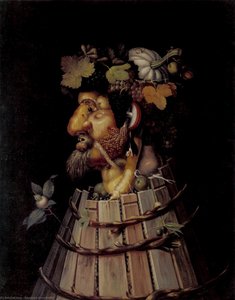
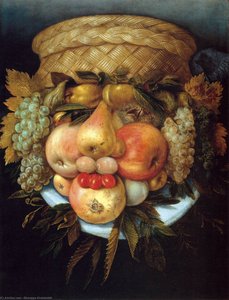
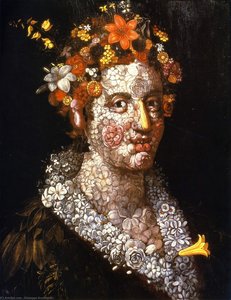
Born in Milan in 1527, Giuseppe Arcimboldo represents the most whimsical and intellectually playful facet of the Mannerist movement. Trained by his father, Biagio, and later refined under the guidance of masters like Giuseppe Meda and Bernardino Campi, his early career as a designer for frescoes and stained glass provided the technical discipline required for his later, more eccentric innovations. His ascent to the position of court portraitist for the Habsburg dynasty—serving emperors from Ferdinand I to Rudolf II—allowed him the creative freedom to move beyond traditional portraiture into the realm of visual paradox.
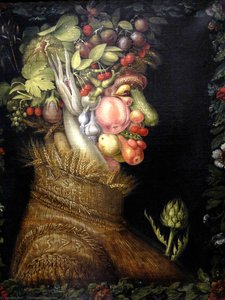
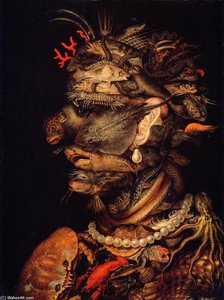
Arcimboldo’s place within the Italian Mannerist tradition is defined by his mastery of exaggeratio and the subversion of naturalism. Rather than adhering to the balanced proportions of the High Renaissance, he utilized the Mannerist penchant for artifice to create composite heads composed entirely of organic matter. His 1572 masterpiece, Autumn, serves as a definitive example of this technique. In this work, a human profile is ingeniously constructed from a symphony of seasonal bounty, where pumpkins, grapes, and gourds seamlessly coalesce into a recognizable face. This ability to transform the mundane into the surreal exemplifies the Mannerist desire to challenge perception through complex, highly stylized compositions.
Bronzino
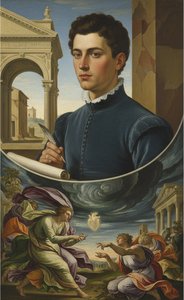
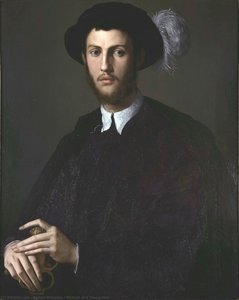 Portrait of a Young Man - Bronzino
Agnolo Bronzino stands as a defining figure of the Italian Mannerist movement, distinguished by a transition from the emotional intensity of his teacher, Jacopo da Pontormo, toward a style of cool, aristocratic composure. His work is instantly recognizable by its polished, enamel-like surfaces and a profound sense of refined elegance. Unlike the balanced harmony of the High Renaissance, Bronzino’s Mannerist approach emphasizes a sophisticated, almost detached psychological depth and an obsession with the meticulous rendering of textures.
As the official court painter to Cosimo I de’ Medici, his brushwork became the visual language of power in Florence. In his representative work, Portrait of a Young Man, we see this mastery on full display. The painting exemplifies the Mannerist penchant for formal, sculptural presence, where the sitter is presented with an austere majesty. Through his technical precision, Bronzino captures the subtle sheen of fabric and the smooth, porcelain-like quality of skin, creating a visual spectacle that prioritizes social status and dynastic grace over raw naturalism. His ability to blend the legacies of Andrea del Sarto and Michelangelo into this highly stylized, courtly aesthetic makes him a cornerstone of the period.
Pontormo
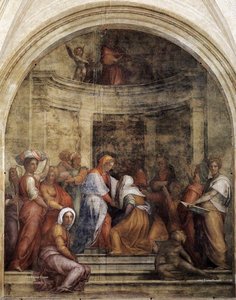 Visitation - Pontormo
Jacopo Carucci, famously known as Pontormo, was a transformative figure whose psychological intensity helped define the transition from the High Renaissance to the expressive complexities of the Mannerist movement. Born in Italy around 1494, his artistic journey was deeply shaped by the monumental influence of Michelangelo, from whom he learned anatomical precision, yet he possessed a restless spirit that sought to move beyond mere mathematical harmony. Instead of the serene balance favored by his predecessors, Pontormo embraced the hallmarks of Italian Mannerism: elongated, elegant figures and a sense of spiritual tension that seems to defy gravity.
His 1528 masterpiece, Visitation, serves as a profound example of this stylistic shift. In this work, the artist moves away from traditional perspectival regularity to create a dreamlike, emotive atmosphere. Through his use of vibrant, often unexpected colors and crowded, ambiguous spaces, he captures a sense of profound religious devotion that feels both intimate and unsettling. By prioritizing the turbulent inner life of the soul over the rigid rules of classical proportion, Pontormo established himself as a visionary who bridged the gap between the stability of the Renaissance and the dramatic elegance of the coming Baroque era.
Parmigianino
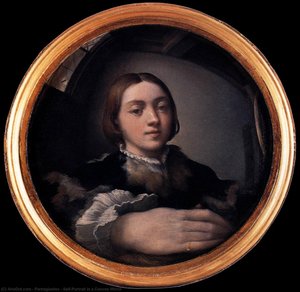 Self-Portrait in a Convex Mirror - Parmigianino
In his Self-Portrait in a Convex Mirror, Parmigianino offers a profound exploration of perception and identity. This work, created around 1524, utilizes the distortion of a curved glass to manipulate space, presenting the artist with an elongated hand and a sense of spatial tension that challenges the viewer's reality. This mastery of artifice and the deliberate departure from naturalistic proportions are what define him as a quintessential figure of the Italian Mannerist movement.
Born in Parma in 1503, Girolamo Francesco Maria Mazzola—known as Parmigianino—transcended his early training under his uncles to become a revolutionary force in art. While he absorbed the grace of Raphael and the technical precision of Leonardo da Vinci during his time in Florence and Rome, he moved beyond High Renaissance harmony. His style is characterized by a refined sensuality, elegant, elongated figures, and a sophisticated grace that prioritizes aesthetic beauty over strict anatomical accuracy. Whether depicting sacred scenes or intimate portraits, his palette and fluid brushwork emphasize a polished, almost ethereal elegance. By embracing these stylistic distortions and complex compositions, Parmigianino helped shift the artistic paradigm from the balanced perfection of the Renaissance toward the expressive, sophisticated artifice of Mannerism."
Giulio Romano
 Evangelist symbols - Giulio Romano
A gifted pupil of Raphael, Giulio Romano transitioned from a vital collaborator in the Vatican Stanze to a transformative force in the Italian Mannerist movement. While his early years were spent perfecting the High Renaissance harmony of his master, his later work embraced the deliberate distortions and sophisticated artificiality that define Mannerism. This shift is vividly captured in his 1522 work, Evangelist symbols. In this piece, the artist moves away from simple naturalism toward a more structured, symbolic presentation, utilizing a tight, intimate grouping of figures that prioritizes complex iconography over expansive landscape.
The painting features a central, child-like figure bathed in a celestial glow, flanked by the winged creatures of the Evangelists: the lion, the ox, the eagle, and the winged man. Through a heavy chiaroscuro effect and a palette of warm, golden tones, Romano creates a sense of spiritual drama. By employing fluid, organic lines and a shallow perspective, he achieves the elegant tension and emotional intensity characteristic of the Mannerist style, marking a departure from the balanced perfection of the previous era toward a more stylized, expressive visual language.
Domenico Beccafumi
 Saint Ignatius of Antioch Disemboweled by Trajan's Torturers - Domenico Beccafumi
A central figure in the Sienese school, Domenico Beccafumi (c. 1486–1551) represents a fascinating departure from the balanced harmonies of the High Renaissance. While his journey took him to Rome, where he absorbed the monumental language of Raphael and Michelangelo, he refused to merely emulate them. Instead, he synthesized these Roman innovations with the decorative intensity of his Sienese heritage, creating a highly individualistic vision that places him firmly within the Mannerist movement. His work is defined by a restless, expressive energy, characterized by elongated figures and a sophisticated use of light and shadow that creates an unsettling psychological depth.
In his evocative work, Saint Ignatius of Antioch Disemboweled by Trajan's Torturers (c. 1525), Beccafumi exemplifies the Mannerist penchant for dramatic tension and compressed, claustrophobic space. The composition utilizes a tight, triangular arrangement of figures to heighten the visceral impact of the scene. Through jagged lines and a palette of earthy ochres and deep crimsons, he moves away from classical stability toward a style defined by emotional turbulence and distorted, muscular forms, marking a pivotal transition into the complexities of the Mannerist era.
Alessandro Allori
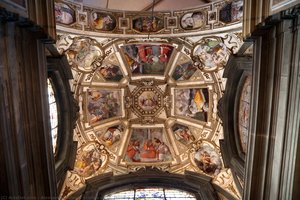 Stories of St. Jerome - Alessandro Allori
Alessandro Allori (1535–1607) stands as a quintessential figure of the late Italian Mannerist movement, embodying the transition from High Renaissance balance to the sophisticated artifice of the late sixteenth century. Having been mentored by the great Agnolo Bronzino, Allori inherited a distinctive aesthetic characterized by polished, marble-like surfaces and an elegant, sculptural approach to the human form. His work is defined by this Mannerist preoccupation with stylistic grace and elongated, statuesque figures that prioritize aesthetic harmony and intellectual rigor over strict naturalism.
In his masterful fresco, Stories of St. Jerome (1577), Allori demonstrates the full breadth of his Mannerist training. Located in the Cappella Gaddi within Florence's Santa Maria Novella, the work utilizes complex trompe l'oeil effects to dissolve the ceiling's plane, creating an illusionistic space that feels both vast and crowded. The composition is a dynamic tableau of scholarly debate, where figures move with an emphatic, choreographed grace. Through a palette of restrained ochres and siennas, softened by subtle sfumato, Allori achieves a quiet prestige, capturing the intersection of humanistic intellect and the refined, decorative elegance central to the Mannerist tradition.
Giuseppe Cesari
 Christ Taken Prisoner - Giuseppe Cesari
Giuseppe Cesari stands as a pivotal figure in the transition from the classical grace of the Renaissance to the theatrical intensity of the Baroque. Born in Arpino around 1568, his artistic journey was deeply shaped by his relocation to Rome, where he moved beyond the foundational training of his father to apprentice under Benedetto Cesani. His association with the architect Carlo Maderno further elevated his status, allowing him to navigate the competitive, high-stakes patronage of the Roman art world. Cesari is a quintessential representative of the Italian Mannerist movement, acting as a stylistic bridge through his use of elongated forms and complex, crowded compositions that prioritize psychological tension over the serene balance of previous eras.
His 1597 masterpiece, Christ Taken Prisoner, serves as a profound testament to this Mannerist sensibility. In this dramatic scene, Cesari employs a sophisticated use of chiaroscuro to carve figures out of deep shadows, heightening the emotional gravity of the biblical confrontation. The work is defined by its expressive gestures and stylized drapery, utilizing oil on canvas to achieve a meticulous rendering of textures. Through his ability to blend technical precision with the exaggerated elegance of the period, Cesari secured his place among the masters of Roman Mannerism.
Domenico Tintoretto
 Lamentation - Domenico Tintoretto
Born in Venice around 1560, Domenico Tintoretto navigated the complex artistic landscape of the Venetian Renaissance, often working within the formidable shadow of his father, the legendary Jacopo Tintoretto. Rather than merely imitating his father's flamboyant energy, Domenico developed a more poised and psychologically observant style. He transitioned from the grand, theatrical compositions of the Tintoretto lineage toward a refined mastery of portraiture and decorative elegance, finding beauty in stillness where his predecessor sought overwhelming movement.
His work, such as the 1580 painting Lamentation, exemplifies his place among Italian Mannerist painters through its sophisticated use of compressed space and emotional tension. In this piece, the figures are arranged in a tight, pyramidal composition, creating a sense of physical density and psychological weight. He employs a dramatic chiaroscuro to define the volume of the limp body of Christ, using sharp highlights against a dark, moody backdrop to emphasize human suffering. By utilizing fluid, organic lines and a somber tonal range of crimson reds and deep blues, Domenico captures the grace and dignity of his subjects, blending the Venetian tradition of light with the elongated, emotive sensibilities characteristic of the Mannerist movement.
Polidoro Da Caravaggio
 The Way to Calvary - Polidoro Da Caravaggio
In his evocative oil sketch The Way to Calvary, Polidoro Da Caravaggio captures a profound moment of physical and spiritual exhaustion. Created before 1534 as a preparatory study for a larger altarpiece in Messina, the work depicts Christ collapsing under the crushing weight of the Cross. The composition is characterized by a claustrophobic, crowded arrangement of figures that heightens the emotional pressure of the procession, a hallmark of the Mannerist tendency to move away from High Renaissance equilibrium toward more tension-filled, compressed spaces.
Polidoro’s journey from a humble laborer in Rome to a protégé in Raphael’s workshop allowed him to master classical perspective, yet he ultimately carved a unique path that defines the transition into Mannerism. He is celebrated for his innovative use of sgraffito on Roman palace facades, a technique that brought narrative art to the streets. His style often employs a controlled, somber palette and a mastery of grisaille-inspired tones, which lends a sculptural, dramatic quality to his religious subjects. Whether through his architectural decorations or his intense, emotive oil sketches, Polidoro’s work embodies the dramatic shifts in form and emotional gravity central to the Italian Mannerist movement."
Conclusion
The legacy of these Italian Mannerist painters lies in their courageous departure from the harmonious ideals of the High Renaissance, opting instead for a sophisticated language of elongated forms, chromatic tension, and complex emotionality. From the surreal, allegorical compositions of Arcimboldo to the elegant, courtly grace of Bronzino, each artist contributed a unique layer to this era of stylistic experimentation. Whether through the dramatic spatial distortions of Pontormo or the intricate, swirling energy of Parmigianino, these masters redefined the boundaries of visual storytelling, proving that beauty could be found in the unexpected and the asymmetrical.
For those looking to bring this era of Italian elegance into their own living spaces, Mus3ums.com offers a way to experience these masterpieces firsthand. Our artisans specialize in creating museum-quality, hand-painted oil reproductions that capture the distinctive brushwork and vibrant palettes of the Mannerist period. You can explore our full collection to find the perfect piece and invite the profound complexity of Italian art history into your home through our bespoke, handmade works.