Introduction
Emerging from the heart of Victorian England, the Pre-Raphaelite movement represented a profound rebellion against the academic conventions of the Royal Academy. These artists sought to escape the artificiality of the "Grand Style" promoted by followers of Raphael, choosing instead to return to the luminous clarity, intense color, and meticulous detail found in Italian art prior to the High Renaissance. Their work was a poetic fusion of medievalism, nature, and a deep, often spiritual, commitment to truth in representation.
The movement was defined by a radical devotion to the natural world. Rather than working in darkened studios with idealized lighting, these painters often ventured outdoors, capturing the intricate textures of flora and the subtle nuances of light with scientific precision. Their canvases became vibrant tapestries of symbolism, drawing heavily from Arthurian legends, Shakespearean drama, and contemporary social themes, all rendered with a startling, jewel-like brilliance that challenged the muted palettes of their contemporaries.
Today, the legacy of these painters endures through their unparalleled ability to evoke intense emotion and atmospheric beauty. Their influence can be seen in the evolution of modern design and the enduring fascination with romanticism and symbolism. By examining the lives and works of the movement's most significant figures, one gains an appreciation for a period that fundamentally redefined the boundaries of British art. The following profiles explore the masters who shaped this aesthetic revolution, from the intense psychological depth of Dante Gabriel Rossetti to the delicate, nature-infused compositions of John Everett Millais.
Dante Gabriel Rossetti
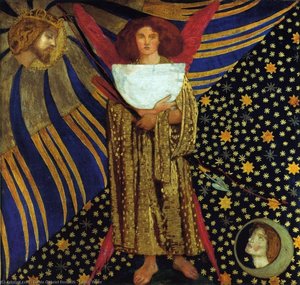 Dantis Amor - Dante Gabriel Rossetti
In his 1860 oil on panel, Dantis Amor, Dante Gabriel Rossetti presents a profound vision of divine love, featuring a winged female figure set against a celestial backdrop of stars and a crescent moon. This work exemplifies the ethereal and spiritual essence of the Pre-Raphaelite movement, utilizing a rich palette and a dreamlike atmosphere to bridge the gap between the earthly and the divine. As a central leader of the Pre-Raphaelite Brotherhood, Rossetti was instrumental in the movement's rejection of rigid academic conventions, opting instead for a direct, emotional connection to his subjects.
Born in London in 1828 to an Italian scholar and an English mother, Rossetti’s work was deeply informed by his literary lineage. He was a multi-faceted creator who seamlessly integrated poetry and painting, often treating his canvases as visual counterparts to his own sonnets. His style is characterized by a unique ability to translate complex literary and symbolic concepts into physical form, often focusing on sensual, romantic, and spiritual themes. Through his meticulous attention to detail and his departure from traditionalist patterns, Rossetti remains a defining figure of British Pre-Raphaelite art, leaving a legacy that explores the intersection of the spoken and the seen.
John Everett Millais
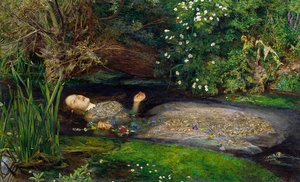 Ophelia (Cropped) - John Everett Millais
A true prodigy of the Victorian era, John Everett Millais (1829–1896) emerged as a foundational force of the Pre-Raphaelite movement. His entry into the Royal Academy Schools at just eleven years old signaled the arrival of a talent destined to challenge the polished, idealized conventions of his time. As a co-founder of the Pre-Raphaelite Brotherhood, Millais rejected the artificiality of post-Raphael academicism, seeking instead a return to the luminous clarity and profound sincerity found in early Italian masters.
To encounter a Millais is to experience a breathtaking devotion to verisimilitude. His work is instantly recognizable by its intense, jewel-like color palettes and a meticulous, almost scientific attention to the natural world. He possessed a rare ability to render textures—the delicate translucency of skin, the dampness of river water, or the intricate veins of a leaf—with startling precision. His masterpiece, Ophelia, stands as a definitive testament to this style; it is a melancholic, immersive vision where vibrant flora and flowing water converge in a scene of tragic, serene beauty. Through his mastery of light and organic detail, Millais transformed the canvas into a window of profound, hyper-realistic truth.
Edward Burne-Jones
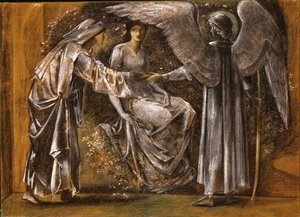 The Heart of the Rose - Edward Burne-Jones
In The Heart of the Rose, painted in 1890, we encounter the profound essence of Edward Burne-Jones's vision. This work serves as a masterful gateway into his ethereal and mysterious aesthetic, where romanticism meets deep medieval allegory. The composition, inspired by the poetry of William Morris, presents a delicate encounter between a young woman and an angelic figure, all set within a rich, velvety palette of deep reds and blues that defines his signature style.
Born in Birmingham in 1833, Burne-Jones was raised in an environment of craftsmanship, the son of a frame-maker. His journey from the industrial landscape of the United Kingdom to the academic halls of Oxford shaped a temperament of quiet contemplation. As a central figure of the Pre-Raphaelite movement, his work exemplifies the movement's rejection of post-Raphael conventions in favor of a return to bright color, sharp detail, and the spiritual depth of the Middle Ages. His paintings often inhabit a dreamlike realm, populated by mythical subjects and graceful, melancholic figures. Through his mastery of texture and symbolic storytelling, he transformed the canvas into a window for the soul, bridging the gap between the physical world and the realm of legend.
Arthur Hughes
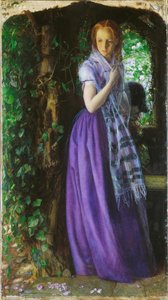 April Love - Arthur Hughes
Arthur Hughes, born in London in 1832, emerged as a vital voice within the Pre-Raphaelite movement, a group of British painters dedicated to reclaiming the luminous clarity and intense detail of art produced before the era of Raphael. After training at the Somerset House art school under Alfred Stevens and later attending the Royal Academy Schools, Hughes found himself aligned with the revolutionary ideals of his contemporaries, John Everett Millais and William Holman Hunt. His work is defined by a magical, glowing quality and a delicate draughtsmanship that captures the ephemeral nature of emotion.
His masterpiece, April Love, serves as a profound testament to this aesthetic. Painted in 1855, the work features his wife, Tryphena Foord, as the central figure. In this poignant tableau, the subject gazes upon fallen rose petals, a symbolic gesture that evokes the transience of beauty and the vulnerability of romance. Through his meticulous use of oil on canvas, Hughes achieved a dreamy, ethereal atmosphere that remains a hallmark of the Pre-Raphaelite style, blending romanticism with a profound, introspective depth.
William Holman Hunt
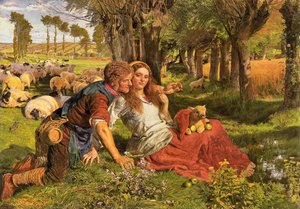 The Hireling Shepherd - William Holman Hunt
In his 1851 masterpiece The Hireling Shepherd, William Holman Hunt captures a lush, pastoral world where every blade of grass and every fold of fabric is rendered with startling clarity. This work serves as a profound testament to the artist's commitment to the Pre-Raphaelite movement, a group he co-founded in 1848 to challenge the artificiality of academic conventions. By rejecting the idealized compositions of the High Renaissance, Hunt sought a return to the sincerity and meticulous detail found in the masters of the early Italian period.
Born in London in 1827, Hunt was a spiritual and philosophical seeker who transformed his deep convictions into visual narratives. His technique is defined by a vibrant, luminous color palette and an uncompromising devotion to naturalism. Whether depicting a shepherd distracted by a death's-head hawkmoth or exploring profound religious themes, his canvases are layered with complex symbolism and intense emotional resonance. Through his precise brushwork and focus on the truth of the natural world, Hunt remains a cornerstone of British Pre-Raphaelite art, bridging the gap between the physical landscape and the spiritual realm.
John Collier
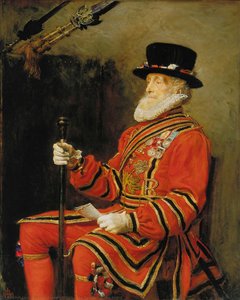
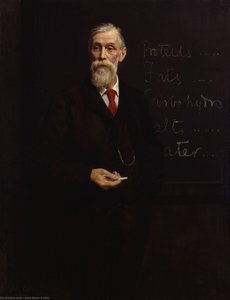 Sir Michael Foster - John Collier
A distinguished figure in late Victorian portraiture, John Maler Collier (1850–1934) brought the meticulous intensity of the Pre-Raphaelite movement into the realm of high society. While many of his contemporaries focused on medievalism or myth, Collier applied the movement's signature devotion to sharp detail and vibrant, symbolic color to the faces of the intellectual elite. His training at the Munich Academy and under Jean-Paul Laurens in Paris provided him with a technical sophistication that allowed him to master the narrative portrait—a hallmark of the Pre-Raphaelite aesthetic.
His work is defined by a profound ability to weave a story into a likeness. In his 1907 masterpiece, Sir Michael Foster, Collier transcends simple representation to capture the very essence of scientific inquiry. The portrait is a study in intellectual vitality, where the subject is framed by a chalkboard inscribed with biochemical terms like Proteins and Carbohydrates. Through a restrained palette of somber charcoal and deep browns, punctuated by a singular, passionate splash of crimson in the subject's tie, Collier utilizes the Pre-Raphaelite emphasis on color to symbolize the fire of human thought amidst the quietude of academic study.
Frederick Sandys
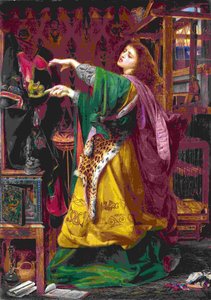 Morgan le Fay - Frederick Sandys
Frederick Sandys stands as a pivotal figure within the British Pre-Raphaelite movement, embodying the era's obsession with medievalism and intense, symbolic detail. Born in Norwich in 1829, Sandys developed a rigorous technical foundation at the Norwich School of Design, later relocating to London where his artistic identity solidified through a profound connection to the Pre-Raphaelite circle. His close association with Dante Gabriel Rossetti allowed him to absorb the visionary, often mystical, aesthetic that defined the movement's rejection of academic convention in favor of sharp, naturalistic precision.
His 1864 masterpiece, Morgan le Fay, serves as a quintessential example of his ability to conjure atmosphere through meticulous craftsmanship. In this work, Sandys captures the legendary Arthurian enchantress with a magnetic, dangerous allure. The painting is a triumph of texture and symbolism; every element, from the delicate crown to the heavy, intricate fabrics, is rendered with a luminous depth that blurs the line between myth and reality. By focusing on such profound, enigmatic subjects, Sandys moved beyond mere portraiture to create complex narratives that remain central to the Pre-Raphaelite legacy of reclaiming historical and mythological truth.
Joseph Noel Paton
 The Quarrel of Oberon and Titania - Joseph Noel Paton
Sir Joseph Noel Paton stands as a vital bridge between Scottish folklore and the aesthetic revolution of the Pre-Raphaelite movement. Although he famously declined an invitation to join the Pre-Raphaelite Brotherhood, his work is deeply aligned with their core principles of intense naturalism and a rejection of idealized, academic forms. Born in Dunfermline, Scotland, in 1821, Paton’s artistic eye was shaped by his family’s background in intricate textile design, a heritage that manifested in the extraordinary, meticulous detail characteristic of his canvases.
His masterpiece, The Quarrel of Oberon and Titania (1849), serves as a definitive example of his ability to fuse Pre-Raphaelite sensibilities with ethereal, mythological storytelling. In this work, Paton captures a dramatic moment from Shakespearean legend, imbuing the enchanted woodland with a psychological complexity that transcends mere illustration. By focusing on sharp detail and the vibrant, truthful depiction of nature and character, Paton brought a unique, visionary depth to the Pre-Raphaelite tradition, transforming folklore into profound, high-Victorian drama.
Simeon Solomon
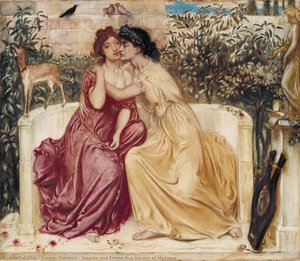 Sappho and Erinna in a Garden at Mytilene - Simeon Solomon
Simeon Solomon (1840–1905) occupies a singular, often melancholic position within the Pre-Raphaelite movement. Born in London into a prominent Jewish family, he received his foundational training from his brother, Abraham Solomon, before honing his craft at Carey’s Art Academy and the Royal Academy Schools. His artistic trajectory was profoundly shaped by his close association with Dante Gabriel Rossetti, a connection that firmly embedded him within the Pre-Raphaelite circle alongside figures like Edward Burne-Jones.
Solomon’s work is distinguished by its departure from conventional Victorian subject matter, instead favoring the lush, symbolic language of classical antiquity and the exploration of identity. His paintings are characterized by a meticulous attention to detail and a vibrant, saturated color palette that aligns him with the movement's rejection of academic artifice. In his masterpiece, Sappho and Erinna in a Garden at Mytilene (1864), Solomon utilizes a fluid, evocative brushwork to depict an intimate moment of mythological connection. Through his use of rich symbolism and themes of desire, Solomon provided a unique, subversive perspective that expanded the boundaries of Pre-Raphaelite expression, capturing the complexities of the human spirit through a lens of ethereal beauty.
Henry Treffry Dunn
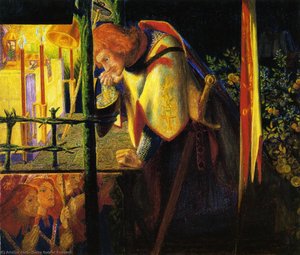
 Sir Launcelot in the Queen's Chamber (after Dante Gabriel Rossetti) - Henry Treffry Dunn
Henry Treffry Dunn (1838–1899) remains a vital figure within the British pre-raphaelite movement, largely due to his profound connection to the movement's core philosophy. As a dedicated assistant and protégé to Dante Gabriel Rossetti, Dunn did not merely observe the Pre-Raphaelite revolution; he became a custodian of its aesthetic soul. His work is characterized by a rejection of sterile academicism in favor of the luminous color palettes and intense psychological depth that defined his contemporaries. A viewer can recognize a Dunn composition by its meticulous attention to detail and a tactile, almost sculptural quality achieved through masterful impasto techniques.
His representative work, Sir Launcelot in the Queen's Chamber (after Dante Gabriel Rossetti), exemplifies the movement's obsession with Arthurian legend and medieval tension. In this piece, Dunn captures a moment of profound drama, utilizing rich, vibrant hues to illuminate heavy fabrics and metallic accents. The interplay of light and shadow serves to heighten the emotional volatility of the scene, reflecting the moral ambiguity central to the legends he so faithfully interpreted. Through his disciplined brushwork and devotion to the Rossettian vision, Dunn ensured that the brilliance of the Pre-Raphaelite style was both preserved and expanded.
Conclusion
The legacy of these British pre-raphaelite painters lies in their profound rebellion against the formulaic shadows of the Academy, opting instead for a luminous, hyper-detailed devotion to nature and medieval romanticism. From the intense, symbolic emotionalism of Dante Gabriel Rossetti to the meticulous botanical precision of John Everett Millais, each artist contributed a unique layer to this movement’s quest for sincerity and vibrant color. Whether through the ethereal, dreamlike compositions of Edward Burne-Jones or the dramatic, moral narratives of William Holman Hunt, these masters redefined the visual language of the Victorian era, leaving behind a tapestry of works that continue to captivate the modern imagination.
For those seeking to bring this era of exquisite detail and romantic splendor into a contemporary setting, Mus3ums.com offers a curated selection of these masterpieces. Our artisans specialize in creating museum-quality, hand-painted oil reproductions that capture the true essence, texture, and soul of these iconic works. We invite you to explore our full collection and find a piece of British art history to live with in your own home.