
Introduction
The landscape of the United Kingdom underwent a profound emotional transformation during the late eighteenth and early nineteenth centuries, as the rigid structures of Neoclassicism gave way to the sublime intensity of the Romantic movement. This era was defined by a departure from pure reason, favoring instead the raw power of nature, the depths of human passion, and the awe-inspiring mystery of the unknown. British Romantic painters sought to capture not merely the physical world, but the visceral experience of it—the tempestuous fury of a storm at sea, the spiritual weight of a mythological vision, or the quiet, melancholic beauty of the English countryside.
Culturally, these artists emerged during a period of immense upheaval, as the Industrial Revolution began to reshape the social fabric of Britain. In response, their canvases became sanctuaries for the sublime, celebrating the untamed wilderness against the encroaching tide of modernity. Their work moved beyond mere representation, utilizing dramatic light, expressive brushwork, and a heightened sense of atmosphere to evoke profound psychological responses in the viewer.
Today, the legacy of these masters remains vital, as their ability to translate the intangible essence of emotion into visual form continues to resonate in our modern, often hyper-rationalized world. Their influence can be felt in everything from contemporary landscape photography to the cinematic use of light and shadow. By exploring the lives and works of these ten seminal figures, we trace the evolution of a movement that forever changed the way humanity perceives its place within the natural and spiritual realms.
William Blake
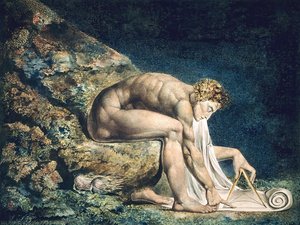 Newton - William Blake
In his evocative monotype Newton, William Blake transcends mere portraiture to explore the profound tension between empirical reason and the boundless reaches of the human imagination. The work depicts a solitary, vulnerable figure submerged in a dark, primordial abyss, intensely focused on geometric diagrams. This composition serves as a powerful testament to his place within the Romanticism movement, as he rejects the rigid, ordered constraints of Neoclassicism in favor of a mystical, visionary perspective that prioritizes internal truth over external observation.
Born in London in 1757, Blake’s artistic journey was shaped by a childhood defined by intense spiritual visions and a rigorous technical apprenticeship under the engraver James Basire. His time sketching the Gothic monuments of Westminster Abbey deeply informed his aesthetic, leading him to develop a unique method of relief etching to merge poetry with visual art. His palette often carries a heavy, atmospheric depth, utilizing fluid lines and textural richness to capture the sublime. Through his innovative printmaking and deeply personal mythology, Blake remains a singular figure of British Romanticism, one who sought to map the infinite landscapes of the soul.
John Constable
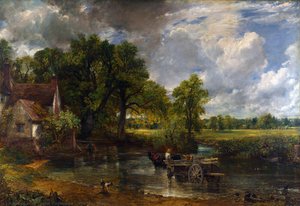 The Hay Wain - John Constable
John Constable stands as a definitive figure among British Romantic painters, having shifted the focus of landscape art from idealized, staged compositions toward a profound, emotive connection with the natural world. While many of his contemporaries sought the dramatic and the sublime, Constable found the essence of Romanticism in the authentic, lived experience of the English countryside. His work is characterized by a deep nostalgia for the Stour Valley, a landscape that shaped his identity from his childhood in East Bergholt through his formal training at the Royal Academy Schools.
His 1821 masterpiece, The Hay Wain, serves as the quintessential expression of this philosophy. In this work, the artist captures more than a mere pastoral scene; he evokes the very soul of the Suffolk landscape. Through a masterful command of light and atmosphere, Constable portrays the harmonious intersection of human industry and the raw, shifting beauty of nature. His technique—defined by expressive brushwork and a sophisticated layering of color—allows the viewer to feel the moisture in the air and the vitality of the riverbanks, cementing his legacy as a master who transformed the observation of nature into a deeply personal, poetic experience.
J. M. W. Turner
Joseph Mallord William Turner stands as a titan of the Romanticism movement, a period defined by the elevation of raw emotion and the overwhelming power of the natural world over rigid classical order. Born in London in 1775, Turner’s journey from the son of a barber and art dealer to a master of the Royal Academy Schools reflects a life dedicated to capturing the sublime. His early training under architects and topographical draughtsmans provided a foundation of structural precision, yet his true legacy lies in his ability to transcend mere documentation to reach a state of atmospheric transcendence.
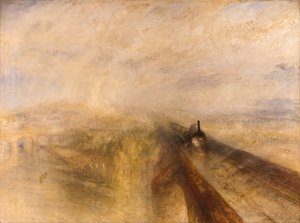
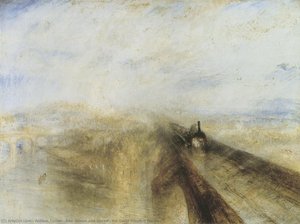
In his masterpiece, Rain Steam and Speed, The Great Western Railway, Turner perfectly encapsulates the Romantic fascination with the transformative forces of nature and human progress. Through a masterful application of impasto, he creates a symphony of light and mist where the locomotive emerges as a powerful force cutting through a golden, rain-soaked landscape. His use of vivid, fiery hues and swirling textures allows the steam and sky to merge, illustrating the tension between the industrial revolution and the eternal, untamable elements of the environment. This ability to render the intangible through tangible, textured brushwork is what secures his position as a defining figure of British Romanticism."
William Etty
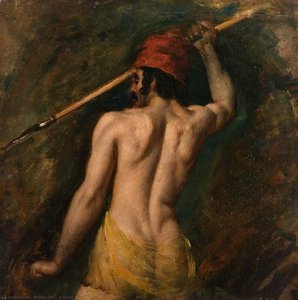 A Greek Slave - William Etty
Born in York in 1787, William Etty’s journey to artistic mastery was far from conventional. He began his career not in a studio, but through a disciplined seven-year apprenticeship as a printer in Hull. This early exposure to the mechanics of visual reproduction provided a technical foundation that he later refined at the Royal Academy Schools under the mentorship of Thomas Lawrence. It was this rigorous training in anatomical precision that allowed him to become a pioneer of the British nude, a subject he approached with a fervor that defined his place among the Romanticism painters from United Kingdom.
Etty’s work is a profound expression of the Romantic movement, prioritizing raw emotion and the dramatic interplay of light and shadow over the rigid order of Neoclassicism. In his striking work, A Greek Slave (1812), he eschews idealized perfection for a visceral, tactile realism. Through masterful tonal modeling and thin glazes of pigment, he sculpts the human form with a sense of vulnerability and strength. The painting’s earthy palette and intense, dramatic lighting exemplify the Romantic obsession with the power of human experience and the sublime tension of the soul.
George Stubbs
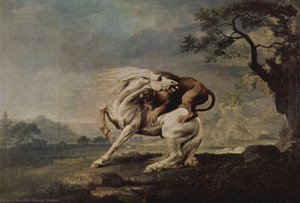 Lion Attacking a Horse - George Stubbs
George Stubbs stands as a foundational figure in the British Romantic movement, bridging the gap between rigorous scientific observation and the raw, untamed emotion of the sublime. Unlike many of his contemporaries who focused solely on surface aesthetics, Stubbs’ work is defined by a profound understanding of anatomy. His early years in Liverpool, working with hides, and his subsequent anatomical studies under surgeon Charles Atkinson allowed him to master the tension of sinew and the underlying structure of life. This scientific precision provides the essential framework for his more dramatic, Romantic compositions.
A visitor can immediately recognize a Stubbs masterpiece through his meticulous rendering of texture and his ability to capture the primal energy of the natural world. His brushwork is precise yet capable of conveying immense movement and tension. In his evocative work, Lion Attacking a Horse, he exemplifies the Romantic preoccupation with the struggle for survival and the power of nature. By utilizing dramatic light and shadow, he elevates a scene of animal confrontation into a profound exploration of life and death, a technique that would later influence major figures like Théodore Géricault.
Thomas Lawrence
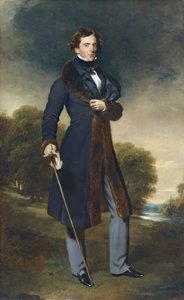 Portrait of David Lyon - Thomas Lawrence
A true prodigy of the Regency era, Sir Thomas Lawrence (1769–1830) rose from a nomadic childhood in Bristol and Bath to become the preeminent portraitist of the British aristocracy. His journey from sketching portraits in his father's inns to securing royal commissions by age eighteen exemplifies the era's fascination with individual character and social dynamism. Lawrence belongs to the group of British Romantic painters through his ability to infuse formal portraiture with the movement's core emphasis on psychological depth and emotional nuance, moving beyond mere likeness to capture the very soul of his subjects.
His 1825 masterpiece, Portrait of David Lyon, serves as a profound testament to this talent. In this work, Lawrence utilizes a tranquil landscape—a hallmark of Romanticism—to frame the subject, allowing the natural world to mirror the sitter's internal state. The painting demonstrates a virtuoso handling of oil, where the interplay of light and shadow creates a sense of dignified introspection. By blending the grandeur of traditional portraiture with the Romantic preoccupation with mood and the sublime, Lawrence secured his legacy as a master of the period's sophisticated aesthetic.
Joseph Wright of Derby
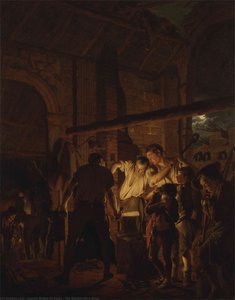 The Blacksmith's Shop - Joseph Wright of Derby
Joseph Wright of Derby (1734–1797) stands as a singular figure among British Romantic painters, bridging the gap between Enlightenment rationalism and the raw, emotional intensity of the Romantic movement. While his contemporaries often sought solace in pastoral landscapes, Wright found a profound, almost spiritual drama in the burgeoning Industrial Revolution. His work captures the sublime power of human innovation and the transformative energy of a changing world, a core tenet of the Romantic spirit that prioritizes feeling and the awe-inspiring nature of sudden change.
His technical mastery is most evident in his sophisticated use of chiaroscuro, where light serves as a metaphor for scientific discovery and intellectual awakening. In his 1771 masterpiece, The Blacksmith's Shop, Wright elevates a scene of manual labor to a monumental event. The intense, flickering glow from the forge pierces through deep, enveloping shadows, casting an ethereal radiance over the anvil and the workers. This dramatic interplay of light and darkness does more than illuminate a workshop; it captures the pulse of a new era, turning the grit of industry into a sublime spectacle of light and shadow.
Thomas Sully
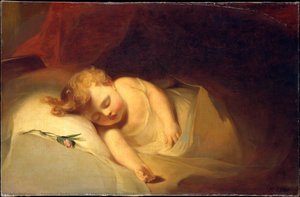 Child Asleep (The Rosebud) - Thomas Sully
Born in Lincolnshire in 1783, Thomas Sully represents a unique transatlantic bridge within the Romanticism movement. His artistic journey began in the United Kingdom before his family emigrated to South Carolina, a transition that allowed him to infuse British stylistic elegance with a burgeoning American identity. His training under Benjamin West and the profound influence of Thomas Lawrence provided him with a mastery of light and texture that defined his Romantic sensibility. Unlike the rigid formality of his predecessors, Sully’s work embraced the movement's emphasis on emotion, grace, and the sublime beauty of the human spirit.
His technical brilliance is most poignantly captured in his 1841 masterpiece, Child Asleep (The Rosebud). In this work, Sully moves beyond mere portraiture to create a profound meditation on innocence. Through a soft, luminous application of oil, he depicts a sleeping infant surrounded by symbolic elements—birds and a delicate rose—that evoke the ephemeral nature of life. This ability to marry meticulous detail with an ethereal, breathing quality ensures his place among the premier Romantic painters, as he transformed the portrait into a vessel for spiritual and emotional contemplation.
Henry Raeburn
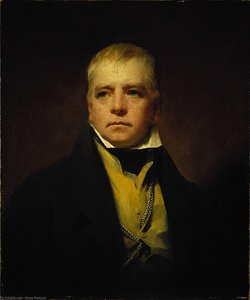 Sir Walter Scott - Henry Raeburn
Sir Henry Raeburn (1756–1823) stands as a cornerstone of British Romanticism, specifically through his ability to infuse portraiture with the movement's characteristic emotional depth and psychological intensity. While many of his contemporaries focused on rigid formality, Raeburn’s work captures the individual spirit, aligning him with the Romantic emphasis on the profound connection between character and essence. His transition from a meticulous goldsmithing background to a master of oil painting allowed him to develop a unique, vigorous brushwork that avoids the static nature of traditional likenesses.
A viewer can recognize a Raeburn original by his masterful use of chiaroscuro, where dramatic light sculpts the subject against deep, atmospheric shadows. His technique often favors a sense of immediacy and vitality, moving beyond mere surface detail to capture the very soul of his sitters. This is epitomized in his 1822 masterpiece, Sir Walter Scott. In this portrait, Raeburn utilizes striking light and texture—from the sheen of spectacles to the tactile richness of velvet—to immortalize the novelist not just as a man, but as a symbol of Scottish identity and intellectual legacy. His ability to ground his subjects in a palpable, emotive reality is what defines his contribution to the Romantic era.
Augustus Wall Callcott
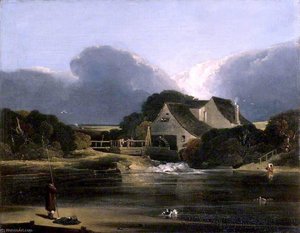 Landscape with Water Mill - Augustus Wall Callcott
Sir Augustus Wall Callcott (1779–1844) stands as a distinguished figure among British Romantic painters, capturing the era's fascination with the atmospheric power of the natural world. While his early training under John Hoppner focused on portraiture, Callcott eventually pivoted to landscapes, a transition that defined his legacy within the Romantic movement. His work eschews rigid academic order in favor of the sublime, often emphasizing the emotional resonance of light and weather.
In his representative work, Landscape with Water Mill (1803), Callcott demonstrates the quintessential Romantic preoccupation with the relationship between humanity and the vastness of nature. The composition utilizes a delicate tonal range to depict a weathered mill and a flowing river, where the expressive brushwork and dramatic, shifting skies evoke a sense of quiet contemplation and impending natural change. Unlike the purely topographical views of earlier eras, Callcott’s landscapes are imbued with a sense of feeling and atmosphere.
His mastery of light and composition earned him a knighthood and a position as Surveyor of the Queen's Pictures. Whether depicting the serene coasts of the Tyne or the dramatic movement of water, Callcott’s ability to translate the sublime into elegant, charming scenes remains a testament to his profound contribution to British Romanticism.
Conclusion
The legacy of these British Romantic painters lies in their profound ability to capture the sublime, whether through the tempestuous, light-drenched seascapes of Turner, the pastoral tranquility of Constable, or the visionary, spiritual landscapes of Blake. From the dramatic chiaroscuro of Wright of Derby to the elegant portraiture of Lawrence and Raeburn, this movement redefined the relationship between the human spirit and the untamed forces of nature. Each artist contributed a unique lens to the era, moving art away from rigid classical structures and toward a deeply personal, emotive expression of the world.
At Mus3ums.com, we invite you to bring this era of passion and grandeur into your own space. Our master artists specialize in creating museum-quality, hand-painted oil reproductions that preserve the tactile depth and emotional intensity of these masterpieces. Whether you are seeking a sweeping landscape to anchor a room or a delicate portrait to evoke a sense of history, you can explore our full collection and find a piece that resonates with your soul.


