

Introduction
In the early 19th century, the art world in France underwent a profound emotional awakening. As the rigid structures of Neoclassicism began to fade, a new generation of creators sought to capture something far more volatile and visceral: the raw power of human passion and the untamed majesty of the natural world. These French romantic painters moved away from the cool, calculated logic of ancient history, choosing instead to explore the shadows of the subconscious, the drama of contemporary struggle, and the sublime intensity of storms and landscapes.
This movement emerged during a period of immense cultural upheaval, reflecting a society caught between the echoes of revolution and the shifting tides of empire. Rather than focusing on idealized perfection, these artists embraced the imperfect and the dramatic. They utilized expressive brushwork, rich color palettes, and dynamic compositions to evoke deep empathy and awe, often prioritizing the "feeling" of a scene over its literal, anatomical accuracy. Their work was a rebellion of the heart, celebrating the individual spirit against the backdrop of destiny and chaos.
Today, the legacy of this era continues to resonate in our modern visual language. The movement's emphasis on atmosphere and emotional truth paved the way for much of the expressive art that followed, influencing how we perceive the relationship between humanity and the environment. Their ability to translate intense psychological states onto canvas remains a powerful tool for storytelling, making their works timelessly relevant to anyone who seeks art that speaks to the soul.
To understand this era of passion and movement, we must look closer at the masters who defined it. From the sweeping, dramatic compositions of Eugène Delacroix to the haunting, emotive depths of Théodore Géricault, the following artists represent the very essence of the French romantic spirit.
Gustave Doré
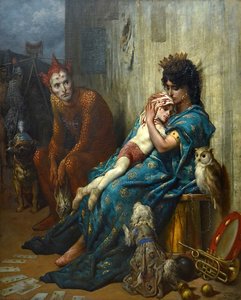 The Acrobats - Gustave Doré
A self-taught prodigy from Strasbourg, Gustave Doré bypassed traditional academic instruction to develop a singular, powerful visual language. His career was defined by an intense, relentless momentum, transitioning from a teenage caricaturist in Paris to an international force whose wood engravings and paintings captured the very essence of the 19th-century imagination. Doré belongs to the French Romantic movement through his profound ability to navigate the spectrum of human emotion, moving effortlessly from the divine to the grotesque. His work embodies the Romantic preoccupation with drama, atmosphere, and the sublime, often utilizing intense chiaroscuro to heighten the emotional stakes of his subjects.
In his evocative work, The Acrobats, we see this mastery on full display. The piece serves as a poignant intersection of Romanticism and burgeoning Realism, capturing a fleeting, theatrical moment of everyday life. Through meticulous rendering and a dramatic play of light and shadow, Doré transforms a scene of entertainers into a study of vulnerability and melancholy. Whether through his iconic illustrations or his large-scale compositions, his legacy remains rooted in this capacity to render the world with both technical precision and deep, soulful resonance.
Eugène Delacroix
Eugène Delacroix (1798–1863) stands as the definitive leader of the French Romantic movement, a visionary who traded the rigid, cold lines of Neoclassicism for a restless, volatile energy. His work captures the very emotional pulse of a changing 19th-century France, favoring raw, individualistic expression over academic restraint. To recognize a Delacroix at a glance is to encounter a whirlwind of movement and color; his brushwork is characterized by a dramatic, sweeping vitality that mirrors the societal upheavals of his era.
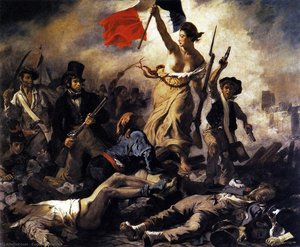
His masterpiece, Liberty Leading the People, serves as a profound testament to the Romantic spirit. In this monumental work, he transforms a historical moment into a surge of passion, using a dynamic triangular composition to lead the viewer through the chaos of revolution. The palette is a striking dance of earthy tones—deep browns and muted grays—interrupted by the sudden, defiant brilliance of the tricolor flag. Through his mastery of light and shadow, Delacroix does not merely depict history; he breathes life into the struggle for freedom, ensuring his legacy remains a cornerstone of European art.
Pierre-Henri de Valenciennes
 A LA VILLA BORGHESE RUISSEAU COULANT PARMI LES ARBRES - Pierre-Henri de Valenciennes
Pierre-Henri de Valenciennes stands as a pivotal figure in the evolution of French Romanticism, specifically through his revolutionary approach to the natural world. While many of his contemporaries focused on idealized, studio-composed scenes, Valenciennes championed the concept of the "landscape portrait." By advocating for en plein air painting—working directly in the open air to capture the fleeting nuances of light and weather—he moved art away from rigid academic rules and toward the raw, emotional connection with nature that defines the Romantic movement.
His time in Rome between 1778 and 1782 served as a transformative period, where his direct observations of the Italian countryside laid the groundwork for his influential 1800 treatise. This dedication to capturing the authentic atmosphere of a location deeply influenced a generation of artists, including Jean-Victor Bertin and Achille Etna Michallon. His representative work, A La Villa Borghese Ruisseau Coulant Parmi Les Arbres, serves as a masterful testament to this philosophy. In this piece, the interplay of sunlight and shadow within a dense woodland creates a sense of profound tranquility, utilizing textured brushwork to bring the vitality of the forest to life.
Théodore Géricault
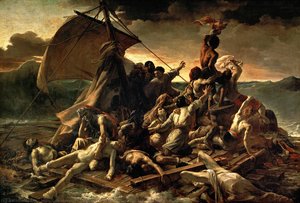 The Raft of the Medusa - Théodore Géricault
Théodore Géricault stands as a titan of the French Romantic movement, a painter who traded the calm, orderly lines of Neoclassicism for the raw, turbulent energy of human emotion. His work is instantly recognizable by its profound psychological depth and a dramatic use of chiaroscuro, where stark, theatrical light battles against deep, somber shadows to pull the viewer into a moment of intense crisis.
A true pioneer of this era, Géricault’s style was forged through a restless, self-directed study of the Old Masters in the Louvre, absorbing the heavy textures and emotional weight of Rubens and Rembrandt. This obsession with the visceral reality of the human condition is most powerfully captured in his monumental masterpiece, The Raft of the Medusa. In this work, he moves beyond mere storytelling to explore the sublime and terrifying power of nature and the resilience of the human spirit amidst tragedy. His brushwork is not merely applied; it is felt, using rich textures and anatomical precision to depict bodies contorted by desperation and hope. Through his focus on movement, suffering, and the dramatic interplay of light, Géricault remains a definitive voice of Romanticism, capturing the chaotic pulse of the 19th century."
Horace Vernet
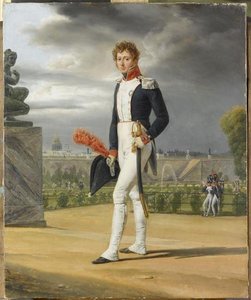 Philippe Lenoir - Horace Vernet
Horace Vernet (1789–1863) was a pivotal figure in the French Romantic movement, distinguished by his departure from the rigid, idealized formalism of academic Classicism. While his predecessors sought perfection in static, balanced compositions, Vernet embraced the movement's core fascination with raw emotion, movement, and the visceral realities of contemporary life. He is most celebrated for his ability to capture the kinetic energy of the battlefield and the vivid, often gritty, details of 19th-century military existence.
A viewer can recognize a Vernet at a glance through his remarkable speed of execution and his preference for realistic, vernacular depictions over grand, mythological allegories. His brushwork is expressive and direct, often utilizing a palette that balances earthy, somber tones with sudden, dramatic splashes of color to heighten the emotional tension of a scene. This approach is masterfully displayed in his representative work, The Taking of an Entrenched Camp. In this piece, he eschews the polished stillness of the old masters to present a chaotic, high-stakes assault, using light and texture to immerse the observer in the fervor of combat. Through his focus on national heroism and the lived experience of soldiers, Vernet remains a quintessential voice of French Romanticism."
Paul Delaroche
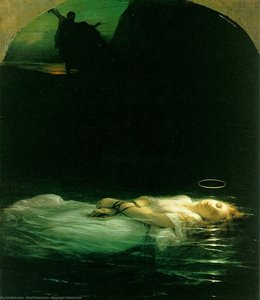 Young Christian Martyr - Paul Delaroche
Paul Delaroche stands as a captivating figure within the French romantic painters group, acting as a vital bridge between the sweeping emotionalism of Romanticism and the disciplined precision of Academic art. Born in Paris in 1797, his artistic journey was shaped by a family deeply immersed in the visual arts, eventually studying under the mentorship of Antoine-Jean Gros. While his contemporaries often drifted toward pure abstraction or rigid neoclassicism, Delaroche carved a unique path by infusing monumental historical narratives with a sense of breathless, human immediacy.
His work is defined by a pragmatic realism that strips away the idealized veneer of history to reveal raw, vulnerable moments of despair and terror. This focus on the psychological weight of a scene is perfectly encapsulated in his 1853 masterpiece, Young Christian Martyr. In this evocative piece, he utilizes a dramatic interplay of light and shadow to create a mystical, melancholic atmosphere. By transforming the canvas into a theatrical stage, Delaroche ensured that the grand events of the past felt startlingly present, cementing his legacy as a master of historical drama who prioritized the profound emotional core of his subjects.
Thomas Couture
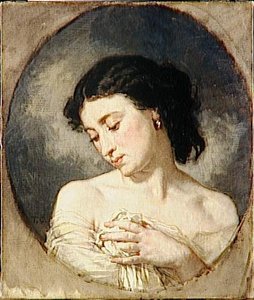 JEUNE FEMME EN BUSTE LES EPAULES DENUDEES - Thomas Couture
Thomas Couture (1815–1879) stands as a transformative figure in the French Romantic movement, acting as a vital bridge between the emotional intensity of Romanticism and the burgeoning realism of the mid-19th century. His artistic journey was defined by a spirit of rebellion; after facing repeated rejections from the prestigious Prix de Rome, he bypassed the rigid constraints of the École des Beaux-Arts to establish his own independent atelier. This sanctuary for creative freedom became a breeding ground for future masters, as he went on to influence legendary artists such as Manet, Fantin-Latour, and Puvis de Chavannes.
Couture’s place within the Romantic tradition is most evident in his ability to infuse historical and classical subjects with profound psychological depth and social commentary. His masterpiece, Romans During the Decadence, utilized dramatic tonal contrasts to mirror the moral unrest of his own era. In contrast to his grand historical narratives, his work Jeune Femme en Buste les Épaules Dénudées showcases a more intimate, melancholic side of the movement. This portrait captures a sense of vulnerability and quiet introspection through a masterful play of light and shadow, proving that Romanticism could be as much about the subtle whispers of the soul as it was about the grand, sweeping passions of history.
Pierre-Paul Prud'hon
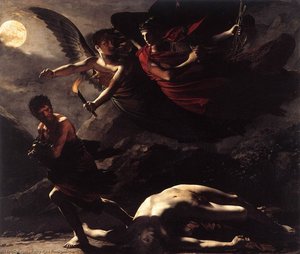 Justice and Divine Vengeance Pursuing Crime - Pierre-Paul Prud'hon
Pierre-Paul Prud'hon stands as a masterful bridge between the disciplined elegance of Neoclassicism and the raw, emotional turbulence of the Romantic movement. While his early training in Dijon and his time in Rome instilled in him a profound respect for classical form and the grace of masters like Canova, his soul was deeply attuned to the dramatic shifts of the early 19th century. This transition is perfectly captured in his ability to move beyond mere idealized beauty toward a more visceral, psychological depth.
His representative work, Justice and Divine Vengeance Pursuing Crime, serves as a cornerstone of this Romantic sensibility. In this monumental composition, Prud'hon abandons strict, calm order in favor of the sublime. He utilizes intense chiaroscuro to sculpt figures out of shadow, creating a sense of cosmic drama that prioritizes emotional impact over anatomical perfection. By juxtaposing the terrifying presence of Death against angelic serenity amidst a rugged, mountainous landscape, he embraces the Romantic obsession with the power of nature and the heavy weight of morality. It is this shift from the rational to the spiritual and the dramatic that firmly secures his place among the great French romantic painters.
Adolphe Joseph Thomas Monticelli
 Flowers in a Blue Vase - Adolphe Joseph Thomas Monticelli
Adolphe Joseph Thomas Monticelli (1824–1886) stands as a captivating figure in French art, bridging the gap between the emotional intensity of Romanticism and the textured innovations of modernism. Born in Marseille, his journey took him from the École Municipale de Dessin to the prestigious École des Beaux-Arts in Paris, where he studied under Paul Delaroche. It was here, while meticulously copying Old Masters, that he absorbed the dramatic spirit of the era. His style became deeply infused with the Romantic fervor of Eugène Delacroix, particularly through a shared devotion to expressive brushwork and the emotive power of color.
Monticelli’s work is defined by a profound sense of drama and a tactile, almost sculptural approach to oil paint. In his representative work, Flowers in a Blue Vase (1881), this Romantic sensibility is palpable. Rather than focusing on mere botanical accuracy, he uses heavy impasto to create ridges of paint that catch the light, allowing blossoms to emerge from a deep, shadowy gloom. This dramatic use of light and shadow, combined with his vigorous, energetic application of pigment, places him firmly within the Romantic tradition of prioritizing feeling and atmosphere over rigid, classical order.
Anne-Louis Girodet
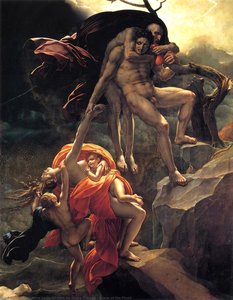 Scene of the Flood - Anne-Louis Girodet
Anne-Louis Girodet (1767–1824) occupies a fascinating position in art history, serving as a vital bridge between the disciplined precision of Neoclassicism and the emotive turbulence of the Romantic movement. A student of the legendary Jacques-Louis David, Girodet initially mastered the clarity and moral gravity of the classical tradition. However, his work began to drift toward a more soulful, dramatic sensibility that prioritized feeling and the sublime over strict rational order.
His inclusion among French romantic painters stems from this shift toward intense emotionality and the exploration of human vulnerability. This is masterfully captured in his 1806 work, Scene of the Flood. In this piece, Girodet moves away from static classical compositions to embrace the chaotic power of nature and the divine. By depicting the biblical deluge, he taps into the quintessential Romantic fascination with cosmic upheaval and the dramatic struggle of humanity against overwhelming forces. His ability to infuse scenes with a sense of melancholy and spiritual tension marks him as a pioneer who helped pave the way for the full-scale emotionalism of the Romantic era.
Conclusion
The French romantic painters captured a world in transition, moving away from the rigid constraints of neoclassicism to embrace the raw, untamed essence of human emotion and the sublime power of nature. From the dramatic, swirling compositions of Delacroix to the haunting, atmospheric landscapes of Prud'hon, these artists collectively redefined how we perceive light, shadow, and the intensity of the soul. Whether through the epic storytelling of Géricault or the delicate, dreamlike textures of Monticelli, this movement left an indelible mark on art history, proving that feeling is just as vital as form.
At Mus3ums.com, we believe these evocative masterpieces deserve a place in your own home. If you find yourself drawn to the passion and movement of this era, we invite you to explore our full collection. You can bring the spirit of French Romanticism into your living space through our museum-quality, hand-painted oil reproductions, each meticulously crafted by skilled artists to capture the authentic texture and soul of these timeless works.


