Breaking the Frame: Moving Beyond Traditional Representation
The era of the easel was changing. By 1960, a group of artists in Paris felt that the traditional way of painting—the attempt to represent life through a window of oil and canvas—was no longer enough to capture the pulse of a modernizing world. They did not want to paint a picture of a city; they wanted to use the city itself. This shift was a reaction to the rapid industrialization and the rise of consumer culture in post-war Europe. Instead of looking inward at abstract emotions, these artists looked outward at the physical, tangible debris of existence.
This impulse to find art in the immediate surroundings of the city echoes the earlier intentions of the Dadaists. Much like the Dadaists, the New Realists sought to disrupt traditional aesthetics by using found objects to challenge what was considered "art." However, while
Dada often used the found object to provoke or mock, the New Realists used it to reconcile art with the lived experience of a changing, material world. They were not just looking for shock value; they were looking for a new way to perceive the reality of a world filled with mass-produced goods.
The 1960 Manifesto: A Collective Declaration of Reality
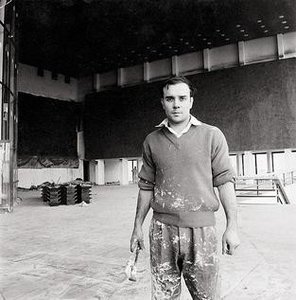 Yves Klein
Explore Yves Klein (1928-1962), the French pioneer of post-war art! Discover his iconic International Klein Blue (IKB), monochrome paintings, performance art & Nouveau Réalisme influence. A forerunner to Minimal & Pop Art.
The movement found its formal voice through the critic Pierre Restany and the painter
Yves Klein. In April 1960, Restany wrote the "Constitutive Declaration of New Realism," a text that proposed "new ways of perceiving the real." This was not a solitary effort but a collective one. On October 27, 1960, a group of nine artists gathered in
Yves Klein's workshop to sign a joint declaration. This group included figures like Arman,
Jean Tinguely, and Daniel Spoerri, among others.
This moment of unity mirrors the way art movements often coalesce around a shared dissatisfaction with the status quo. Just as the Impressionists once gathered to challenge the rigid standards of the Salon, the New Realists gathered to declare that the boundaries of art had expanded to include the street and the factory. By signing this manifesto, they were not just forming a club; they were claiming a new territory where the distinction between life and art could finally dissolve.
The Weight of Objects: Finding Art in Accumulation
 Marcel Duchamp
Dadaist pioneer Marcel Duchamp redefined art with his readymades like Fountain. Discover his revolutionary works and philosophical impact today.
One of the most striking ways the New Realists reclaimed reality was through the method of accumulation. Rather than depicting a collection of items, artists like Arman chose to present the items themselves. He became known for his massive assemblages of
musical instruments, watches, or even industrial trash. By gathering these objects in large quantities, the artist highlighted the sheer volume of consumption that defined the era. The object loses its individual utility and becomes a sculptural mass, a physical record of
human presence and waste.
This focus on the material weight of objects finds a historical echo in the "readymades" of
Marcel Duchamp. Duchamp had previously challenged the idea of the artist's hand by presenting a urinal or a bicycle wheel as art. The New Realists took this concept a step further by moving from the single, isolated object to the overwhelming pile. They took the "readymade" and placed it within the context of mass production, turning the leftovers of consumerism into a heavy, undeniable reality.
Urban Layers: The Poetic Destruction of Décollage
 Jacques de la Villeglé
Explore the art of Jacques Mahé de la Villeglé (Jacques Villeglé), a pioneer of décollage & Nouveau Réalisme. Discover his unique mixed-media works focusing on urban ephemera, found objects, and societal remnants.
The city itself became a canvas through the technique of décollage. Artists such as Jacques Villeglé, Raymond Hains, and Mimmo Rotella did not paint on blank surfaces; they worked on the walls of the streets. They practiced the art of tearing away layers of posters from advertising hoardings. This process of removal and destruction revealed the history of the city written in paper. Each torn layer was a fragment of a message, a piece of public communication that had been weathered by time and the elements.
This method of working with the surface of the city finds a parallel in the way history is layered in any urban environment. Just as an archaeologist digs through strata of earth to find remnants of past civilizations, the décollage artist digs through the layers of urban advertising to find the "real" city. They transformed the ephemeral, disposable nature of street posters into something permanent and sculptural, capturing the very texture of
modern life.
Kinetic Energy: The Beauty of Self-Destructing Machines
 Jean Tinguely
 (1925-1991) was a Swiss kinetic art sculptor renowned for his satirical, self-destructive machines—'Métamatics'. Explore Dadaist influences & collaborations with Niki de Saint Phalle. A pioneer of New Realism.
If some artists were accumulating objects, others were interested in their movement and eventual decay.
Jean Tinguely became a central figure through his creation of kinetic machines. These were not the polished, efficient machines of a factory, but often chaotic, clattering constructions that moved in unpredictable ways. Many of his works were designed to be self-destructive, performing a programmed act of breakdown that mirrored the planned obsolescence of the
industrial age.
This fascination with the machine and its lifecycle echoes the industrial revolution's impact on the human psyche. Just as the machine changed the rhythm of labor and life,
Tinguely’s machines changed the rhythm of art. He replaced the static, unchanging sculpture with a machine that lived, moved, and eventually died, reflecting the frantic and often unstable energy of the mid-century technological boom.
The Monochrome: Pursuing the Essence of Being
While some artists were busy with the clutter of objects,
Yves Klein was exploring the opposite extreme: the monochrome.
Klein sought to reach a state of pure presence through color, most famously through his "International
Klein Blue." His work often involved "happenings" or performances where the human body was used as a tool to apply paint, or where the color itself was presented as a totalizing, immersive environment. For
Klein, the goal was to capture the essence of a feeling or a space without the distraction of recognizable shapes.
This pursuit of the absolute finds its roots in the spiritual and philosophical inquiries of earlier movements like
Suprematism. Where
Kazimir Malevich used the square to represent the "zero of form,"
Klein used the monochrome to represent a spiritual or elemental reality. Both sought to strip away the "noise" of the world to reach a fundamental truth, though the New Realists would eventually pull the focus back toward the physical world of objects.
A Response to Consumerism: The Enduring Legacy of New Realism
The New Realism movement eventually dissolved around 1970, but its impact remained. It was a movement that refused to look away from the debris of progress. By incorporating the actual, physical world into the gallery, they forced the viewer to confront the reality of their own environment—the trash, the posters, the machines, and the mass-produced goods. They proved that art did not need to be an idealized representation; it could be a direct encounter with the world as it is.
This legacy is still felt today in how we perceive the relationship between art and the environment. The movement's focus on the "poetic recycling" of reality anticipated much of the contemporary interest in
installation art and environmental art. As we continue to navigate a world of unprecedented consumption, the New Realists remind us that even in the most mundane or discarded objects, there is a reality waiting to be perceived.
For those who appreciate the profound impact of
art history, Mus3ums.com offers a way to bring these historical perspectives into your own space. Whether you are looking for a high-quality, hand-painted oil reproduction of a classic work or a custom commission that reimagines a personal moment in a historical style, our artists are dedicated to preserving the soul of art through meticulous craftsmanship.