

Introduction
The 17th century in the Netherlands marked a golden age of visual storytelling, a period where a unique convergence of economic prosperity and religious shifts transformed the very nature of art. As the Dutch Republic emerged as a global maritime power, the focus of painting shifted away from the grand, idealized subjects of the Church and monarchy toward the intimate, the domestic, and the tangible. This era birthed a profound fascination with the beauty of the everyday, capturing the play of light through a window, the texture of a silk gown, and the quiet dignity of a shared meal.
What unites these masters is an unparalleled mastery of chiaroscuro and a scientific precision in observing the natural world. Whether documenting the vast, moody landscapes of the Low Countries or the meticulous details of a still life, these artists moved beyond mere representation to capture the essence of light and atmosphere. Their work reflects a society that found divinity in the details of human existence, turning the mundane into the monumental through sophisticated brushwork and a deep understanding of optics.
Today, these painters remain vital because they pioneered the visual language of realism. Their ability to evoke emotion through subtle tonal shifts and composition continues to influence how we perceive light and space in modern art. By exploring the lives and techniques of these ten masters—from the dramatic shadows of Rembrandt to the luminous interiors of Vermeer—we gain a deeper understanding of the era that defined the modern eye.
Rembrandt
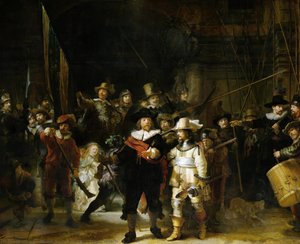 Night Watch - Rembrandt
Born in Leiden in 1606, Rembrandt van Rijn emerged from a modest background to become the preeminent figure of the Dutch Golden Age. His career, which spanned several decades until his death in 1669, exemplifies the creative explosion of the 17th century in the Netherlands. He was a master of both the heavy, tactile application of oil paint and the delicate precision of intaglio printmaking, a versatility that allowed him to capture the profound complexities of the human condition.
His technical mastery is most vibrantly realized in his 1642 masterpiece, Night Watch. In this monumental work, he revolutionized the traditional group portrait by replacing static, formal rows with a sense of organized chaos and mid-motion energy. Through his signature use of chiaroscuro, he pulls figures from deep, murky shadows into theatrical spotlights, creating a dramatic interplay of light and volume. This ability to manipulate illumination to reveal both physical presence and psychological depth remains a defining characteristic of his legacy. From his early training to his most complex compositions, Rembrandt’s work remains a testament to the artistic vitality of the Dutch Republic during this era.
Johannes Vermeer
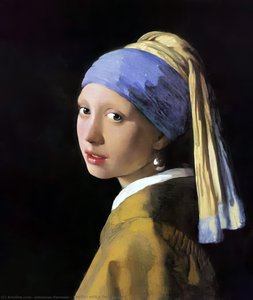 The Girl with a Pearl Earring - Johannes Vermeer
A central figure of the Dutch Golden Age, Johannes Vermeer (1632–1675) represents the pinnacle of 17th century Dutch painting through his unparalleled mastery of light and domestic stillness. Born in Delft, he grew up in an environment steeped in the commerce of art, as his father was both a weaver and an art dealer. This early exposure to the tactile nature of fine fabrics and the mechanics of the pigment trade deeply informed his technical precision. His life in the Netherlands was marked by significant personal shifts, including his marriage to Catharina Bolnes and his conversion to Catholicism, adding layers of complexity to his social standing in a predominantly Protestant city.
Vermeer’s work is defined by a mystical, quiet intensity, most famously captured in The Girl with a Pearl Earring. Created around 1665, this tronie showcases his ability to render luminous skin tones and the exotic textures of a blue and yellow turban using expensive ultramarine. Through the meticulous application of translucent glazes, he achieved a sense of realism that remains a benchmark for the era, turning a simple moment of transition into an eternal study of light and character.
Jacob van Ruisdael
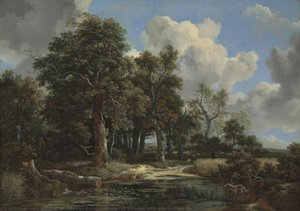 Edge of a Forest with a Grainfield - Jacob van Ruisdael
A central figure among 17th century Dutch painters, Jacob van Ruisdael (1628–1682) redefined the landscape genre through his profound ability to capture the atmospheric essence of the natural world. Born in Haarlem, he was immersed in a lineage of skilled craftsmen, being the son of Isaack van Ruisdael and the nephew of the prominent landscape artist Salomon van Ruysdael. It is widely believed that he received his formal training under his uncle, a connection that deeply rooted his work in the traditions of the Haarlem school. After joining the Haarlem painters' guild in 1648, he eventually moved to Amsterdam, where his reputation as a master of the Dutch Golden Age flourished.
His work is characterized by a sophisticated use of sfumato and a muted palette of greens, greys, and browns, which creates a remarkable sense of depth and contemplative stillness. In his representative work, Edge of a Forest with a Grainfield (c. 1656), Ruisdael demonstrates his mastery of atmospheric perspective, using light and shadow to evoke the quiet power of untamed spaces. His ability to balance intricate detail with expansive, dramatic horizons ensures his place as a premier voice in 17th century Dutch art.
Gerrit Dou
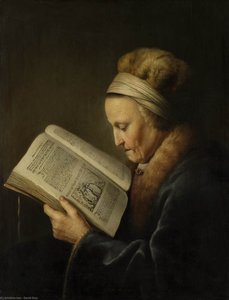 Old Woman Reading a Bible - Gerrit Dou
A central figure of the 17th century Dutch painters, Gerrit Dou (1613–1675) was a pioneer of the Leiden fijnschilder style, a movement defined by an almost obsessive devotion to minute detail. His technical precision was deeply rooted in his upbringing in Leiden; the son of a glazier, he possessed an innate understanding of how light interacts with glass and texture. After training under the copper engraver Bartholomeus Dolendo and studying in a stained-glass workshop, Dou entered the studio of Rembrandt between 1628 and 1631. This apprenticeship was pivotal, as it allowed him to master the dramatic interplay of light and shadow that would characterize his early development before he transitioned into his own highly specialized genre painting.
In his representative work, Old Woman Reading a Bible (c. 1630), Dou demonstrates the hallmark of the Leiden School through a meticulous rendering of materiality. The composition utilizes a shallow perspective to focus the viewer on the tactile qualities of the subject's weathered skin, the heavy folds of her shawl, and the crisp edges of the scripture. Through this refined technique, Dou transformed domestic and spiritual moments into profound studies of light and human presence.
Jan Steen
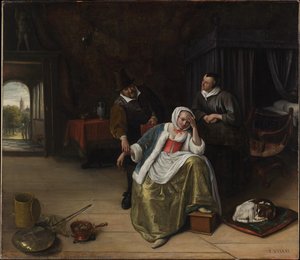 The Lovesick Maiden - Jan Steen
Born in Leiden around 1626, Jan Steen emerged as a vital figure among the 17th century Dutch painters, bringing a unique sense of vitality and human fallibility to the Golden Age. His upbringing in a household run by his father, a brewer and tavern keeper, provided him with an intimate, firsthand understanding of the boisterous social gatherings that would become his signature subject matter. After registering as a master with the Leiden Guild of Saint Luke in 1648, Steen’s career was marked by a restless movement through the urban centers of the Dutch Republic, establishing him as a premier genre painter of his era.
While his technical foundation likely drew from the methods of masters such as Jan van Goyen and Adriaen van Ostade, Steen’s true genius lay in his ability to blend humor with profound psychological insight. His representative work, The Lovesick Maiden (c. 1660), exemplifies this duality. In this composition, he moves beyond mere domestic observation to stage a theatrical drama of social and emotional vulnerability. Through a masterful application of chiaroscuro, Steen illuminates the textures of a private interior, capturing the complex tensions of reputation and romance that defined the human experience in the 17th century Netherlands."
Gabriel Metsu
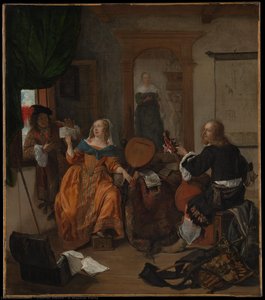 A Musical Party - Gabriel Metsu
In his 1659 masterpiece, A Musical Party, Gabriel Metsu captures a sophisticated tableau of leisure and courtship that epitomizes the social elegance of the Dutch Golden Age. This work serves as a profound window into the refined domesticity of the 17th century, utilizing a warm palette of ochre, deep reds, and rich browns to create an atmosphere of intimate decadence. The composition expertly guides the viewer through a scene of subtle interaction, from the tuning of a viol to the quiet exchange of a songbook, all framed by a window that emphasizes the enclosed, private world of the subjects.
Born in Leiden in 1629, Metsu was a quintessential figure among 17th century Dutch painters, distinguished by his refusal to be confined to a single genre. While many of his contemporaries specialized in one niche, Metsu moved fluidly between grand history paintings, precise still lifes, and intimate genre scenes. His training in the Leiden milieu, influenced by his father’s background in textile design, instilled in him a meticulous eye for detail and texture. Whether depicting the quietude of a domestic interior or the complexity of a portrait, his ability to masterfully manipulate light and perspective remains a testament to his versatile mastery of the oil medium.
Pieter de Hooch
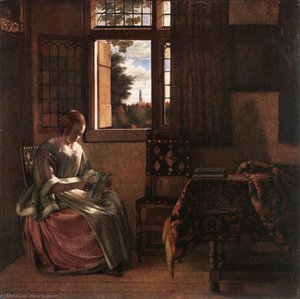 Woman Reading a Letter - Pieter de Hooch
A master of the Dutch Golden Age, Pieter de Hooch (1629–1864) stands as a central figure among 17th century Dutch painters due to his unparalleled ability to transform domestic spaces into profound studies of light and order. Born in Rotterdam to a family of skilled artisans, his technical precision was likely rooted in this early exposure to craftsmanship. After moving to Haarlem to pursue formal training, he studied under the landscape painter Nicolaes Berchem, a period that refined his disciplined observation of the physical world. His professional journey through Rotterdam, Delft, and Amsterdam allowed him to capture the quiet rhythms of everyday existence with a unique, serene naturalism.
De Hooch is celebrated for his sophisticated use of the "see-through-doorway" technique, which creates a sense of spatial depth and interconnectedness within a home. His representative work, Woman Reading a Letter (1664), exemplifies this mastery. In this piece, he invites the viewer into a private moment of quiet contemplation, using soft, streaming light to bathe the subject in a sense of intimacy. Through his focus on the mundane—from correspondence to household tasks—he elevated the domestic sphere to a level of high art, defining the visual language of 17th century Dutch interior life.
Gerard ter Borch
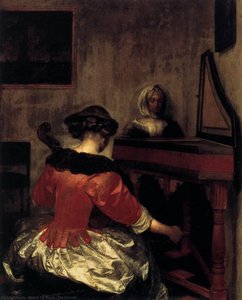 The Concert - Gerard ter Borch
Gerard ter Borch stands as a quintessential figure among 17th century Dutch painters, distinguished by his ability to elevate intimate, domestic scenes into profound psychological studies. Born in Zwolle in 1617, he was raised in an artistic lineage, receiving early instruction from his father before refining his craft in the urban centers of the Dutch Republic. His journey through the artistic hubs of Amsterdam and Haarlem—where he was admitted to the St. Lukas Guild in 1635—allowed him to absorb the technical foundations of the era. His travels through London, France, and Italy, including a period in Rome where he worked on copper, eventually led him to the Spanish court, where he earned knighthood from Philip IV.
A visitor recognizes a ter Borch masterpiece by his exquisite realism and unparalleled mastery of texture. He possessed a rare ability to render the tactile quality of fabrics and the subtle nuances of light with a precision that feels almost sensory. In his representative work, The Concert, this skill is on full display. The painting captures a delicate musical duet within a richly furnished interior, using light and shadow to create a sense of quiet, sophisticated energy. His work remains a testament to the elegance and psychological depth characteristic of the Dutch Golden Age.
Willem van de Velde the Younger
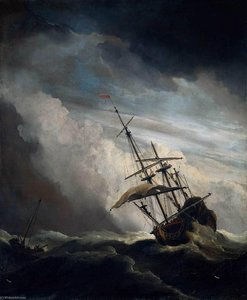 The Gust - Willem van de Velde the Younger
Born in Leiden in 1633, Willem van de Velde the Younger emerged from a lineage of maritime specialists, cementing his place among the most significant 17th century Dutch painters. While his father, Willem van de Velde the Elder, focused on the precise, monochrome documentation of naval vessels, the younger Van de Velde expanded the family's legacy by translating these rigorous draughtsmanship studies into vibrant, atmospheric oil paintings. His technical evolution was shaped by a formal apprenticeship with Simon de Vlieger and the subtle influence of Jan van de Cappelle, particularly regarding the interplay of light and cloud-heavy skies.
His mastery is most profoundly realized in The Gust, a work that exemplifies the dramatic intensity characteristic of the Dutch Golden Age. In this piece, he moves beyond mere ship portraiture to capture the sublime struggle between humanity and the elements. Through a sophisticated use of impasto, he creates a tactile, textured surface that mimics the churning energy of a tempestuous sea. This ability to marry technical nautical accuracy with the emotional weight of a storm allows his work to stand as a powerful testament to the maritime soul of the 17th century Netherlands.
Jan van Goyen
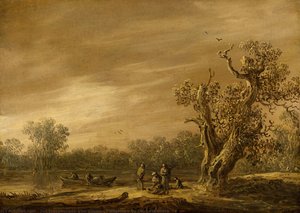 Fishermen by the Lakeshore - Jan van Goyen
A central figure of the 17th century Dutch painters, Jan van Goyen (1596–1656) revolutionized the landscape genre through his mastery of the tonal style. Moving away from the highly saturated palettes of his predecessors, he became a pioneer of atmospheric realism. His training in Leiden and later under Esaias van de Velde in Haarlem allowed him to develop a distinctive approach characterized by a restrained, monochromatic palette of browns, greens, and grays. This technique allowed him to capture the ephemeral qualities of light and moisture in the low-lying Dutch countryside, a hallmark of the Golden Age.
His ability to evoke vast, open spaces through subtle tonal shifts is perfectly exemplified in his 1651 work, Fishermen by the Lakeshore. In this composition, Van Goyen utilizes a sophisticated sense of atmospheric perspective to depict a serene waterscape. The painting focuses on the quiet rhythm of rural life, using a balanced arrangement of figures and natural elements to create a sense of profound stillness. By prioritizing the essence of the atmosphere over flamboyant detail, Van Goyen left a lasting legacy that influenced many subsequent masters, including his pupil Jan Steen.
Conclusion
The Golden Age of the Netherlands produced a visual language that remains unparalleled, defined by the mastery of light, the intimacy of domestic life, and the dramatic tension of the human soul. From the profound psychological depth of Rembrandt and the quiet, luminous stillness of Vermeer to the sweeping, atmospheric landscapes of Jacob van Ruisdael, these artists collectively transformed the way we perceive reality. Whether through the meticulous detail of a genre scene by Jan Steen or the maritime grandeur of Willem van de Velde the Younger, this era captured the essence of a changing world with technical precision and emotional resonance.
At Mus3ums.com, we invite you to bring this legacy of Dutch excellence into your own living space. Our master artists specialize in creating museum-quality, hand-painted oil reproductions that honor the specific textures and brushwork of these 17th-century masters. You can explore our full collection to find the perfect piece and experience the timeless beauty of these masterpieces through a bespoke, handmade work of art.