
Introduction
The 18th century in the United Kingdom marked a transformative era where the visual arts transitioned from rigid formality toward a profound exploration of nature, emotion, and the human condition. As the nation underwent significant social and industrial shifts, a distinct school of thought emerged, moving away from purely aristocratic portraiture toward the sublime landscapes and dramatic narratives that would define a golden age of British creativity. This period saw the birth of a unique aesthetic language, blending the meticulous detail of classical traditions with a burgeoning Romantic sensibility that sought to capture the raw power of the natural world and the complexities of individual character.
What unites these masters is a shared commitment to elevating the status of the artist from a mere craftsman to a profound intellectual and visionary. Through the development of the Royal Academy and the rise of sophisticated art patronage, painters began to experiment with light, texture, and composition in ways that challenged the established hierarchies of the time. Their works do not merely document faces or scenery; they evoke atmosphere and temperament, capturing the very essence of an era caught between Enlightenment reason and the sweeping passion of the Romantic movement.
Today, these artists remain vital because they laid the foundational stones of modern landscape and portraiture. Their influence can be felt in how we perceive the relationship between humanity and the environment, and in the technical mastery of light that continues to inspire painters across the globe. By examining the lives and legacies of these ten seminal figures, we trace the evolution of a national identity expressed through brush and canvas, from the satirical wit of the streets to the ethereal light of the English countryside.
William Blake
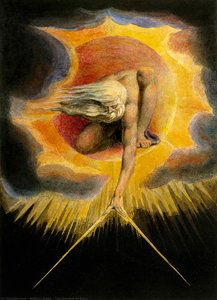 The Ancient of Days - William Blake
A singular visionary of the English Romantic movement, William Blake stands as a defining figure of 18th century British painters due to his profound ability to merge spiritual mysticism with technical precision. Born in London in 1757, his artistic journey began with formal training at Henry Pars' drawing school, followed by a transformative seven-year apprenticeship under the engraver James Basire. This rigorous training in the mechanics of printmaking, combined with his early fascination with the Gothic architecture of Westminster Abbey, allowed him to develop a unique visual language that transcended the standard commercial art of his era.
His masterpiece, The Ancient of Days (1794), serves as a powerful testament to his creative genius. This work, created as a frontispiece for his prophetic text, depicts the figure Urizen within a swirling, circular composition. Through bold, sweeping lines and an intense palette of bronze, orange, and red, Blake captures the tension between divine order and cosmic chaos. His ability to synthesize poetry and relief etching established him as a master of the visionary style, forever altering the trajectory of British art through his exploration of the sublime and the divine.
John Constable
 Stratford Saint Mary from the Coombs - John Constable
Born in 1776, John Constable emerged as a pivotal figure among 18th century British painters, bridging the gap between classical tradition and the emotive depth of Romanticism. His formative years were deeply intertwined with the Stour Valley, where his father’s role as a corn and coal merchant provided him with an intimate, lifelong connection to the rhythms of the river and the Suffolk countryside. This early exposure to the natural world, combined with his formal training at the Royal Academy Schools starting in 1799, allowed him to master both anatomical structure and the subtle nuances of light.
His work is characterized by a profound nostalgia for the landscapes of East Bergholt and Dedham. In his representative work, Stratford Saint Mary from the Coombs (1800), we see the early mastery of a painter who would redefine the English landscape. The composition utilizes a high horizon and a diagonal sweep of grassy slopes to guide the eye toward a distant church spire. Through a palette of olive greens and ochre under a hazy, pale sky, Constable captures a sense of tranquil aerial perspective, establishing the serene, atmospheric style that would become his hallmark.
William Hogarth
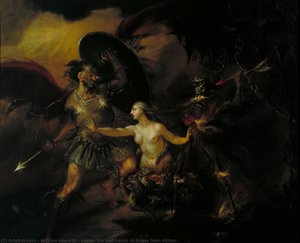 Satan, Sin and Death (A Scene from Milton - William Hogarth
A central figure of 18th century British painters, William Hogarth (1697–1764) transformed the landscape of English art by turning the canvas into a stage for social critique. His perspective was forged in the grit of London, shaped by an early childhood marked by the economic instability of his family and his father's imprisonment in the Fleet Prison. This firsthand observation of the vast divide between social classes allowed him to become a master of satire, using his work to dissect the moral complexities of the growing metropolis.
His ability to weave narrative into visual art is epitomized in his dramatic 1735 work, Satan, Sin and Death. Moving beyond mere illustration of Milton’s epic, this piece serves as a profound moral allegory. Through the personification of Sin as a captivating woman and Death as a skeletal inevitability, Hogarth captures the tension between temptation and consequence. His work remains a cornerstone of the 18th century British satirical movement, bridging the gap between fine art and the biting social commentary that defined the era's intellectual spirit.
J. M. W. Turner
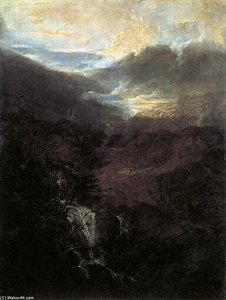 Morning amongst the Coniston Fells - J. M. W. Turner
Born in London in 1775, Joseph Mallord William Turner emerged as a transformative figure within the landscape tradition of the United Kingdom. His journey began in the bustling Covent Garden district, where his father’s work as an art dealer provided him with an early, unforced proximity to visual works. This foundational exposure, combined with his entry into the Royal Academy Schools in 1789, allowed him to refine a raw, prodigious talent into professional mastery. Before fully embracing the expressive potential of the natural world, Turner’s vision was grounded by his work with architects and the topographical precision learned from draughtsman Thomas Malton.
As a defining voice of the late 18th century, Turner’s work represents the evolution from meticulous topographical rendering toward the emotional intensity of Romanticism. His 1798 work, Morning amongst the Coniston Fells, serves as a profound testament to this transition. In this piece, he moves beyond mere description to capture the sublime power of the Lake District. Through a masterful manipulation of light and atmosphere, he uses loose, rapid brushstrokes to evoke the shifting qualities of dawn, prioritizing the visceral impression of nature over photographic likeness.
George Romney
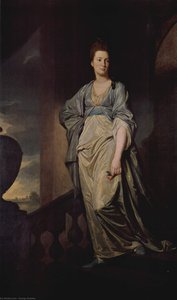 Portrait of Mrs. Verelst - George Romney
In his 1773 Portrait of Mrs. Verelst, George Romney demonstrates the refined elegance that defined his career as a leading figure among 18th century British painters. This work captures a sense of quiet dignity through a masterful command of light and shadow, presenting the subject with a composure that became a hallmark of the Georgian era. Born in Lancashire in 1734, Romney’s journey from a cabinet maker’s apprentice to a celebrated London portraitist reflects the shifting artistic landscape of the United Kingdom during this period.
Romney’s style is characterized by a romantic sensibility and a distinctive, soft-focus technique. Unlike the rigid precision of some contemporaries, he utilized loose, fluid brushwork—particularly when rendering the textures of drapery—to create an atmospheric and graceful effect. His ability to sculpt form through subtle tonal gradations allowed him to navigate the competitive social circles of London, often standing alongside giants like Thomas Gainsborough. His legacy is deeply tied to the development of British Romanticism, particularly through his celebrated depictions of figures such as Emma Hamilton, which solidified his reputation as a master of the elegant portrait.
Thomas Gainsborough
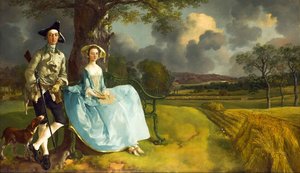 Mr and Mrs Andrews - Thomas Gainsborough
A quintessential figure of the 18th century in the United Kingdom, Thomas Gainsborough (1727–1788) redefined the boundaries of British portraiture by infusing it with a profound sense of naturalism. Born in the market town of Sudbury, his journey from a weaver's son to a master of the Rococo style began with an early move to London in 1740. Under the guidance of the French painter Hubert-François Gravelot, he developed a sophisticated technical foundation that allowed him to blend continental elegance with a uniquely English sensibility.
Gainsborough’s work is instantly recognizable through its luminous skin tones and a brushwork that feels both delicate and atmospheric. He possessed a rare ability to harmonize the human figure with the environment, treating landscapes not as mere backdrops, but as living, breathing extensions of his subjects. This mastery is epitomized in his 1748 masterpiece, Mr and Mrs Andrews. In this work, he seamlessly integrates a double portrait with a sweeping vista of an expansive estate, using light and composition to narrate the prosperity and social standing of the landed gentry. His legacy remains anchored in this tranquil, light-drenched intersection of character and nature."
Joshua Reynolds
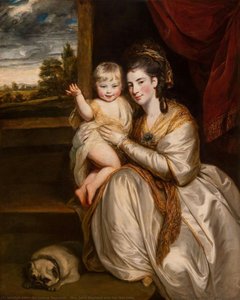 Mrs. John Weyland and Her Son John - Joshua Reynolds
A cornerstone of 18th century British art, Joshua Reynolds (1723–1792) redefined the possibilities of portraiture through his revolutionary concept of the "Grand Style." Born in Devon and trained in London under Thomas Hudson, Reynolds’s vision was profoundly shaped by his transformative travels to Italy, where he absorbed the grace and composition of the Old Masters. As the first President of the Royal Academy, he moved British painting away from mere literal likeness toward an idealized, dignified representation of the human spirit.
His work is instantly recognizable by its luminous, atmospheric light and a sophisticated handling of color that imbues subjects with an air of timeless prestige. In his 1776 masterpiece, Mrs. John Weyland and Her Son John, this mastery is on full display. The painting transcends simple documentation, presenting a serene tableau of Georgian domesticity. Through soft, flowing brushwork and a balanced composition, Reynolds captures a sense of quiet power and familial warmth, elevating a private moment into a monumental expression of character and social grace.
George Stubbs
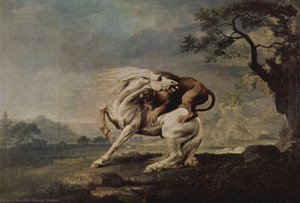 Lion Attacking a Horse - George Stubbs
A central figure among 18th century British painters, George Stubbs (1724–1806) revolutionized the depiction of animals through a unique fusion of scientific precision and Romantic drama. Born in Liverpool, his early life was shaped by his father's work as a currier, providing him with a tactile understanding of animal hides. This foundation, combined with a rigorous study of anatomy under surgeon Charles Atkinson, allowed him to transcend mere imitation. Unlike many of his contemporaries, Stubbs sought to master the internal mechanics of life, capturing the tension of sinew and bone beneath the skin.
His masterpiece, Lion Attacking a Horse (1765), exemplifies this mastery. Inspired by ancient Roman sculpture, the work presents a dramatic confrontation that balances meticulous realism with the emotional intensity of the Romantic movement. Through sophisticated use of light and shadow, Stubbs imbues the struggle with a sense of profound movement and tension. This ability to marry the anatomical accuracy of a scientist with the expressive power of a fine artist secures his legacy as a pioneer of the era, influencing generations of artists through his profound understanding of the natural world.
John Hoppner
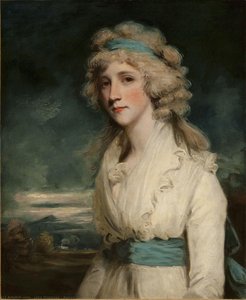 Agnes Coussmaker - John Hoppner
A prominent figure among 18th century British painters, John Hoppner (1758–1810) brought a sophisticated vitality to the portraiture of the Georgian era. Born in London to German parents with ties to the royal court, Hoppner’s artistic journey began at the Royal Academy in 1775. His technical mastery was recognized early through prestigious accolades, including a silver medal for drawing from life and a gold medal for his historical work on King Lear. These achievements paved the way for a career defined by high-society commissions, where his likenesses of figures such as the Prince of Wales and Lord Nelson were displayed in the state apartments at St James's Palace.
Hoppner’s reputation rests heavily on his exquisite ability to capture the grace of women and the innocence of children. His 1788 masterpiece, Agnes Coussmaker, exemplifies this talent, showcasing a luminous use of color and a delicate rendering of texture that became his signature. Through his vibrant palette and command of light, Hoppner secured his place alongside the great masters of the United Kingdom's 18th-century artistic landscape, leaving behind a legacy of refined, character-driven portraiture.
Thomas Lawrence
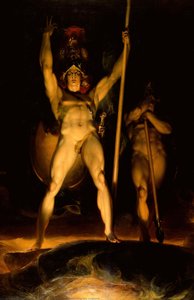 Satan Summoning His Legions - Thomas Lawrence
Born in Bristol in 1769, Sir Thomas Lawrence represents the pinnacle of late 18th-century British portraiture. A child prodigy who began supporting his family with pastel sketches in Bath, he moved to London at eighteen, quickly ascending to the heights of society. His career is defined by a virtuoso technique that captures the elegance and psychological depth of the Regency era, making him a central figure among 18th-century painters from the United Kingdom.
A visitor can recognize a Lawrence original by his fluid, energetic brushwork and a sophisticated handling of light that imbues his subjects with a sense of living character. While he is celebrated for his flattering portraits of the aristocracy, his dramatic range is equally profound. In his 1797 masterpiece, Satan Summoning His Legions, Lawrence moves beyond the social sphere into the realm of the sublime. This monumental work demonstrates his mastery of chiaroscuro, using intense light and shadow to sculpt muscular, tragic figures out of a dark, nebulous void. Through this interplay of movement and atmosphere, Lawrence captures the emotional turbulence of the Romantic spirit, cementing his legacy as a master of both the social portrait and the epic vision.
Conclusion
The masters of this era collectively defined a golden age of British art, moving from the structured elegance of portraiture to the raw, emotive power of landscape and the visionary depths of Romanticism. Whether it was the dramatic light of a Turner seascape, the delicate brushwork of a Gainsborough landscape, or the satirical wit of a Hogarth scene, these artists transformed the visual language of the United Kingdom. Their ability to capture both the grandeur of nature and the nuance of human character ensures their legacy remains vital in the modern era.
At Mus3ums.com, we invite you to bring this historical splendor into your own space. Through our meticulous six-step process, our academic artists create museum-quality, hand-painted oil reproductions that preserve the tactile soul and visible brushstrokes of these 18th-century masterpieces. You can explore our full collection to find the perfect piece and experience the timeless beauty of these legends through art that is crafted to last for generations.


