


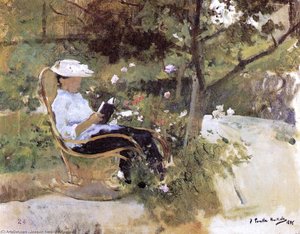

Introduction
The 19th century in Spain was a period of profound transformation, where the shadows of Romanticism met the vibrant, light-drenched energy of Impressionism. This era saw Spanish art move away from the rigid traditions of the Academy toward a more visceral, emotional, and eventually modern way of seeing the world. From the dramatic, dark intensity of the late Romantic period to the luminous, sun-soaked landscapes of the Mediterranean, these artists captured a nation in flux, navigating the tension between historical grandeur and the burgeoning realities of a changing society.
What unites these masters is a unique ability to manipulate light and texture to convey the soul of the Iberian Peninsula. Whether through the psychological depth of a portrait or the fleeting movement of a coastal scene, their work reflects a deep connection to the Spanish identity, blending technical mastery with a raw, expressive power. This period laid the essential groundwork for the avant-garde movements that would eventually reshape global art history, making these painters vital to understanding the evolution of modern visual language.
As we walk through this curated selection, we will encounter the diverse voices that defined this golden age. From the masters of light and color to the pioneers of stylistic revolution, the following ten artists represent the pinnacle of 19th-century Spanish creativity, each offering a distinct window into the heart of a transformative era.
Pablo Picasso
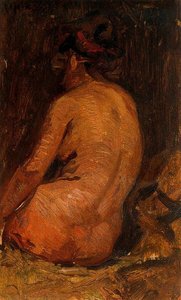 Female nude from back - Pablo Picasso
Born in Málaga in 1881, Pablo Picasso represents the bridge between the classical traditions of the 19th century and the radical modernism of the 20th. His inclusion in this group of 19th century Spanish painters is defined by his formative years in Spain, where his prodigious talent was nurtured under the disciplined guidance of his father, a painter himself. This early training in the Spanish tradition allowed him to master the complexities of figure drawing and the nuances of oil painting long before he would go on to co-found Cubism.
His technical precision was evident even in his youth; by age thirteen, he was already navigating advanced studies in Barcelona, demonstrating a mastery of form that surpassed his peers. A poignant example of this early period is his 1895 work, 'Female Nude from Back'. This piece, executed in oil on canvas, showcases a remarkable command of Realism. Through a warm palette of oranges and reds and a striking red bandana, the young artist demonstrated an ability to create a profound illusion of three-dimensionality and anatomical elegance, marking the beginning of a journey that would forever alter the course of art history.
Francisco Goya
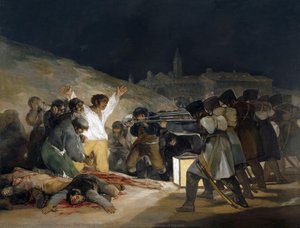 The Third of May 1808 (Execution of the Defenders of Madrid) - Francisco Goya
In his 1814 masterpiece, The Third of May 1808 (Execution of the Defenders of Madrid), the raw brutality of conflict is captured with a visceral intensity that redefined the boundaries of emotional expression. This work serves as a profound chronicle of resistance, immortalizing the victims of the Peninsular War and standing as a stark condemnation of violence rather than a glorification of combat.
As a central figure of 19th century Spanish painters, Francisco Goya transitioned from the technical precision of his early training under José Luzán y Martínez and Anton Raphael Mengs to becoming a transformative force in Romanticism. His journey from the provincial setting of Aragon to the Royal Court in Madrid allowed him to serve as a painter to Charles IV and Ferdinand VII, producing both delicate tapestry designs and hauntingly dark visions. His style is defined by a masterful use of chiaroscuro and expressive, loose brushwork that favors dramatic tension over Neoclassical restraint. Through his ability to navigate the shifting fortunes of the Spanish monarchy, Goya’s legacy remains anchored in his capacity to translate the profound suffering and the indomitable human spirit into enduring visual narratives.
Joaquín Sorolla
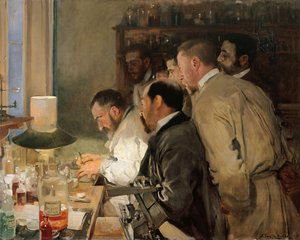 Research - Joaquín Sorolla
A preeminent figure of the 19th century Spanish painters, Joaquín Sorolla brought a breathtaking vitality to the art world through his mastery of Luminism. Born in Valencia in 1863, his journey from an orphaned youth to a celebrated master was shaped by the early guidance of mentors like Cayetano Capuz and José Benlliure. His ability to translate the essence of light onto canvas allowed him to transcend local traditions, establishing a profound presence in Madrid and beyond during the late 1800s.
His representative work, Research (1897), serves as a profound testament to his technical evolution. In this piece, Sorolla moves away from his famous sun-drenched beach scenes to explore a more introspective, dramatic atmosphere. The painting captures Dr. Luis Simarro Lacabra in a laboratory setting, utilizing a sophisticated application of chiaroscuro reminiscent of Rembrandt. By sculpting forms through the intense interplay of light and shadow, Sorolla elevates a scene of scientific observation into a moment of intellectual drama, proving that his genius lay not just in capturing the sun, but in mastering the very soul of light itself.
Eduardo Cano De La Peña
 Christopher Columbus in the Convent of La Rábida - Eduardo Cano De La Peña
A prominent figure among 19th century Spanish painters, Eduardo Cano De La Peña (1823–1897) embodied the dramatic intensity of the Romantic movement. Born in Madrid before settling in Seville, his artistic trajectory was marked by a transition from architectural studies to a profound mastery of oil painting. His career reached a significant turning point during his time in Paris, where he refined his ability to depict grand historical narratives, a hallmark of the era's aesthetic.
His technical precision is most vividly realized in his representative work, Christopher Columbus in the Convent of La Rábida (1856). This piece exemplifies his command of chiaroscuro, using deep shadows and focused light to elevate a moment of intellectual and spiritual tension. Through his ability to render the textures of monastic robes and the metallic sheen of scientific instruments, Cano De La Peña transformed historical chronicles into palpable, living dramas.
Beyond his large-scale compositions, his legacy was cemented through his roles as a professor at the Escuela de Bellas Artes and as the conservator of the Museo de Bellas Artes in Seville. His versatile output, spanning from intimate portraits to detailed engravings, ensures his enduring place in the history of Spanish Romanticism."
José Villegas Cordero
 Examining Antique Arms - José Villegas Cordero
Born in Seville in 1844, José Villegas Cordero stands as a quintessential figure among 19th century Spanish painters, a period defined by the tension between rigid academicism and the luminous allure of Orientalism. His journey from a young talent selling works at the Exposición Sevillana to becoming the Director of the Prado Museum reflects the professional evolution of the Spanish art scene during this era. After studying under Eduardo Cano de la Peña, his style underwent a profound transformation through his association with Mariano Fortuny, which infused his work with a more liberated brushstroke and a fascination with light.
His representative work, Examining Antique Arms (1870), serves as a masterful bridge between his academic training and his later, more atmospheric genre scenes. In this composition, Villegas Cordero utilizes a dramatic chiaroscuro to illuminate the cold, reflective surfaces of historical steel against a backdrop of deep ochres and shadows. The painting captures a moment of quiet, scholarly intensity, showcasing the meticulous attention to texture and materiality that characterized his contribution to the 19th-century Spanish tradition.
Ramon Casas
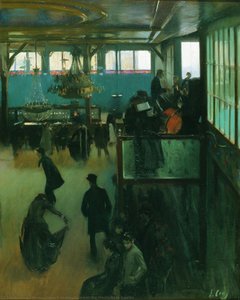 Dance at the Moulin de la Galette - Ramon Casas
A central figure of the 19th century Spanish painters, Ramon Casas i Carbó (1866–1932) emerged from a prosperous Catalan background to become a leading pioneer of the Modernisme movement. His artistic journey began early, abandoning formal schooling at age eleven to study under Joan Vicens, a decision that set the stage for a career defined by technical mastery and social observation. His ability to navigate the elite circles of Barcelona and Paris allowed him to capture the essence of a changing era, blending the precision of Realism with the atmospheric light of Impressionism.
His 1890 masterpiece, Dance at the Moulin de la Galette, serves as a profound testament to his skill in synthesizing these influences. The work transports the viewer into the vibrant, bustling atmosphere of a Parisian dance hall, capturing a spontaneous social gathering with remarkable energy. Through a dynamic composition and a sophisticated use of light, Casas illustrates the leisure of the era's intellectuals and patrons. This piece highlights his capacity to transform a fleeting moment of everyday life into a significant cultural snapshot, cementing his legacy among the most influential Spanish artists of the late 19th century.
Manuel Cabral y Aguado Bejarano
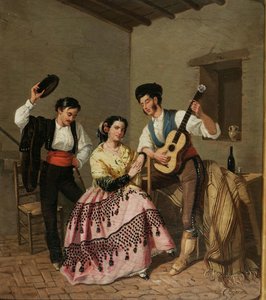 La copla - Manuel Cabral y Aguado Bejarano
Born in Seville in 1827, Manuel Cabral y Aguado Bejarano stands as a quintessential figure among 19th century Spanish painters, specifically through his devotion to the costumbrismo movement. His artistic journey began under the guidance of José Domínguez Bécquer, eventually leading him to the prestigious Real Academia de Bellas Artes de Santa Isabel de Hungría. His work serves as a vital documentary of the era, capturing the soul of Andalusia through a romantic lens that defined much of the Spanish art of the 1800s.
In his evocative masterpiece, La copla (1890), Aguado-Bejarano invites viewers into the amber-hued intimacy of a nineteenth-century tavern. The painting is a sensory triumph, where the rhythmic presence of a guitarist and a contemplative woman evoke the poetic traditions of the Spanish people. Through a masterful command of light and an earthy palette, he transforms a simple social gathering into a profound reflection of cultural identity. His ability to navigate the nuances of both aristocratic portraiture and the vibrant, everyday customs of his homeland ensures his enduring legacy within the history of Spanish Romanticism.
Ignacio Zuloaga
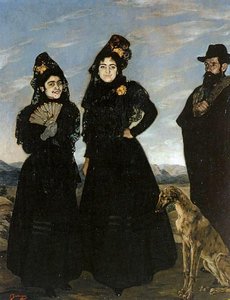 My Uncle and My Cousins - Ignacio Zuloaga
Born in 1870, Ignacio Zuloaga emerged as a pivotal figure in the evolution of Spanish Realism, a movement that defined the visual identity of the nation during the late 19th century. While his early years were shaped by a family of skilled damasceners, his artistic soul was ignited during a transformative journey to Rome and later in the vibrant, post-impressionist atmosphere of Paris. However, rather than remaining a mere observer of French trends, Zuloaga underwent a profound stylistic homecoming. By returning to Spain and immersing himself in the traditions of masters like Velázquez, he transitioned from a student of international modernism to a guardian of his country's cultural essence.
His work is characterized by a melancholic elegance and a deep, earthy palette that captures the tragic beauty of Spanish life. In his 1898 masterpiece, My Uncle and My Cousins, Zuloaga demonstrates his mastery of formal portraiture. The painting utilizes a muted palette of deep blacks and subtle beiges to depict a scene of dignified social hierarchy. Through precise composition and atmospheric perspective, he elevates a family tableau into a profound study of Spanish societal structure and quiet contemplation.
Ignacio Pinazo Camarlench
 In his final moments, King Jaime el Conquistador gives his sword to his son, Pedro - Ignacio Pinazo Camarlench
A pivotal figure in the evolution of Spanish art, Ignacio Pinazo Camarlench represents the transformative shift from rigid academicism to the luminous Impressionism that would later define the late 19th century. Born in Valencia in 1849, his journey from a humble background—working as a silversmith and fan decorator—to the prestigious San Carlos Academy of Fine Arts highlights the intense dedication required of Spanish masters of this era. His stylistic evolution was profoundly shaped by his time in Rome, where he moved away from traditional historical themes toward a more intimate, light-drenched approach to daily life and landscapes.
His technical mastery is exemplified in the 1881 work, In his final moments, King Jaime el Conquistador gives his sword to his son, Pedro. This piece serves as a vital bridge in his career, showcasing his ability to handle complex historical narratives with the precision demanded by his patrons. Through a sophisticated use of chiaroscuro and a somber palette of ochres and deep browns, Pinazo captures a heavy, dramatic moment of dynastic succession. This work demonstrates how he could balance the gravity of Academic Realism with the rapid, expressive brushwork that would eventually pave the way for the next generation of Spanish painters.
Mariano Fortuny Marsal
 African Chief - Mariano Fortuny Marsal
A true polymath of the 19th century, Mariano Fortuny Marsal (1838–1874) represents the extraordinary intersection of fine art, textile design, and scientific curiosity. Born into an illustrious Spanish lineage of painters, he inherited a profound sensitivity to texture and light that would define his unique aesthetic. His work is instantly recognizable by its luminous quality and a tactile, sensory approach to surface and substance, often bridging the gap between historical grandeur and modern innovation.
In his 1870 masterpiece, African Chief, Fortuny demonstrates a masterful command of light and shadow. The composition centers on a powerful figure whose regalia is rendered with vigorous, gestural brushstrokes. He utilizes a thick, tactile impasto to capture the highlights of white fabric, creating a physical presence that commands attention against a serene, pale blue sky. The landscape, composed of deep earthy tones, is built through energetic patches of color rather than rigid outlines, showcasing an almost impressionistic sensitivity to natural light.
His legacy remains a testament to the Spanish artistic tradition, evolving from his father's Orientalist sensibilities into a revolutionary vision that transformed how we perceive the interplay of color, material, and atmosphere.
Conclusion
The 19th century was a transformative era for Spanish art, a period where the dramatic shadows of the previous century met the vibrant light and experimental spirit of modernity. From the profound emotional depth of Goya to the luminous, sun-drenched seascapes of Sorolla, these masters collectively redefined the visual language of their nation. Whether through the meticulous realism of the early century or the bold, avant-garde shifts that paved the way for the 20th century, these artists captured the soul of Spain through light, texture, and intense human expression.
At Mus3ums.com, we invite you to bring this rich heritage into your own living space. Our artisans specialize in creating museum-quality, hand-painted oil reproductions that honor the specific brushwork and tonal depth of these legendary masters. You can explore the diverse styles of these creators in our full collection and find a piece that resonates with your personal aesthetic. Transform your home with a timeless masterpiece that celebrates the enduring legacy of Spanish art.


