Introduction
The 20th century in Argentina marked a profound era of visual transformation, as the nation's artistic landscape shifted from traditional academicism toward the radical energies of modernity. Within this vibrant period, a generation of creators began to navigate the tension between local identity and the burgeoning international avant-garde, blending South American sensibilities with movements like Cubism, Surrealism, and Abstract Expressionism. This era was defined by a restless search for a new language, one that could capture the rapid urbanization of Buenos Aires and the deep, soulful complexities of the Argentine spirit.
These artists matter today because they did not merely follow European trends; they reinvented them. By experimenting with new materials, spatial dimensions, and social themes, they established a visual vocabulary that continues to influence contemporary art across the globe. Their work serves as a vital bridge between the classical past and the experimental future, offering a profound look into how culture evolves through the lens of individual genius and collective social change.
The following selection explores the diverse trajectories of this movement, from the spatial provocations of Lucio Fontana and the social realism of Antonio Berni to the geometric precision of Emilio Pettoruti. Through these ten masters, we trace the evolution of a movement that redefined the boundaries of the canvas and the very essence of Argentine modernism.
Lucio Fontana
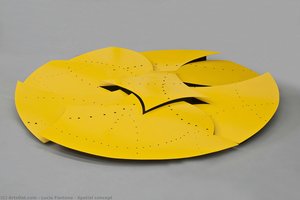
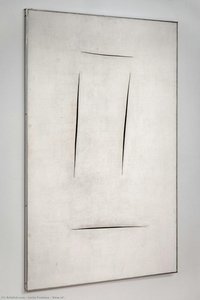
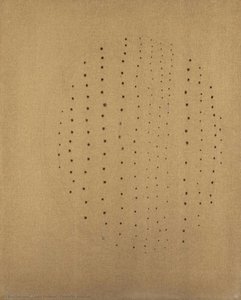
 Concetto spaziale - Lucio Fontana
Born in Rosario, Argentina, in 1899, Lucio Fontana stands as a pivotal figure among 20th century Argentine painters due to his radical departure from traditional representation. His artistic identity was forged at the intersection of his Argentine roots and his Italian heritage, a dual perspective that allowed him to reimagine the physical boundaries of art. Having begun his training under his father, the sculptor Luigi Fontana, he developed a profound understanding of the tactile weight of material, which eventually led him to challenge the very surface of the canvas.
As the founder of Spatialism, Fontana moved beyond the two-dimensional plane to explore the concept of space itself. His most revolutionary contribution involved the deliberate disruption of the picture plane, using incisions to puncture the barrier between the painting and the infinite void beyond. His 1967 work, Concetto spaziale, exemplifies this mastery, utilizing architectural incisions to transform the canvas into a portal. By treating the canvas as a three-dimensional object rather than a mere surface for pigment, Fontana irrevocably altered the trajectory of mid-century abstraction and redefined the possibilities of modern art.
Antonio Berni
 Colla Market or Andean Mountain Market - Antonio Berni
A central figure of 20th century Argentine painters, Antonio Berni (1905–1981) redefined the nation's visual language through the lens of Nuevo Realismo. His work is instantly recognizable by its profound tactile quality and its unflinching commitment to social reality. Berni moved beyond mere representation, often utilizing collage and complex textures to capture the visceral struggles of marginalized communities and the rapid industrialization of his homeland.
His mastery of composition is exemplified in the mural Colla Market or Andean Mountain Market (1936). In this significant work, Berni employs a cinematographic approach, using close-ups and detailed perspectives to render characters as individual portraits. The piece serves as a powerful testament to his Americanist concerns, exalting the indigenous peoples of northern Argentina, Chile, Peru, and Bolivia. Through vibrant depictions of their colorful clothing and commerce, he elevates the archetypes of Andean culture into monumental art. Whether through large-scale murals or his later, iconic depictions of the character Juanito Laguna, Berni’s brushwork remains deeply connected to the material and social essence of the Argentine experience.
Marta Minujín
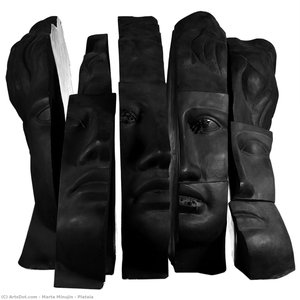 Plataia - Marta Minujín
A central figure of the Latin American avant-garde, Marta Minujín represents the radical shift in 20th century Argentine painters and artists who moved beyond the traditional canvas to embrace the ephemeral. Born in Buenos Aires in 1943, her creative trajectory was profoundly shaped by her studies at the National University Art Institute and a transformative period in Paris during the 1960s. It was there that she challenged the sanctity of the art object through provocative "happenings," such as the daring La Destrucción, where she invited participants to dismantle a labyrinth of mattresses, critiquing consumer culture through direct action.
Her evolution from these participatory performances to complex sculptural investigations is epitomized in her 1998 work, Plataia. This installation deconstructs the human form into seven vertical, overlapping panels made of painted plaster, Styrofoam, and enamel. By slicing and reassembling facial features, the work explores the tension between individual identity and collective memory. Through this fragmentation, Minujín continues to push the boundaries of Argentine modernism, transforming the viewer's perception of the human visage into a structural, monochromatic study of form and social experience.
Albert Emile Artigue
 Corner of the cemetery - Albert Emile Artigue
Albert Emile Artigue stands as a vital bridge between the academic traditions of the Old World and the evolving artistic landscape of the 20th century in Argentina. Born in Buenos Aires to French parents, his life and work embodied a cultural duality that defined much of the era's sophisticated output. After receiving rigorous training in Bordeaux and studying under the esteemed Alexandre Cabanel, Artigue brought a profound mastery of form and light back to his birthplace. His influence was cemented through his role as a professor at the Académie nationale des beaux-arts de Buenos Aires, where he helped shape the pedagogical foundations for subsequent generations of Argentine artists.
His oeuvre is characterized by a transition from the exotic allure of Orientalism to the refined grace of the Belle Époque. In his 1922 work, Corner of the Cemetery, Artigue demonstrates a masterful command of atmosphere, utilizing a soft, impressionistic touch to transform a somber setting into a scene of profound peace. Through the delicate interplay of light and shadow, he captures a tranquil, historical tableau that reflects the serene, contemplative spirit of early 20th-century Argentine art.
Eileen Agar
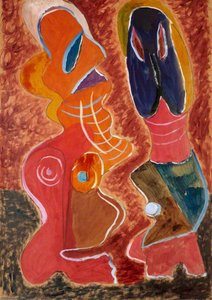 An Abstract Composition with Two Anthropomorphic Figures - Eileen Agar
In An Abstract Composition with Two Anthropomorphic Figures, the viewer is thrust into a dreamlike realm where the boundaries between the organic and the imagined dissolve. This 1940 work exemplifies the artist's ability to weave together biomorphic forms and a sense of profound mystery. Born in Buenos Aires in 1899, Eileen Agar is a vital figure in this collection of 20th century Argentine painters, representing the international reach of the nation's creative diaspora. Her early years in Argentina provided a foundational cultural backdrop before her relocation to London and subsequent transformative studies in Paris.
Agar’s visual language is characterized by a playful, intuitive engagement with the subconscious, moving away from rigid manifestos toward a more sensory exploration of the unconscious. Her technique often involved innovative collages and a fascination with objects that bridge the gap between reality and the surreal. Her palette and compositions frequently evoke a sense of the uncanny, utilizing shapes that suggest life without strictly adhering to anatomical reality. Through her unique blend of sculptural sensibility and painterly intuition, she remains a pioneering force in the avant-garde movements of the century.
Eugenia Belín Sarmiento
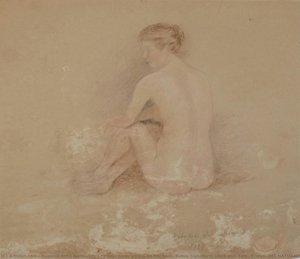 Female nude sitting on her back. Below signature, place and date, it says: DEL NATURAL - Eugenia Belín Sarmiento
Eugenia Belín Sarmiento represents a vital link in the evolution of Argentine art, bridging the transition from 19th-century traditions into the stylistic shifts of the 20th century. Born in 1860, her career flourished as the artistic landscape of Argentina began to embrace modern European movements. She is particularly noted for her ability to infuse Impressionistic techniques—such as visible brushstrokes and a focus on atmospheric light—with a meticulous, classical attention to detail. This unique synthesis allowed her to move beyond mere likeness, capturing the psychological depth of her subjects, including intimate portraits of her grandfather, the former President Domingo Faustino Sarmiento.
Her technical mastery is profoundly displayed in the 1919 work, Female nude sitting on her back. Below signature, place and date, it says: DEL NATURAL. In this evocative piece, Sarmiento utilizes a sophisticated monochrome palette of blacks, whites, and silvery greys to emphasize the sculptural quality of the human form. By stripping away color, she focuses the viewer's attention on the rhythmic dance of light and shadow across the skin, creating a sense of profound stillness and introspection. Her work remains a significant testament to the sophisticated portraiture and expressive studies that defined the early 20th-century Argentine aesthetic.
Xul Solar
 City and Abysses - Xul Solar
A central figure of the Argentine avant-garde, Xul Solar remains one of the most enigmatic voices among 20th century Argentine painters. Born Oscar Agustín Alejandro Schulz Solari in 1887, his work emerged from a cosmopolitan upbringing and extensive travels through European cultural hubs like Paris and Milan. This international exposure, combined with his deep interest in mysticism and the occult, allowed him to transcend mere imitation of European movements to create a singular, visionary language. He was a vital member of the influential "Florida Group" in Buenos Aires, contributing to the intellectual ferment that defined the nation's modern art scene during the first half of the century.
His practice was characterized by a fascination with light and universal energy, a concept reflected in his very name. Moving between watercolor, tempera, and oils, his compositions often merged geometric abstraction with esoteric symbolism. In his 1946 work, City and Abysses, we see the profound chromatic reduction and architectural complexity that defined his mature period. Through his explorations of sacred geometry and spiritual landscapes, Solar bridged the gap between the tangible world and the metaphysical, leaving an indelible mark on the history of Latin American modernism.
Emilio Pettoruti
 Centripetal Force - Emilio Pettoruti
A central figure in the evolution of Argentine modernism, Emilio Pettoruti redefined the visual language of 20th century Argentine painters by bridging the gap between European avant-garde movements and a distinctly Latin American sensibility. His work serves as a vital link in the country's artistic history, moving away from traditionalism toward a sophisticated, geometric abstraction that captured the pulse of a changing era.
Pettoruti's journey began in La Plata, where his early studies in drawing and caricature provided a foundation for his later, more radical explorations. His time in Florence was transformative; there, he immersed himself in the study of Renaissance masters like Masaccio and Giotto, while simultaneously absorbing the dynamic, energetic spirit of Futurism. This unique synthesis of classical equilibrium and modern motion is masterfully captured in his representative work, Centripetal Force.
In this piece, the artist explores the tension between translucent planes and spiral shapes. The composition is organized around a central point, creating a sense of inward movement that draws the eye into a rhythmic, structural dance. Through his precise use of line and form, Pettoruti established a legacy of clarity and geometric elegance that remains a cornerstone of Argentine art history.
León Ferrari
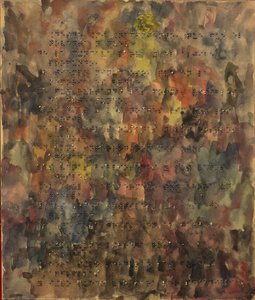 Blind man - León Ferrari
A central figure in the landscape of 20th century Argentine painters, León Ferrari (1920–2013) utilized art as a profound vehicle for social and political dissent. His work is instantly recognizable by its conceptual rigor and its ability to weave provocative symbolism into complex compositions. Whether working with oil on paper or exploring large-scale installations, Ferrari’s aesthetic often balances a haunting, painterly quality with a sharp, intellectual edge, frequently addressing themes of imperialism, religious dogma, and the tensions of modern civilization.
In his 1995 work Blind Man, this mastery of conceptual layering is vividly displayed. The piece features a central figure with eyes closed, creating a sense of profound internal stillness amidst a chaotic, atmospheric tapestry of multilingual text and numerical symbols. This juxtaposition of the silent, meditative subject against a whirlwind of linguistic fragments creates a visual hum, challenging the viewer to look beyond mere sight toward a deeper, cerebral perception. Through such works, Ferrari established himself as a vital voice in Argentine art, using the canvas to confront the noise of the modern world and the complexities of the human psyche.
Alfredo Guttero
 Nude - Alfredo Guttero
In his 1924 work Nude, Alfredo Guttero demonstrates a profound mastery of form and a sensual approach to composition. This piece, rendered with delicate precision, exemplifies the artist's ability to balance naturalist figuration with a highly decorative sensibility. His palette often leans toward warm, earthy tones, such as rosy browns, which lend a quiet prestige to his subjects.
A pivotal figure among 20th century Argentine painters, Guttero’s influence extended far beyond the canvas. After studying in Paris under Maurice Denis and traveling extensively through Europe, he returned to Argentina in 1927 to become a vital promoter of modernism. He was instrumental in bridging the gap between European avant-garde trends—such as Post-Impressionism and early Cubism—and the burgeoning local scene. His unique technical contributions, including the use of the yeso cocido technique, and his focus on kinetic figures and industrial landscapes, helped redefine the visual language of his homeland. Whether capturing the rhythmic energy of modern life or the soft contours of the human form, Guttero’s legacy remains deeply woven into the fabric of Argentine modern art history.
Conclusion
The 20th century was a transformative era for Argentine art, defined by a restless spirit of innovation that bridged the gap between traditionalism and the avant-garde. From the spatial provocations of Lucio Fontana to the social realism of Antonio Berni and the geometric precision of Emilio Pettoruti, these artists collectively redefined the visual language of South America. Whether through the surrealist dreamscapes of Xul Solar or the bold, pop-influenced energy of Marta Minujín, each painter contributed a unique layer to a national identity that was constantly evolving, experimenting with texture, form, and the very boundaries of the canvas.
For those looking to bring this rich heritage into their own spaces, Mus3ums.com offers a way to honor these masters. You can explore our full collection to find your favorite pieces. We invite you to live with these historic movements through our museum-quality, hand-painted oil reproductions, each meticulously crafted by expert artists to capture the authentic soul and brushwork of these Argentine legends.