Introduction
The 20th century marked a profound metamorphosis for the Dutch artistic identity, as the nation transitioned from the traditionalist roots of the Hague School toward the radical abstractions and expressive distortions of the modern era. This period was defined by a tension between the meticulous observation of light and form and a revolutionary desire to deconstruct reality into its most essential elements. From the structured geometry of De Stijl to the raw, gestural energy of post-war abstraction, these artists navigated a world in flux, redefining how space, color, and emotion could coexist on a canvas.
Cultural shifts across Europe catalyzed this evolution, pushing Dutch masters to move beyond mere representation. While some sought to capture the fleeting atmosphere of urban life, others dismantled the very concept of the subject, favoring the pure rhythm of lines and primary colors. This era was not merely a change in style, but a fundamental rethinking of the relationship between the artist and the visual world, bridging the gap between the classical heritage of the Old Masters and the experimental spirit of the avant-garde.
Today, the legacy of these painters remains vital, as their explorations into abstraction and expressionism continue to influence contemporary visual language and interior aesthetics. Their ability to balance order with chaos, and stillness with movement, ensures their relevance in a modern world that still seeks both structure and spontaneity. The following selection highlights ten pivotal figures who shaped this transformative century, ranging from the architects of modernism to the masters of expressive portraiture and landscape.
Piet Mondrian
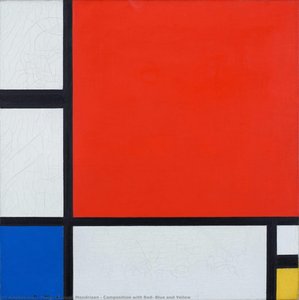
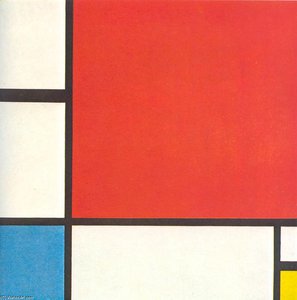 Composition with Red, Blue and Yellow - Piet Mondrian
Piet Mondrian stands as a transformative figure among 20th century Dutch painters, having fundamentally reshaped the visual language of modernism. Born in Amersfoort in 1872, his journey began with the naturalistic landscapes of the Netherlands, but his intellectual evolution led him toward a radical abstraction that defined the era. After training at the Rijksakademie van Beeldende Kunsten in Amsterdam, Mondrian transitioned from his early impressionist roots toward the development of Neoplasticism, a movement that sought to map the underlying structures of existence through pure geometry.
His 1930 masterpiece, Composition with Red, Blue and Yellow, serves as a definitive testament to this evolution. In this work, Mondrian moves entirely beyond representation, utilizing a rigorous system of straight lines and right angles to create a dynamic, balanced asymmetry. By restricting his palette to the primary colors—red, blue, and yellow—set against a field of white and delineated by bold black grids, he achieved a sense of universal harmony. This shift from the quietude of his Dutch upbringing to the rhythmic, geometric precision of his mature style marks him as a central architect of 20th-century abstraction.
Willem de Kooning
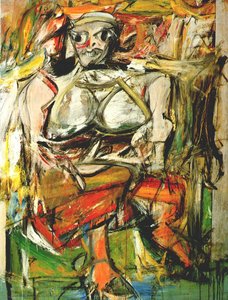 Woman I - Willem de Kooning
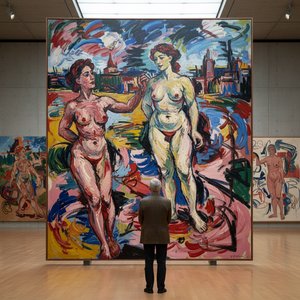
Born in Rotterdam in 1904, Willem de Kooning stands as a monumental figure among 20th century Dutch painters. His journey from the Netherlands to the urban grit of New York City defined a career that bridged the gap between traditional craftsmanship and the raw, gestural energy of the New York School. After leaving formal schooling at twelve to apprentice in commercial art, he transitioned from the physical labor of a carpenter to the intense, expressive demands of the canvas, eventually becoming a pioneer of Abstract Expressionism.
His work is characterized by a continuous negotiation between structure and chaos. In his iconic 1952 masterpiece, Woman I, he deconstructs the human form through vigorous brushstrokes and thick impasto. This piece exemplifies his ability to move beyond mere representation, using a fragmented language of form to articulate the complexities of the human psyche. Unlike the more serene traditions of his predecessors, de Kooning’s approach is visceral and unapologetically powerful, leaving a lasting legacy that reshaped the landscape of modern art through his spontaneous and emotive application of paint.
Lawrence Alma-Tadema
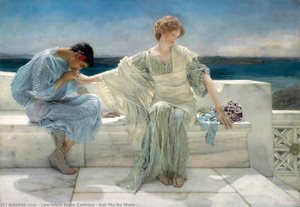 Ask Me No More - Lawrence Alma-Tadema
Born in Dronryp, Friesland, Lawrence Alma-Tadema remains a profound link to the Dutch artistic legacy within the 20th-century landscape. Although his training began in the 19th century at the Royal Academy of Antwerp under the mentorship of Louis Jan de Taeye, his influence and continued production into the early 1900s solidified his status as a master of Academic Classicism. His ability to breathe life into antiquity ensured his relevance well into the 20th century, bridging the gap between traditional meticulousness and the evolving tastes of a new era.
His 1906 masterpiece, Ask Me No More, serves as a quintessential example of his technical brilliance. The work captures a moment of serene classical romance, featuring a woman with a bouquet and a kneeling man set against a breathtaking marble balustrade. Through a soft, muted palette of light blues and translucent whites, Alma-Tadema achieves a dreamy, tranquil atmosphere. His mastery of light and shadow creates a lifelike quality in the drapery and textures, transporting the viewer to a world of idealized Roman elegance and timeless grace.
Theo van Doesburg
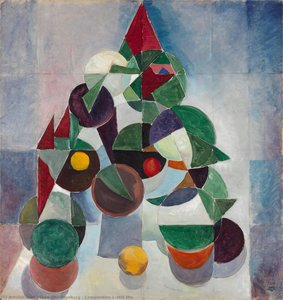
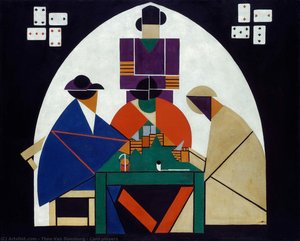 Card players - Theo van Doesburg
A central figure in the landscape of 20th century Dutch painters, Theo van Doesburg (1883–1931) acted as a revolutionary architect of abstraction. His artistic evolution represents a profound shift in the Dutch avant-garde, moving from the emotional intensity of Post-Impressionism toward a radical, spiritualized geometry. This transition was catalyzed by his encounter with the writings of Wassily Kandinsky, which prompted him to abandon the replication of the external world in favor of a universal visual language.
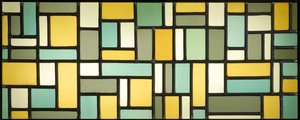
As the founder of the De Stijl movement, van Doesburg championed Neoplasticism, a philosophy that sought harmony through the most essential elements: straight lines, right angles, and a strict palette of primary colors—red, yellow, and blue—balanced against black, white, and gray. His seminal work, Card Players (1917), serves as a vital bridge in this journey. In this piece, the human form begins to dissolve into a series of interlocking, simplified shapes and color blocks, marking a decisive departure from representation toward pure abstraction. By stripping art down to its cosmic essence, van Doesburg ensured his place as a visionary who redefined the relationship between painting, architecture, and design during the 20th century.
Isaac Israëls
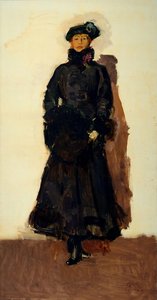 Portrait of Mata Hari - Isaac Israëls
A visitor can immediately recognize the hand of Isaac Israëls through his spontaneous, rapid brushwork and a profound ability to capture the fleeting energy of modern life. His canvases are characterized by loose, impressionistic strokes and a vibrant palette that emphasizes the interplay of light and shadow in urban settings. Moving away from the traditional landscapes of his father, Jozef Israëls, he became a central figure of Amsterdam Impressionism, focusing on the bustling atmosphere of cafes, street scenes, and the glamour of the city's nightlife.
His place among 20th century Dutch painters is cemented by his role in documenting the social shifts of the era, transitioning from the Hague School traditions into a more modern, emotionally charged style. This is masterfully exemplified in his 1916 Portrait of Mata Hari, where he captures the exotic allure of the celebrated dancer. Through a sophisticated handling of paint, he avoids photographic rigidity, opting instead to convey the shimmering textures of silk and the subtle tension of a poised, modern icon. Whether depicting the seaside of Scheveningen or the sophisticated interiors of Amsterdam, Israëls’ work remains a testament to the vibrant, evolving spirit of the Netherlands at the turn of the century.
Charles Warren Eaton
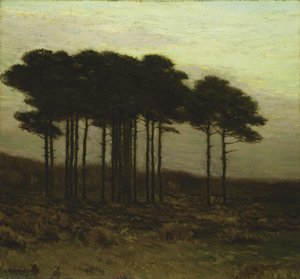 November Landscape - Charles Warren Eaton
In his 1910 work November Landscape, the quietude of the natural world is captured through a masterful command of atmosphere. This piece exemplifies the Tonalist approach, utilizing a subdued palette and a rhythmic arrangement of silhouetted forms to evoke a sense of profound stillness. The composition relies on the interplay of light and shadow, where the fading warmth of a sunlit sky meets the deep, phthalo green of a forest canopy, creating a scene that feels both intimate and expansive.
Charles Warren Eaton (1854–1935) was a Dutch-born painter whose artistic journey spanned the transition into the 20th century, making him a significant figure among 20th century Dutch painters. His work is characterized by a serene, almost spiritual engagement with the landscape, often focusing on the evocative textures of rural life and the structural elegance of trees. Rather than seeking photographic precision, Eaton employed loose, moody brushwork to capture the essence of his subjects, particularly his iconic depictions of pines. His ability to translate the ethereal light of dawn or dusk into a decorative, patterned composition reflects a sophisticated understanding of tonal harmony, ensuring his legacy remains a vital part of the Dutch artistic tradition during this era.
George Hendrik Breitner
 MCJ (Marie) Jordan (1866-1948), The Artist's Wife - George Hendrik Breitner
George Hendrik Breitner stands as a transformative figure among 20th century Dutch painters, bridging the gap between traditional realism and the energetic pulse of modern urban life. Born in 1857, his artistic journey was shaped by a restless spirit that often clashed with academic rigidity, leading to his departure from the Hague Academy of Fine Arts. Rather than following a conventional path, Breitner embraced a self-directed evolution that eventually established him as the leading exponent of Amsterdam Impressionism.
His work is defined by a cinematic eye, often capturing the fleeting, raw energy of the city's streets. This commitment to observing the unvarnished truth of everyday existence allowed him to redefine the visual language of the Netherlands during the turn of the century. In his notable work, MCJ (Marie) Jordan (1866-1948), The Artist's Wife, we see his mastery of atmosphere. The piece utilizes a somber, muted palette of earthy umbers and deep blacks, employing a dramatic chiaroscuro effect to pull the subject from an impenetrable gloom. Through bold, visible brushstrokes and a profound sense of intimacy, Breitner captured the soul of a changing era.
Jozef Israëls
 Scene in Laren, North Holland - Jozef Israëls
A visitor can immediately recognize the work of Jozef Israëls through his profound ability to capture the melancholic dignity of everyday existence. His canvases are characterized by an earthy, tonal palette—often dominated by deep espresso shadows and muted, atmospheric light—that evokes a sense of quietude and introspection. Eschewing the dramatic flair of Romanticism, his brushwork serves a poignant realism, focusing on the textures of weathered wood, damp earth, and the humble garments of the working class.
Though his career began in the 19th century, Israëls remains a vital figure in the context of 20th century Dutch painters due to his foundational influence on the Hague School and the continued relevance of his realist mastery into the early 1900s. His work, such as the 1905 piece Scene in Laren, North Holland, exemplifies this enduring legacy. In this composition, he utilizes a dark, textured interior to frame a transition between a shadowed threshold and the pale light of the North Holland landscape. Through such compositions, Israëls immortalized the solitary, quiet moments of rural life, bridging the gap between traditional realism and the atmospheric sensibilities that would define Dutch art well into the next century."
Petrus Van der Velden
 Storm at Wellington Heads - Petrus Van der Velden
A viewer can immediately recognize the work of Petrus Van der Velden through his profound ability to capture the restless, dramatic energy of the sea. His brushwork is characterized by an expressive, almost visceral application of paint, often utilizing a striking tension between light and shadow to convey the weight of the atmosphere. His palette frequently leans into deep, moody tones that emphasize the raw power of maritime environments, moving away from static tradition toward a more emotive realism.
Although his training began in the 19th century at the Rotterdam Academy of Fine Arts, Van der Velden remains a vital figure in the context of 20th century Dutch painters due to his enduring influence and the continued relevance of his late-career works. His emigration to New Zealand in 1890 allowed him to expand his Dutch maritime roots into a new landscape of harbor scenes and rugged coastlines, bridging the gap between European traditions and a more modern, atmospheric approach to nature.
In his evocative work, Storm at Wellington Heads, he masterfully depicts the sublime chaos of a southerly gale. The painting captures the churning ocean and the struggle of human figures against the elements, illustrating the terrifying, restless energy that defined his artistic legacy.
Joseph Eduard Adolf Spier
 Terezin: Staff - Joseph Eduard Adolf Spier
Joseph Eduard Adolf Spier stands as a profound figure among 20th century Dutch painters, a creator whose artistic journey transitioned from the whimsical to the deeply poignant. Born in the Netherlands in 1900, Spier initially gained fame for his humorous illustrations and courtroom sketches, capturing the social pulse of the era with a satirical wit. However, the turbulence of the mid-20th century fundamentally reshaped his vision. Following his arrest for political satire, he was held in the Theresienstadt concentration camp, an experience that infused his work with a heavy, contemplative gravity.
This shift is masterfully captured in his 1943 work, Terezin: Staff. In this evocative piece, Spier moves beyond mere illustration to explore the resilience of the human spirit. The painting depicts a fragmented community gathered near a red-roofed building, where the interplay of light and shadow creates an atmospheric tension. Through his skilled use of line and tone, he transforms a somber moment of historical reality into a timeless study of stillness and endurance. His ability to navigate such extreme emotional landscapes marks him as a vital voice in the Dutch artistic canon of the 1900s.
Conclusion
The evolution of 20th-century Dutch art represents a profound journey from the textured, atmospheric realism of the late Impressionists to the radical, geometric abstractions that redefined modernism. Whether through the structured precision of Mondrian and Van Doesburg or the expressive, gestural energy of Willem de Kooning, these artists transformed the visual language of the era, leaving behind a legacy that continues to influence contemporary aesthetics. From the intimate, light-filled scenes of the early century to the bold, experimental movements that followed, this group of masters captured the shifting spirit of a nation in transition.
At Mus3ums.com, we invite you to bring these historical movements into your own living space. Our master artists specialize in creating museum-quality, hand-painted oil reproductions that capture the authentic brushstrokes and depth of these iconic works. You can explore our full collection to find the perfect piece and experience the tactile beauty of these Dutch masterpieces in your home.