Introduction
The 20th century in Mexico was a period of profound cultural rebirth, where the canvas became a battlefield for identity, revolution, and social transformation. Following the upheaval of the Mexican Revolution, a powerful movement emerged that sought to reclaim the nation's indigenous roots and monumental history, moving away from European academicism toward a visual language that was uniquely and unapologetically Mexican. This era was defined by a vibrant fusion of pre-Columbian symbolism and modern social realism, creating a legacy that reshaped the global perception of Latin American art.
What unites these masters is a shared commitment to storytelling through color and form. Whether through the intimate, psychological depth of personal portraiture or the sweeping, epic scale of public murals, these artists transformed the act of painting into a tool for political and cultural awakening. Their work does not merely decorate a space; it captures the soul of a people navigating the complexities of modernity, tradition, and struggle.
Today, the influence of this movement remains palpable, resonating through contemporary art and continuing to inspire collectors who seek works with deep historical weight and emotional intensity. By examining the lives and legacies of the most significant figures of this period, we gain a clearer understanding of how art can shape a national consciousness. The following profiles explore the diverse voices—from the monumental muralists to the evocative surrealists—that defined this golden age of Mexican creativity.
Frida Kahlo
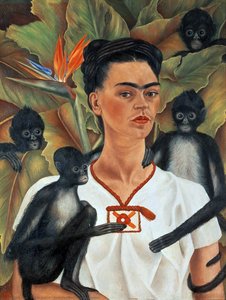 Self-Portrait with Monkeys - Frida Kahlo
Born in 1907 in Coyoacán, Frida Kahlo remains a central figure among 20th century Mexican painters, her life and work deeply intertwined with the cultural and personal complexities of her era. Her artistic journey was forged in the crucible of physical suffering; following a catastrophic bus accident in 1925 that left her with lifelong injuries, she turned to painting as a means of navigating a reality defined by medical intervention and chronic pain. This resilience transformed her into a master of self-portraiture, using the canvas to document the internal landscape of her own existence.
In her 1943 work, Self-Portrait with Monkeys, we see the profound intersection of her biological reality and her symbolic language. The painting serves as a window into her psyche, blending meticulous realism with surrealist undertones. Through the presence of these animals and the lush, phthalo green foliage, she explores themes of companionship and solitude. Her ability to fuse traditional Mexican heritage with a deeply personal, modern psychological depth is what secures her legacy as a cornerstone of 20th century Mexican art.
Diego Rivera
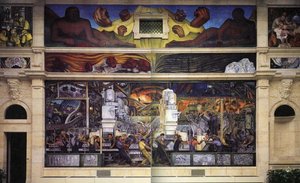
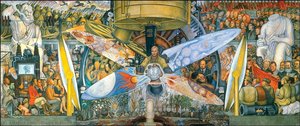 Man at the Crossroads/Man, Controller of the Univers - Diego Rivera
A central figure of the 20th century Mexican painters, Diego Rivera transformed the visual landscape of his nation through monumentalism and social conviction. Born in Guanajuato in 1886, his artistic journey began with rigorous academic training at the Academy of San Carlos in Mexico City. His evolution as a master was further shaped by his time in Europe, where he engaged with the avant-garde movements in Paris and studied the ancient tradition of fresco in Italy. This unique synthesis of academic discipline and modern innovation allowed him to become a titan of the Mexican Muralism movement, bringing art out of private galleries and into the public consciousness.
His representative work, Man at the Crossroads/Man, Controller of the Universe, serves as a profound testament to his mastery of Social Realism. This 1934 fresco captures the dramatic tension of the era, utilizing dynamic compositions to explore themes of industrialization, technological progress, and human conflict. Through his ability to weave complex narratives into large-scale architectural surfaces, Rivera solidified his legacy as a defining voice of 20th-century Mexican art, using the permanence of fresco to document the struggles and aspirations of a changing world.
Heriberto Juárez
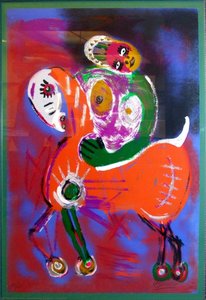 Caballo - Heriberto Juárez
Born in 1932 in the historic cradle of San Juan Teotihuacán, Heriberto Juárez stands as a vital figure among 20th century Mexican painters due to his profound ability to translate the primal energy of his heritage into a modern, expressive language. A self-taught master, Juárez bypassed formal academic training, instead drawing inspiration from the rhythms of rural life and his early aspirations toward bullfighting. This unique background allowed him to develop a highly personal aesthetic that bridges the gap between traditional Mexican iconography and contemporary abstraction.
His representative work, Caballo (1999), serves as a testament to this energetic style. In this piece, the artist utilizes a vibrant, almost rhythmic palette of green, white, red, and black to evoke the spirit of motion. Rather than adhering to strict anatomical realism, Juárez employs a swirling vortex of color to depict an equine figure, creating a sense of mythic transition. The interplay of saturated hues and the presence of human figures within the composition reflect his lifelong fascination with the beauty of everyday life and the deep cultural soul of Mexico, cementing his legacy as a significant voice in the nation's 20th-century artistic evolution.
David Alfaro Siqueiros
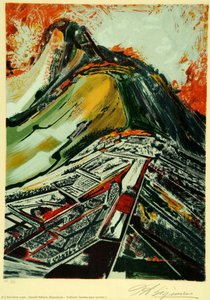 Telluric landscape series I - David Alfaro Siqueiros
A central figure of the 20th century Mexican painters, David Alfaro Siqueiros (1896–1974) was a force of nature whose life was inseparable from the political upheavals of his era. His journey began at the Academy of San Carlos, where his defiant spirit led to the creation of an "open-air academy" to challenge rigid academic traditions. This revolutionary impulse was further forged in the crucible of the Mexican Revolution, where his direct participation in the struggle informed a lifelong mission to use art as a tool for social transformation. Unlike many of his contemporaries, Siqueiros was a pioneer of technical experimentation, often utilizing industrial materials to capture the dynamism of modern life.
His 1950 work, Telluric Landscape Series I, exemplifies this radical approach. In this piece, he moves beyond traditional landscape painting to create a dramatic, almost visceral vision of the earth. By employing innovative techniques such as spray guns and pyroxin on Masonite, he achieved textures and tonal ranges that reflect the tension and grandeur of the Mexican spirit. This masterpiece stands alongside the monumental works of his peers, cementing his legacy as a master of social realism and a vital architect of Mexico's 20th-century artistic identity.
José Clemente Orozco
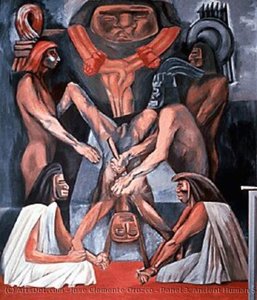 Panel 3. Ancient Human Sacrifice - The Epic of American Civilization - José Clemente Orozco
A central figure of the 20th century Mexican painters, José Clemente Orozco (1883–1949) transformed the visual language of his nation through a lens of profound social critique. His journey was marked by an incredible resilience; after losing his left hand in a youthful accident involving explosives, he channeled his determination into a career that would define the Mexican Muralism movement. His work moved away from idealized beauty, opting instead to confront the raw, often painful realities of human existence and the turbulent currents of the Mexican Revolution.
This commitment to visceral storytelling is epitomized in his monumental fresco, Panel 3. Ancient Human Sacrifice - The Epic of American Civilization. Created between 1932 and 1934, this work serves as a powerful meditation on the contradictions of faith and the inherent violence of the human condition. Through dynamic diagonals and a somber palette of earthy reds and deep blues, Orozco captures the primal anxieties of civilization. His ability to translate the struggles and hopes of a nation into such intense, textured compositions ensures his place as a monumental voice among the great 20th century Mexican painters.
María Izquierdo
 Living Still Life [Naturaleza Viva] - María Izquierdo
A defining figure of the 20th century Mexican painters, María Izquierdo (1902–1955) carved a unique path through a landscape dominated by the monumentalism of her male contemporaries. While the muralists focused on political narratives, Izquierdo turned her gaze inward, blending Surrealism with a profound Mexican folk sensibility. Her journey began at the Escuela Nacional de Bellas Artes in 1928, and her distinctive voice was further shaped during her years sharing a studio with Rufino Tamayo. As a pioneer, she became the first Mexican woman to exhibit her work in the United States, establishing a legacy rooted in poetic expression rather than overt political messaging.
Her mastery is vividly captured in Living Still Life [Naturaleza Viva] (1947), a work that transcends the traditional genre. In this piece, she breathes a rhythmic vitality into inanimate objects, placing vibrant fruit alongside a chess set in a state of suspended animation. Through distorted perspectives and dreamlike, desolate landscapes, Izquierdo’s work explores the intersection of cultural identity and the subconscious, cementing her status as a vital architect of Mexico's modern art history.
Alfonso Michel Nava
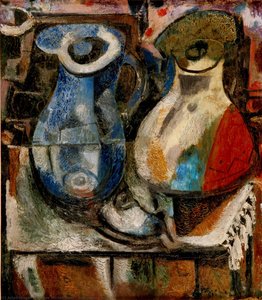 Still nature Jugs - Alfonso Michel Nava
Alfonso Michel Nava stands as a transformative figure within the landscape of 20th century Mexican painters, acting as a vital bridge between the monumental social narratives of the muralism movement and the more experimental Generación de la Ruptura. Born in Colima in 1897, his artistic evolution mirrored the shifting cultural identity of Mexico throughout the 1900s, moving from the heavy social commentary of the post-revolutionary era toward a sophisticated, modern abstraction.
In his representative work, Still nature Jugs (1956), this transition is masterfully realized. While many of his contemporaries sought grandeur in public walls, Michel Nava found profound expression in the intimate. This piece demonstrates his ability to infuse everyday domesticity with a sense of rhythmic geometry. Through a careful orchestration of light and shadow, he elevates simple vessels into a study of form. The interplay between resonant blue tones and stark whites showcases a mastery of color that moves beyond mere realism, embracing a contemporary realism that defined the mid-century Mexican aesthetic. His legacy remains etched in the way he synthesized traditional themes with the avant-garde language of the 20th century.
Javier Arevalo
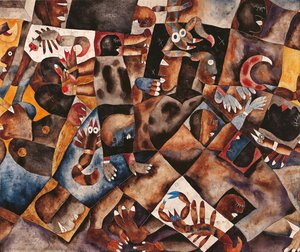 Veracruz’s warm and quiet nights - Javier Arevalo
Born in Guadalajara in 1937, Javier Arévalo emerged as a vital voice within the 20th century Mexican painters movement, bridging classical training with a profound, modern sensitivity. His artistic journey began under the guidance of Jorge Martínez, an assistant to the great José Clemente Orozco, a connection that deeply rooted his technique in the rigorous traditions of Mexican muralism and drawing. After graduating from the Escuela Nacional de Artes Plásticas in 1963, Arévalo’s work evolved through a deep exploration of the Mexican landscape, particularly during his travels along the coasts of Jalisco and Nayarit.
His mastery is perhaps most vividly captured in the 1985 watercolor Veracruz’s warm and quiet nights. This work exemplifies his ability to weave together geometric precision and organic mystery, utilizing a rhythmic mosaic of color to evoke the atmospheric stillness of the tropical lowlands. Through his teaching at the Palacio de Bellas Artes, Arévalo left a lasting legacy, ensuring his sophisticated approach to light and form would influence subsequent generations of artists. His inclusion in prestigious collections, such as the Colección Andrés Blaisten, solidifies his status as a significant figure in the mid-to-late 20th-century Mexican art canon.
Octavio Medellín
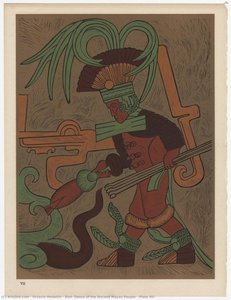 Xtol: Dance of the Ancient Mayan People, [Plate VII] - Octavio Medellín
Octavio Medellín stands as a profound voice among 20th century Mexican painters and sculptors, his creative identity forged in the crucible of the Mexican Revolution. Born in 1907 in San Luis Potosí, his life was defined by the movement between his Mexican roots and his relocation to San Antonio, Texas. This dual heritage allowed him to channel the spiritual resonance of his homeland into a modern, sculptural language. His work serves as a bridge between the ancient and the contemporary, capturing the resilience of the human spirit through a lens of cultural memory.
His mastery of form is vividly captured in the evocative piece Xtol: Dance of the Ancient Mayan People, [Plate VII]. Created in 1947, this work exemplifies his deep immersion in the ethnographic traditions of Mexico. The piece radiates a mysterious energy, utilizing deep espresso tones to depict Mayan warriors in ritualistic motion. Through intricate details of feathered headdresses and indigenous iconography, Medellín transforms historical memory into a tactile, rhythmic celebration of ancient culture, cementing his legacy as a vital chronicler of Mexican heritage during the 20th century.
Graciela Iturbide
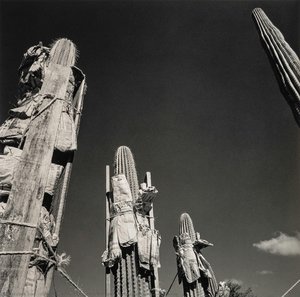 Jardín Botánico (Botanical Garden), Oaxaca - Graciela Iturbide
In her 1998 masterpiece, Jardín Botánico (Botanical Garden), Oaxaca, the profound stillness of the Mexican landscape is captured through a striking interplay of light and form. This work exemplifies the visual poetry of Graciela Iturbide, a prominent figure among 20th century Mexican painters and visual artists whose career emerged from a deep, observational connection to her nation's identity. Though primarily recognized for her mastery of the photographic medium, her compositions possess a painterly quality, utilizing a sophisticated monochrome palette to emphasize texture and monumental scale.
Born in Mexico City in 1942, Iturbide’s artistic journey was shaped by a formative mentorship with Manuel Álvarez Bravo, who taught her the importance of the decisive moment. Her work often transcends mere documentation, moving into the realm of humanist documentary photography. She is celebrated for her poetic black-and-white imagery that explores indigenous cultures, rituals, and the essence of Mexican identity. Through a meticulous use of perspective and negative space, she transforms subjects—whether they be ritualistic figures or the sculptural cacti of Oaxaca—into symbols of quiet introspection and timeless elegance.
Conclusion
The legacy of these 20th century Mexican painters is defined by a profound dialogue between identity, social struggle, and the vibrant textures of a nation in transformation. From the raw, intimate symbolism of Frida Kahlo to the monumental, epic narratives of the muralists like Diego Rivera and David Alfaro Siqueiros, these artists collectively reshaped the visual language of the Americas. Whether through the surrealist undertones of María Izquierdo or the evocative, atmospheric compositions of the era's landscape and portrait specialists, each creator contributed a unique layer to a movement that was as much about political revolution as it was about aesthetic innovation.
For those looking to honor this rich heritage, Mus3ums.com offers a way to bring these historical narratives into your personal space. Our master artists specialize in creating museum-quality, hand-painted oil reproductions that capture the soul, the impasto, and the emotional depth of these masterpieces. You can explore our full collection to find the perfect piece and invite the spirit of Mexican modernism into your home through our bespoke, fine-art services.