Introduction
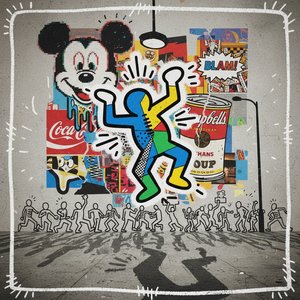
Emerging from the vibrant, post-war landscape of the mid-twentieth century, American pop art painters revolutionized the boundaries between high culture and everyday life. This movement arose as a bold reaction against the introspective intensity of Abstract Expressionism, turning the gaze away from the subconscious and toward the tangible, neon-lit reality of the modern world. Instead of seeking truth in spontaneous gestures, these artists found inspiration in the ubiquitous symbols of consumerism: the glossy sheen of advertising, the dramatic outlines of comic books, and the repetitive patterns of mass-produced packaging. By elevating supermarket icons and celebrity imagery to the status of fine art, they challenged the very definition of what was considered worthy of a gallery wall.
The cultural shift led by these creators mirrored the rapid expansion of media and industrial production in the United States, capturing a moment when the world was becoming increasingly visual and interconnected. Their work often utilized techniques that mimicked mechanical reproduction—such as Ben-Day dots, silk-screening, and hard-edged graphic lines—to question the concept of the unique, hand-crafted masterpiece. This playful yet profound interrogation of imagery remains deeply relevant today, as we continue to navigate a world saturated by digital media and instant visual consumption.
To understand the visual language of the contemporary era, one must look to the pioneers who first dared to paint the mundane. The following artists represent the essential voices of this movement, each offering a distinct perspective on the intersection of art, commerce, and American identity.
Andy Warhol
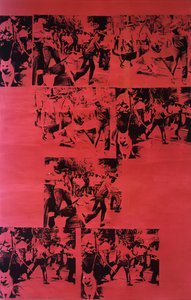
Born Andrew Warhola Jr. in 1928, Andy Warhol emerged from the industrial landscape of Pittsburgh to become the definitive architect of the American Pop Art movement. His work bridged the gap between the grit of working-class reality and the glossy, manufactured veneer of consumerism. By elevating supermarket staples and celebrity iconography to the status of high art, he fundamentally redefined the boundaries of visual culture in the United States.
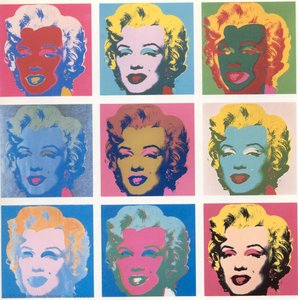
Warhol’s practice was characterized by a fascination with mass production, often utilizing the silkscreen process to mimic the repetitive nature of media and advertising. This technique allowed him to explore the commodification of the human image, treating fame as a consumable product. His 1962 masterpiece, Marilyn Diptych, stands as a monumental exploration of this theme. Through the repetition of Monroe’s likeness, the work navigates the tension between vibrant celebrity glamour and the inevitable decay of mortality. By transforming the ephemeral images of magazines and television into lasting icons, Warhol ensured that the visual language of the everyday would forever be recognized as fine art.
Jasper Johns
Jasper Johns stands as a pivotal figure in the transition toward Pop Art, a movement that elevated everyday imagery to the status of high art. While his roots lie in the expressive textures of the mid-century, his decision to utilize recognizable, mass-produced symbols fundamentally shifted the focus of American painting from internal emotion to external, cultural icons. By taking objects that the public already knew and treating them as subjects for fine art, he paved the way for the Pop Art movement to flourish.
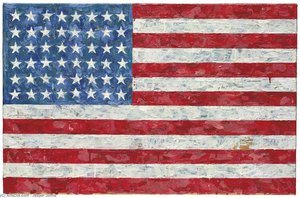
His seminal work, Flag, exemplifies this revolutionary approach. Rather than a simple patriotic tribute, the painting serves as a profound investigation into the nature of representation. Through a complex, tactile technique involving the layering of oil and encaustic wax, Johns creates a surface that is almost sculptural. This method allows the viewer to see the physical reality of the paint itself, contrasting the familiar, geometric pattern of the stars and stripes with a deeply textured, unpredictable materiality. In doing so, he transformed a ubiquitous national symbol into a complex object of contemplation, bridging the gap between abstract expression and the iconic imagery of Pop Art.
Roy Lichtenstein
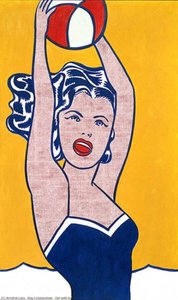
Born in Manhattan in 1923, Roy Lichtenstein emerged from an upper-middle-class Jewish family to become a transformative force in the American art landscape. While his early years were steeped in the cultural rhythms of New York—from jazz music to museum visits—his true impact arrived with a radical departure from the heavy, emotional brushwork of Abstract Expressionism. He turned his gaze outward, finding profound subject matter in the glossy, mechanical surfaces of American mass culture.
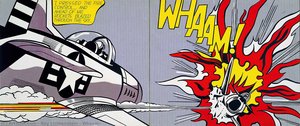
Lichtenstein is a quintessential figure among American Pop Art painters because he elevated the "lowbrow" language of comic books and commercial advertising to the status of fine art. He famously utilized the Ben-Day dot system, meticulously hand-painting tiny, precise dots to mimic the look of industrial printing. This technique, combined with bold black outlines and simplified forms, created a sense of deliberate detachment that challenged the boundaries of traditional painting.
His 1963 masterpiece, Whaam!, stands as a defining moment of this era. Through this large-scale work, he distilled the dramatic aesthetics of comic panels into a monumental commentary on media and the stylized representation of violence, forever cementing his legacy in the Pop Art movement."
Keith Haring
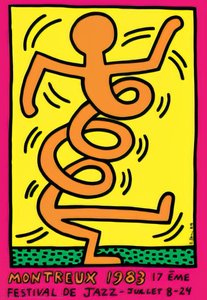 Montreux - Keith Haring
Keith Haring stands as a vital figure in the American Pop Art movement, bridging the gap between the gritty street culture of 1980s New York City and the high-art galleries of the world. His work exemplifies the Pop Art ethos by utilizing the visual language of mass media, comic strips, and advertising to create an accessible, democratic form of art. Rather than remaining confined to traditional studios, Haring famously utilized the urban landscape—specifically the black matte paper of subway stations—to broadcast his rhythmic, symbolic iconography to the public.
His signature style is characterized by thick, bold outlines and a vibrant, flat color palette that echoes the immediacy of graphic design and commercial printmaking. In his work Montreux, this aesthetic reaches a celebratory peak. The piece captures the kinetic energy of the Montreux Jazz Festival through fluid, exaggerated limbs and radiating lines that symbolize sound vibrations. By distilling complex human emotions and musical spontaneity into simplified, iconic forms, Haring transformed the visual vocabulary of the street into a powerful, universal language of joy and movement.
Alex Katz
 The green cap - Alex Katz
Alex Katz stands as a pivotal figure in the American Pop Art movement, distinguished by a style that favors cool emotional detachment and a sophisticated simplification of form. Unlike the gestural intensity of his contemporaries, Katz achieved a unique presence through the use of large, flat areas of color and a striking, cinematic approach to composition. His work often utilizes dramatic cropping—reminiscent of advertising and film—to create a rhythmic, modern tension between the subject and the viewer.
A hallmark of his technical innovation is the use of "cutouts," where he paints directly onto shaped panels of wood or aluminum, breaking the traditional rectangular confines of the canvas. This experimentation, combined with his signature monochrome backgrounds, helped anticipate the Pop Art aesthetic by elevating everyday subjects into stylized icons. His representative work, The Green Cap, exemplifies this mastery, utilizing vibrant teal and green tones to capture a moment of curiosity through bold, graphic lines.
Educated at the Cooper Union and the Skowhegan School of Painting and Sculpture, Katz’s oeuvre spans from intimate portraits of his wife, Ada, to expansive, painterly landscapes. His ability to blend the precision of printmaking with the soul of fine art ensures his place as a master of modern American painting.
Robert Rauschenberg
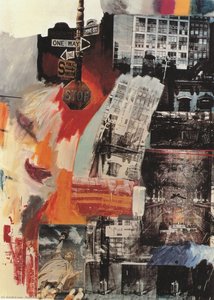 Estate - Robert Rauschenberg
A central figure in the evolution of American Pop Art, Robert Rauschenberg (1925–2008) fundamentally redefined the boundaries of visual expression. His journey from the landscapes of Texas to the avant-garde crucible of Black Mountain College—where he studied alongside luminaries like Josef Albers and John Cage—allowed him to develop a radical sensibility. Rauschenberg belongs to the Pop Art movement through his profound engagement with the artifacts of everyday life, effectively bridging the gap between high art and the mundane realities of the modern world.
He is most celebrated for his revolutionary "Combines," which merged painting and sculpture by incorporating found objects, newspaper clippings, and urban detritus. This approach challenged the sanctity of the canvas, treating the textures of American life as legitimate artistic subjects. In his 1963 work, Estate, this legacy is vividly realized. The piece serves as a dynamic urban vision, masterfully straddling the line between abstraction and representation. By juxtaposing sharp, recognizable street signs with fluid, organic brushstrokes, Rauschenberg captures the chaotic energy of the cityscape, embodying the very essence of the Pop Art spirit through his tactile, collage-like compositions.
Ed Ruscha
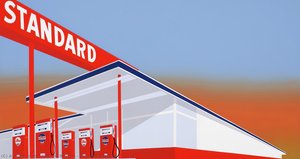 Standard station - Ed Ruscha
In his 1966 masterpiece Standard Station, Ed Ruscha captures the quintessential essence of the American roadside, transforming a mundane service point into a profound cultural icon. This work exemplifies his unique position within the American Pop Art movement, where he moved beyond mere representation to explore the visual language of mass culture and consumerism. By treating the architecture of gas stations and motels with the same reverence as fine art subjects, Ruscha bridged the gap between high art and the vernacular imagery of everyday life.
Born in 1937, Ruscha’s artistic identity was forged in Los Angeles, where he studied at the Chouinard Art Institute. His style is characterized by a deadpan, minimalist aesthetic that frequently integrates typography and text into the landscape. His palette often favors clean lines and a graphic clarity, utilizing bold colors to emphasize the structural forms of the Southern California landscape. Whether through his iconic photographic books or his paintings of urban typography, Ruscha’s work remains a vital exploration of the intersection between language, photography, and the sprawling, neon-lit reality of the American West.
Wayne Thiebaud
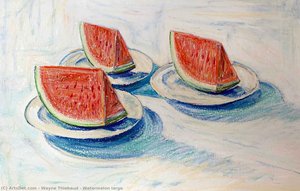 Watermelon large - Wayne Thiebaud
Wayne Thiebaud (1920–2021) occupies a singular space within the American Pop Art movement, bridging the gap between the expressive gestures of Abstract Expressionism and the consumer-driven imagery of the mid-century. While many of his contemporaries focused on the irony of advertising, Thiebaud utilized the visual language of mass production to celebrate the mundane. His background in commercial art and a brief tenure in Walt Disney Studios’ animation department provided him with a sophisticated understanding of form and presentation, which he later applied to the most ordinary of subjects.
His work is defined by a profound fascination with the textures of everyday life, often elevating consumer goods to the status of high art through a masterful use of light and color. In his representative work, Watermelon large, he demonstrates this unique sensibility by transforming simple fruit into a vibrant, rhythmic study of color. Through thick, impasto-like brushstrokes and a focus on the tactile quality of his subjects, Thiebaud captured the essence of American abundance. His ability to find beauty in the repetitive, everyday objects of a burgeoning consumer culture ensures his lasting legacy as a vital figure in the Pop Art landscape.
Tom Wesselmann
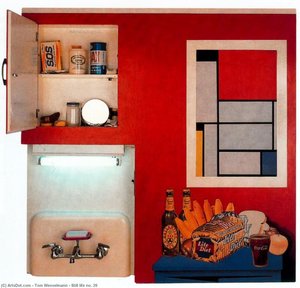 Still life no. 20 - Tom Wesselmann
Born in Cincinnati, Ohio, in 1931, Tom Wesselmann carved a unique niche within the American Pop Art movement by moving away from the heavy abstraction of his era to embrace the visual language of the everyday. His early background in psychology and his experience as a military cartoonist provided him with a sophisticated understanding of both human perception and the power of graphic narrative. Unlike many of his contemporaries who focused solely on the replication of mass media, Wesselmann utilized a distinctive synthesis of collage and representational painting to deconstruct the domestic and consumerist landscape of post-war America.
His work often explores the intersection of desire and the mundane, a theme masterfully captured in Still Life No. 20. In this 1962 piece, he constructs a fragmented interior that blurs the lines between high art and the reality of modern living. By arranging household goods, food, and geometric abstractions, he creates a visual rhythm that reflects the vibrant, often detached, energy of American consumer culture. This ability to transform the objects of daily life into iconic, stylized compositions solidifies his status as a pivotal figure among American Pop Art painters.
Jim Dine
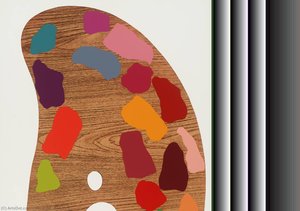 palette II - Jim Dine
In palette II, the artist transforms a humble tool of the craft into a vibrant, abstract celebration of creativity. Through a dynamic interplay of color and texture, the work reimagines the wooden palette as a lively canvas of spontaneity, where bold, irregular patches of pigment meet the organic grain of the wood. This piece exemplifies the artist's ability to bridge the gap between the tactile reality of physical objects and the expressive freedom of modern abstraction.
Jim Dine stands as a vital figure in the American Pop Art movement, specifically for his ability to infuse the movement's fascination with everyday objects with a deeply personal, autobiographical soul. While many of his contemporaries focused on the coldness of mass production, Dine utilized the iconography of the mundane—tools from his grandfather’s hardware store and personal symbols—to create art that felt both playful and profound. His early involvement in the avant-garde "happenings" of New York City further cemented his role as a pioneer who challenged the heavy seriousness of Abstract Expressionism. By elevating domestic and industrial items to the status of high art, Dine infused the Pop Art aesthetic with a unique, rhythmic energy and a sense of joyful, lived experience.
Conclusion
From the vibrant, comic-inspired dots of Lichtenstein to the iconic, repetitive silk-screens of Warhol, these artists fundamentally redefined the boundaries between high culture and everyday consumerism. By elevating supermarket packaging, celebrity imagery, and street art into the realm of fine art, they captured the pulsating energy of a changing society. Whether through the bold lines of Haring or the luscious, sugary textures of Thiebaud, each painter contributed a unique visual language to this movement, ensuring that the aesthetics of the modern age would be immortalized on canvas.
At Mus3ums.com, we invite you to bring this dynamic legacy into your own space. Our master artists specialize in creating museum-quality, hand-painted oil reproductions that capture the true essence and texture of these legendary works. You can explore our full collection to find the perfect piece and transform your home or office with the bold spirit of American Pop Art.