
Introduction
American impressionist painters emerged at the turn of the 20th century, capturing a nation in transition through the ephemeral qualities of light and atmosphere. While the movement found its roots in France, these artists adapted the technique to the unique landscapes and social structures of the United States. Rather than adhering to the rigid, polished traditions of studio-based academicism, they embraced en plein air painting, working outdoors to document the fleeting nuances of sunlight on water, the dappled shadows of American gardens, and the shifting moods of urban life.
This group of artists played a pivotal role in modernizing the American aesthetic, moving away from historical narratives toward a focus on sensory perception and immediate experience. Their work reflects a period of profound cultural shifts, documenting both the serene beauty of the New England coastline and the evolving social dynamics of a rapidly industrializing society. By prioritizing the visual impression of a moment over precise, photographic detail, they paved the way for the diverse modernism that would follow in the decades to come.
Today, these painters remain essential for understanding the evolution of Western art, as their mastery of color and brushwork continues to influence how we perceive light and space. Their ability to translate the transient into the permanent ensures their continued relevance in both academic study and private collections. The following profiles examine ten significant figures of this movement, including Mary Cassatt, Childe Hassam, and John Henry La Farge, whose works define the essence of American Impressionism.
William Merritt Chase
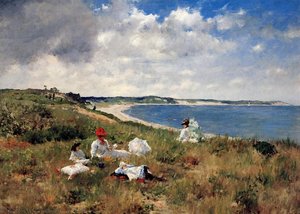
In his 1894 work Idle Hours, William Merritt Chase demonstrates the tranquil essence of the American Impressionist movement. This oil-on-canvas, currently held at the Amon Carter Museum of American Art, captures a serene moment of leisure on the shores of Long Island. Through a balanced composition of tall grasses, sandy beaches, and a soft, cloudy sky, Chase masterfully translates the fleeting effects of light and atmosphere that define the Impressionist aesthetic.
Born in 1849 in Indiana, Chase’s journey to becoming a leader of American Impressionism was rooted in rigorous academic discipline. After receiving early instruction from local artists, he refined his technical draftsmanship at the National Academy of Design under Joseph Oriel Eaton and Lemuel Wilmarth. His subsequent studies at the Academy of Fine Arts in Munich provided the structural foundation that allowed him to eventually embrace the more spontaneous, light-drenched styles of the movement. Chase is distinguished within this group by his ability to merge high-level academic precision with a vibrant, naturalistic palette. His works often feature earthy tones of green and brown juxtaposed against the soft blues of the sea, reflecting a sophisticated command of color that characterizes the transition of American art toward modernism.
Mary Cassatt
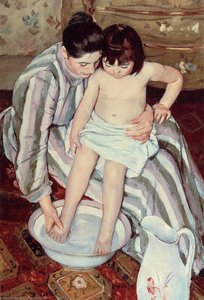
In her 1893 masterpiece The Child's Bath, Mary Cassatt captures a tender moment of domesticity that epitomizes the Impressionist focus on the fleeting, everyday experience. As a prominent figure among American Impressionist painters, Cassatt moved away from the grand, historical narratives favored by the academies to explore the intimate, private spheres of women and children. Her work is characterized by a sophisticated use of color and a focus on the psychological depth of maternal bonds.
Born in Pennsylvania in 1844, Cassatt’s technical foundation was built through rigorous study at the Pennsylvania Academy of the Fine Arts and disciplined daily copying at the Louvre. Her transition to the Parisian art scene, where she studied under Jean-Léon Gérôme, allowed her to fully embrace the Impressionist aesthetic. She utilized loose, confident brushwork and a harmonious palette to prioritize the impression of form and texture over rigid detail. This approach is evident in the way she renders skin, fabric, and water, creating a sense of immediacy and warmth. By centering her subjects on the social and domestic realities of women, Cassatt provided a revolutionary and distinctly modern perspective within the movement.
Childe Hassam
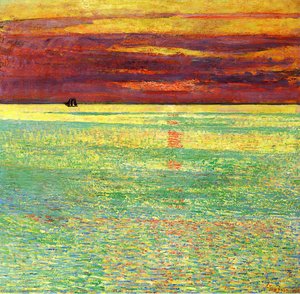 Sunset at Sea - Childe Hassam
A central figure in the American Impressionism movement, Childe Hassam (1859–1935) was a master of capturing the ephemeral qualities of light and atmosphere. Born in Dorchester, Massachusetts, Hassam’s early professional life was shaped by the disciplined precision of commercial drafting and illustration. This foundational training in line and form allowed him to transition seamlessly into the expressive, gestural style that defined his later career. Unlike the rigid studio traditions of the past, Hassam embraced the Impressionist ethos by working to catch the fleeting, vibrant energy of a nation in transition, focusing on both bustling urban textures and serene coastal landscapes.
His representative work, Sunset at Sea (1911), serves as a profound testament to his ability to translate the sensory experience of nature onto canvas. In this seascape, Hassam utilizes a rich, warm palette of oranges and reds to depict a twilight sky, which contrasts beautifully against the cool turquoise and blue tones of the water. Through a tactile impasto technique, characterized by thick, visible brushstrokes, he achieves a sense of movement and depth that is quintessential to the American Impressionist style. His work remains a vital link to the luminous, outdoor-focused traditions of his contemporaries.
Charles Courtney Curran
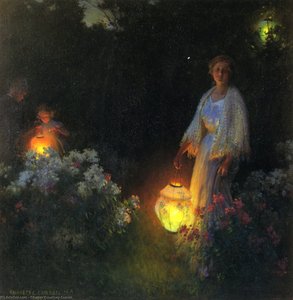 The Lanterns - Charles Courtney Curran
Charles Courtney Curran (1861–1942) stands as a distinguished figure among American Impressionist painters, recognized for his ability to translate the ephemeral qualities of light into evocative genre scenes. His work is characterized by a sophisticated handling of atmosphere, often focusing on women engaged in moments of quiet leisure or domesticity. A hallmark of his style is the masterful interplay between deep, nocturnal tones and sudden, luminous highlights, achieved through a layered application of oil paint that emphasizes mood over rigid realism.
His technical foundation was built through rigorous training at the Fine Arts Academy of Cincinnati and the National Academy of Design, later refined during his pivotal years in Paris at the Académie Julian. This European influence allowed him to move beyond academic traditions to embrace the Impressionist pursuit of capturing fleeting environmental effects. His representative work, The Lanterns (1913), exemplifies this mastery; the painting utilizes a vibrant palette of warm yellows and oranges to contrast against dark blues and greens, creating a sense of nocturnal enchantment. Through his focus on the transient beauty of light and the serenity of everyday life, Curran remains a vital link in the evolution of American Impressionism.
Theodore Clement Steele
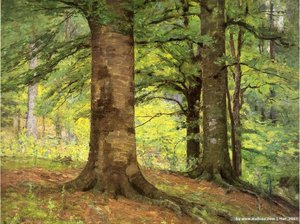 Beech Trees - Theodore Clement Steele
Theodore Clement Steele (1847–1926) stands as a foundational figure among American impressionist painters, distinguished by his ability to synthesize rigorous European training with the raw, luminous beauty of the American landscape. After beginning his studies in Indiana, Steele moved to Munich to study at the prestigious Royal Academy. It was during this period of transatlantic exchange that he embraced the core tenets of Impressionism, moving away from the somber, academic palettes of his youth toward a style defined by light, color, and the fleeting effects of nature.
A viewer can recognize a Steele composition by its profound sense of serene contemplation and its mastery of atmospheric light. His work often features broken brushstrokes and a vibrant, high-key palette that captures the shifting qualities of the outdoors. In his representative work, Beech Trees, he demonstrates this technical expertise through expressive brushwork that conveys the texture of verdant foliage and the interplay of light and shadow within a woodland setting. By translating an emotional connection to the natural world onto the canvas, Steele helped define a unique visual language for American Impressionism, focusing on the tranquil essence of the landscape.
John Henry Twachtman
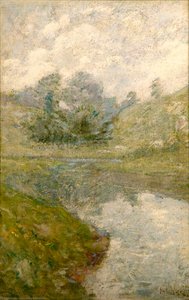 Landscape 3 - John Henry Twachtman
John Henry Twachtman (1853–1902) was a pivotal figure in the development of American Impressionism, known for his ability to synthesize the movement's focus on light with a more introspective, Tonalist sensibility. His work is instantly recognizable through its atmospheric depth and a preference for muted, harmonious color palettes that prioritize mood over mere visual documentation. Unlike many of his contemporaries who sought high-contrast brilliance, Twachtman utilized a loose, flowing brushwork and a sophisticated impasto technique to capture the ephemeral qualities of mist, shadow, and shifting light.
His artistic evolution was shaped by rigorous academic training under Frank Duveneck in Cincinnati and transformative studies in Europe. His time at the Academy of Fine Arts in Munich and the Académie Julian in Paris allowed him to integrate European structural principles with a uniquely American approach to landscape. As a member of the influential group "The Ten," he pushed for artistic independence, often moving away from idealized forms toward a more personal, experimental style. His 1902 work, Landscape 3, serves as a profound example of his mature period, utilizing soft, rosy-brown hues and a serene, cloudy sky to evoke a sense of tranquil, immersive nature.
John La Farge
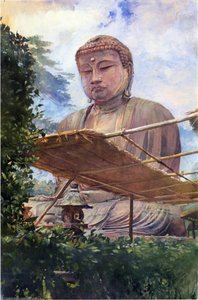 The Great Statue of Amida Buddha at Kamakura, Known as the Diabutsu, from the Priest's Garden - John La Farge
John La Farge (1835–1910) stands as a pivotal figure in American art, bridging the gap between traditional European mastery and the burgeoning light-focused sensibilities of the late 19th century. A student of Thomas Couture in Paris, La Farge developed a cosmopolitan aesthetic that allowed him to integrate the luminous qualities of light and color—hallmarks of the Impressionist movement—into his diverse body of work. His inclusion in the group of American Impressionist painters is defined by his intense preoccupation with how light interacts with surfaces, a pursuit that extended from his evocative landscapes to his revolutionary innovations in stained glass and mural design.
His work is instantly recognizable by its sophisticated use of color and a sense of atmospheric depth. In his 1886 watercolor, The Great Statue of Amida Buddha at Kamakura, Known as the Diabutsu, from the Priest's Garden, one observes his ability to capture spiritual stillness through delicate, translucent washes. This piece exemplifies his fascination with Asian art and his ability to harmonize monumental subjects with the ephemeral, natural world. Whether through the vibrant textures of his murals or the delicate layering of his watercolors, La Farge’s oeuvre remains a testament to the pursuit of capturing light in its most pure and transformative state.
Willard Metcalf
 Gloucester Harbor - Willard Metcalf
Willard Metcalf (1858–1925) stands as a pivotal figure among American impressionist painters, renowned for his ability to translate the ephemeral atmosphere of the New England landscape into vibrant, poetic compositions. His work is characterized by a profound sensitivity to light, often capturing the quietude of rural and coastal scenes through a delicate, expressive touch. A visitor can recognize a Metcalf original by its rhythmic, visible brushwork and a palette that prioritizes the immediate sensation of color over rigid, academic lines.
His artistic evolution was shaped by rigorous training at the School of the Museum of Fine Arts in Boston and the Académie Julian in Paris, where he studied under Gustave Boulanger and Jules-Joseph Lefebvre. While his early years were rooted in academic figure painting, his travels through England and Brittany catalyzed his shift toward the plein-air sensibilities that define his legacy. In his representative work, Gloucester Harbor (1895), Metcalf demonstrates this mastery by utilizing loose, textured strokes to depict a bustling Massachusetts port. The painting serves as a masterclass in the movement, using light and color to transform a panoramic maritime vista into a tranquil, immersive experience of coastal life.
Frederick Carl Frieseke
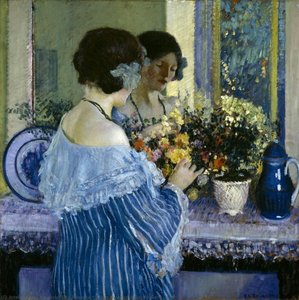 Girl in Blue Arranging Flowers - Frederick Carl Frieseke
Born in Michigan in 1874, Frederick Carl Frieseke became a central figure in the American Impressionism movement through his unique ability to harmonize structured composition with the ephemeral qualities of light. His artistic trajectory was fundamentally altered by his relocation to Paris in 1898, where he moved beyond his early training at the Art Institute of Chicago to embrace the vibrant French scene. By settling in Giverny near Claude Monet, Frieseke integrated the core tenets of Impressionism—the study of light and atmosphere—into a style often termed "decorative impressionism." This approach allowed him to capture the fleeting essence of a moment while maintaining a sophisticated, rhythmic sense of design.
His representative work, Girl in Blue Arranging Flowers (1915), exemplifies this mastery. In this oil on canvas, Frieseke utilizes broken color and deliberate layering to create a shimmering, ethereal atmosphere. The painting captures a quiet, introspective moment, where soft, diffused light dances across textures of velvet and skin. Through his focus on luminous garden scenes and the delicate interplay of light within domestic interiors, Frieseke solidified his legacy as a premier American Impressionist, translating the spontaneous energy of the movement into works of profound, decorative grace.
J. Alden Weir
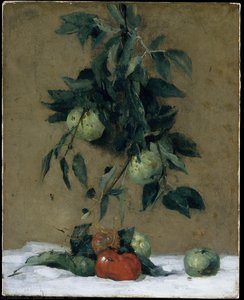 Fruit - J. Alden Weir
A central figure in the development of American Impressionism, J. Alden Weir (1852–1919) underwent a profound stylistic evolution that mirrored the shifting landscape of late 19th-century art. Born into an artistic lineage in West Point, New York, Weir initially trained with academic rigor under Jean-Léon Gérôme in Paris. Interestingly, he was once a skeptic of the Impressionist movement, initially dismissing its departure from formal structure. However, his move to a farm in Branchville, Connecticut, facilitated a transformative shift toward the light-drenched, atmospheric approach characteristic of the movement. As a founding member of "The Ten," Weir helped define the American Impressionist aesthetic by prioritizing the sensory experience of light and color over rigid academicism.
His 1888 work, Fruit, serves as a masterful bridge between his academic foundations and his Impressionist future. In this still life, Weir moves away from photographic precision, instead utilizing loose brushstrokes and a muted palette to capture the transient beauty of the subject. By focusing on the interplay of light and the subtle textures of apples and grapes, he aligns himself with the Impressionist pursuit of capturing a fleeting moment, while simultaneously nodding to the vanitas tradition through the quiet contemplation of nature's abundance.
Conclusion
The legacy of American impressionist painters lies in their ability to translate the fleeting nuances of light and atmosphere into a uniquely New World visual language. From the intimate, domestic scenes captured by Mary Cassatt to the vibrant, sun-drenched landscapes of Childe Hassam, these artists moved beyond mere imitation of European techniques to define a distinct aesthetic of light and color. Whether through the delicate textures of John La Farge or the structural compositions of William Merritt Chase, each artist contributed to a movement that prioritized the immediate, sensory experience of a moment over the rigid formalities of traditional studio painting.
For those seeking to integrate these historical perspectives into a modern environment, our full collection offers a way to engage with this era of art history. We invite you to bring the luminous spirit of these masters into your own space through our museum-quality, hand-painted reproductions, each meticulously crafted to preserve the texture and soul of the original works.


