Early Life, Family and Training
Alfred Fitzwalter Grace enters the historical record in 1844. He is born the son of a Secretary to a Baptist Movement, a background that places him within a specific social and religious framework of the era. By 1861, the census finds him living in Camberwell, a location he remains in through 1871. These years in London mark the formative period of his development, a time of transition from his childhood roots toward professional discipline.
His formal education follows a path through established institutions. He studies at Heatherley's, gaining the foundational technical skills required of a professional painter. This training leads him to the Royal Academy Schools, where his development moves into more rigorous, academic territory. He is a prolific exhibitor, eventually showing his work at various prestigious venues including the Royal Academy and the Royal Institute of Painters in Water Colours.
Personal life and professional life intersect as he establishes his household. By 1881, Alfred Fitzwalter Grace is married to Emily Mary Grace, née Jackson. She is a teacher of art, a profession that suggests a domestic environment deeply immersed in the study and practice of visual arts. The couple eventually settles in the Sussex countryside, moving toward the landscapes that would define his career.
Artistic Technique and Style
Grace works primarily in watercolor, a medium he handles with meticulous precision. He builds his compositions through delicate washes and careful layering, a process that produces luminous effects across the paper. Rather than relying on forceful gestures, his brushstrokes remain understated yet purposeful. He focuses on the subtle nuances of light and atmosphere, often capturing the specific quality of misty mornings or hazy afternoons to define a scene.
The artist demonstrates exceptional accuracy when rendering the natural world, particularly in his treatment of botanical forms. Beech and oak trees appear with significant detail, their branching structures and dappled shadows captured through sensitive observation. He avoids the grand, dramatic narratives favored by some of his contemporaries, choosing instead to prioritize the quiet textures of foliage and the way light settles on water surfaces or distant horizons.
His approach to landscape is defined by a commitment to the essence of a specific place. This is evident in works such as:
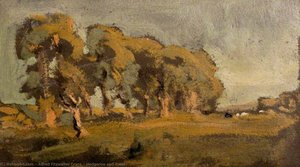
- Hedgerow and Trees (1880)
- Lea Farm, Storrington (about 1882)
Key Works and Notable Paintings
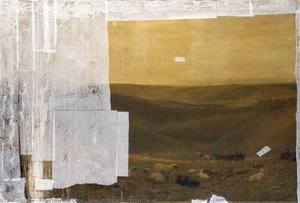
The landscape of West Sussex provides the primary stage for Grace’s most significant compositions. In Hedgerow and Trees, painted about 1880, the artist focuses on the structural complexity of nature. The work features brown branches stretching toward the sky, while a figure stands near the trees, adding a sense of scale to the quiet scene. This piece, an oil on canvas, is held by the Victoria and Albert Museum in London.
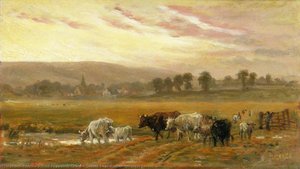
The rural character of his surroundings appears again in Lea Farm, Storrington, executed about 1882. This work is part of the collection at Park House, Horsham. While much of his output remains tied to the pastoral, Grace occasionally turned his attention toward the human form. His Portrait of a Man in a Dark Suit, dated about 1892, offers a departure from his typical focus on the rolling hills and tranquil waters of the Sussex countryside.
Other notable works capture specific atmospheric moments or regional views:
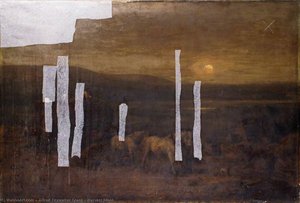
- Harvest Moon, held by the Brighton Museum ^ Art Gallery
- Steyning, West Sussex
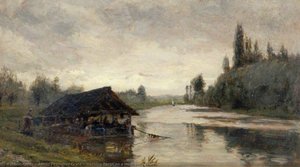
- Washing Barge on a Normandy River
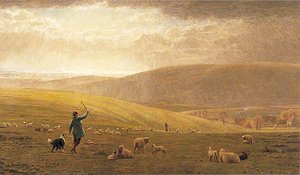
- Valley of the Cuckmere, East Sussex
- Sunset Near Amberley, West Sussex
Legacy and Influence
Grace’s contribution to British art rests on an unwavering pursuit of artistic integrity. He avoids the grand narratives favored by many of his contemporaries, choosing instead to honor the landscape through quiet observation. His work reflects a broader cultural shift during the Victorian period, a time when the value of tranquility and the meticulous study of the natural world began to take precedence in British visual culture.
His technical mastery of watercolor leaves a lasting mark. By employing delicate washes and precise layering to achieve luminous effects, he provided a blueprint for how to render the textures of foliage and water. This dedication to the medium's potential offered a technical foundation that inspired subsequent generations of landscape artists seeking to capture atmosphere without resorting to forceful gesture. His paintings continue to resonate with viewers today, maintaining a sense of stillness that persists long after the brush has dried.
Where to See the Works Today
Tracing the physical presence of Grace’s output requires a move through several key institutions. In London, the Victoria and Albert Museum holds his work Hedgerow and Trees. This piece offers a direct look at his approach to the English countryside. Nearby, the Royal Academy also maintains works from his collection, placing his quiet observations within the broader context of British institutional history.
The landscape of his work extends toward the coast and the north. The Brighton Museum and Art Gallery preserves Harvest Moon, a piece that captures the specific atmospheric qualities he sought in his later years. Further north, the Glasgow Institute of the Fine Arts also includes his paintings in its holdings, demonstrating the reach of his influence beyond the Sussex borders.
Local history remains central to his legacy. At Park House in Horsham, one finds Lea Farm, Storrington. This location keeps his connection to the rural scenes of West Sussex tangible. His presence in these various galleries and museums ensures that his specific, restrained vision of the natural world remains accessible to those studying the Victorian era.
Spørgsmål og svar
I hvilken historisk periode arbejdede Alfred Fitzwalter Grace?
Alfred Fitzwalter Grace var aktiv i 19th Century-perioden. Denne periode placerer kunstnerens virke i en historisk kontekst.