A Life of Neoclassical Intensity
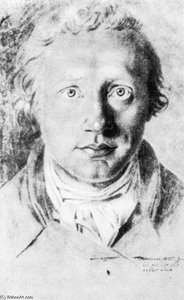
The life of Asmus Jakob Carstens was as dramatic and turbulent as the mythological subjects he sought to immortalize on canvas. Born in Sankt Jürgen, near Schleswig, his early years were far removed from the refined academies of Europe; he was apprenticed to a cooper, learning the rugged craft of barrel-making for five years. Yet, a youthful passion for painting could not be suppressed by the demands of manual labor. After leaving his apprenticeship, Carstens journeyed to Copenhagen, where he immersed himself in the study of art at the academy. It was during these formative years that he began to support himself through the delicate medium of red chalk portraits, honing a precision that would later define his approach to the human form.
His career was marked by an erratic brilliance, often complicated by a difficult personality that frequently placed him at odds with the very institutions meant to support him. From the shores of Denmark to the vibrant art centers of Italy and Germany, Carstens moved with a restless energy. His travels through Milan and Mantua brought him into contact with the legacy of the Renaissance, while his time in Berlin saw him achieve significant recognition. It was in Berlin that his colossal work, The Fall of the Angels—a massive composition featuring over two hundred figures—earned him a prestigious professorship at the academy of fine arts. However, his uncompromising nature eventually led to a fractured relationship with the Prussian academy, resulting in his dismissal and a final, solitary chapter of his life spent in Rome.
The Mastery of Form and Myth
As one of the most committed practitioners of German Neoclassicism, Carstens possessed a singular ability to breathe life into ancient legends. His work often exists in a fascinating tension between the structured restraint of Classicism and the burgeoning emotional depth of Romanticism. While many of his large-scale fresco commissions remained unfinished or were lost to time, the surviving works—particularly his drawings—reveal a master of figure-drawing. He frequently employed a schematic, pale coloring that served as a humble accessory to the commanding presence of his subjects, allowing the anatomical precision and dramatic tension to take center stage.
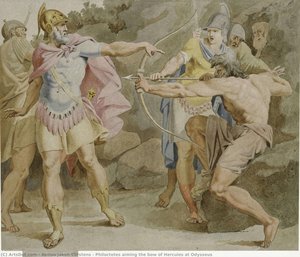
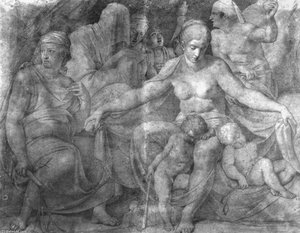
His repertoire was deeply rooted in the tragedies of antiquity and the grandeur of myth. In works such as Philoctetes aiming the bow of Hercules at Odysseus, one can witness a moment frozen in mythic drama, where the watercolor medium captures a palpable sense of energy and destiny. Similarly, his large-scale chalk drawing Night and Her Children, Sleep and Death stands as a masterpiece of his era, embodying the somber, profound themes that characterized his mature style. Whether depicting the tension of a Greek tragedy or the ethereal presence of mythological deities, Carstens utilized light and shadow to create an atmosphere that was both timeless and deeply evocative.
Legacy and Artistic Significance
Though much of his physical output was subject to the whims of fate—with many large projects left incomplete or subsequently destroyed—the historical significance of Asmus Jakob Carstens remains undeniable. He stands as a pivotal figure in the transition of European art, bridging the gap between the structured ideals of Neoclassicism and the emotive power of the Romantic movement. His ability to infuse classical subjects with a sense of psychological weight and dramatic urgency provided a blueprint for future generations of artists exploring the human condition through the lens of myth.
Today, his legacy is preserved through the exquisite drawings and watercolours that survived his tumultuous life. These works continue to invite contemplation of themes such as fate, necessity, and the eternal struggle between light and darkness. Carstens remains a symbol of the dedicated, if often embattled, artist—one whose vision was shaped by the great masters of the past yet whose spirit anticipated the profound emotional shifts of the centuries to follow.
Spørgsmål og svar
I hvilken historisk periode arbejdede Asmus Jakob Carstens?
Asmus Jakob Carstens var aktiv i Early Modern-perioden. Denne periode placerer kunstnerens virke i en historisk kontekst.
Hvor og hvornår er Asmus Jakob Carstens født?
Asmus Jakob Carstens blev født i Schleswig i 1754.
Hvilke andre navne er Asmus Jakob Carstens kendt under?
Asmus Jakob Carstens er også kendt som Asmus Jacob Carstens.