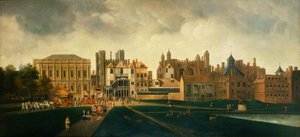
The Master of Two Anchors: The Life and Legacy of Hendrick Danckerts
In the golden light of the seventeenth century, a period defined by both unparalleled artistic flourishing and profound political upheaval, Hendrick Danckerts emerged as a painter capable of bridging the gap between Dutch precision and English grandeur. Born in The Hague around 1625, Danckerts was a product of the Dutch Golden Age, an era that demanded a meticulous eye for detail and a deep reverence for the natural world. Known affectionately by some as the Master with Two Anchors, his life was a journey of movement—from the industrious streets of the Netherlands to the sun-drenched landscapes of Italy, and finally to the royal courts of London. This trajectory allowed him to synthesize the topographical accuracy of his homeland with the sweeping, atmospheric romanticism of the Mediterranean, creating a style that was uniquely his own.
His formative years in The Hague provided him with a rigorous foundation in classical principles and the burgeoning influence of veduta—the art of panoramic cityscape views. However, it was his transformative voyage to Italy between 1653 and 1658 that truly ignited his creative spirit. Immersed in the works of Venetian masters such as Titian and the luminous landscapes of Claude Lorrain, Danck erts began to look beyond mere documentation. He sought to capture the emotional resonance of a scene, infusing his landscapes with a sense of the sublime. This period of exploration taught him how to manipulate light and shadow to evoke spiritual contemplation, a technique that would later define his most celebrated works in England.
Royal Patronage and the English Landscape
Upon settling in England, Danckerts found himself at the heart of a shifting political landscape, eventually entering the service of Charles II and the Duke of York. This period of royal patronage elevated his status from a skilled painter to an essential chronicler of the English realm. His work became a visual testament to the stability and magnificence of the Restoration era. Through his brush, the English countryside was transformed into a stage for architectural splendor and historical importance. He possessed a rare ability to render grand estates and bustling harbors with equal parts intimacy and majesty.
His achievements during this time are marked by several monumental compositions that serve as windows into the seventeenth century:
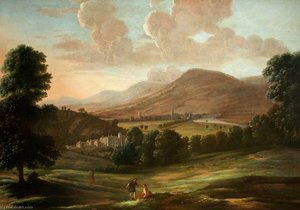
- A Panorama of Monmouth (c. 1672): A breathtaking depiction of Monmouth Castle, where his mastery of depth and atmosphere allows the viewer to feel the weight of history within the landscape.
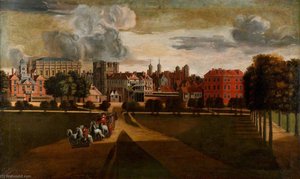
- Whitehall from St James's Park (1675): An expansive oil on canvas that captures the vibrant energy of a bustling London, showcasing his skill in depicting both grand architecture and the small, everyday movements of city life.
- A View of Falmouth Harbour (c. 1678): A serene coastal masterpiece that highlights his ability to blend maritime activity with the tranquil beauty of the natural coastline.
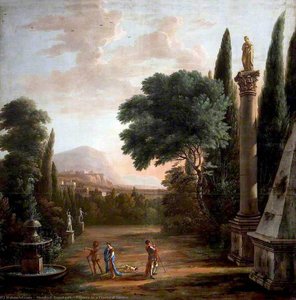
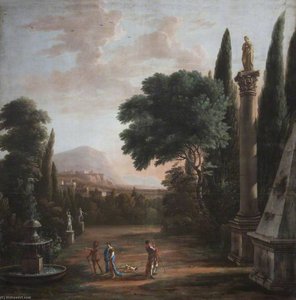
- Figures in a Classical Garden (1675): An exquisite example of his ability to integrate elegant human figures into lush, meticulously detailed greenery, reflecting the era's fascination with classical ideals.
A Lasting Impression on Art History
The significance of Hendrick Danckerts lies not only in his technical proficiency but in his role as a cultural bridge. He brought the sophisticated techniques of the Dutch and Italian traditions to an English audience, helping to shape the aesthetic preferences of the British monarchy and aristocracy. His paintings were more than mere decorations; they were instruments of prestige, documenting the landscape and the architectural triumphs of a nation rebuilding itself after years of conflict.
Though he passed away in 1680, leaving behind a legacy etched in oil and copper, his influence persists. Danckerts remains a pivotal figure for anyone studying the evolution of landscape painting. He moved the genre away from simple topographical recording toward a more emotive, atmospheric, and narrative form of art. Today, his works continue to captivate, offering a profound sense of nostalgia and a window into a world where the grandeur of nature and the ambitions of humanity were captured in perfect, enduring harmony.
Spørgsmål og svar
I hvilken historisk periode arbejdede Hendrick Danckerts?
Hendrick Danckerts var aktiv i Early Modern-perioden. Denne periode placerer kunstnerens virke i en historisk kontekst.