what materials did david hockney use
 Arranged felled trees
Arranged felled trees, David Hockney
David Hockney utilized a vast array of media throughout his career, ranging from traditional oil paints on canvas to specialized printmaking materials. His toolkit includes acrylics, watercolors, gouache, and various drawing tools like crayons and ink, allowing him to masterfully manipulate light, color, and texture across different surfaces.
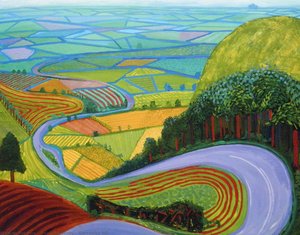
During his rise within the Pop Art movement, Hockney became known for his vibrant use of color. In works like Arranged Felled Trees, he demonstrated a command of oil on canvas, using thick impasto strokes to create tactile volume. He also embraced acrylics, a relatively new material at the time, to achieve a luminous effect in his forest scenes.
His printmaking repertoire is equally extensive and technically diverse. He has worked with several high-quality papers and processes, including:
- Lithography: Often executed on BFK Rives or handmade Fabriano Roma paper.
- Etching: Including works from his Six Fairy Tales from the Brothers Grimm portfolio.
- Inkjet: Utilizing 8-colour inkjet printing on cotton-fiber archival paper.
- Other media: Aquatint and offset lithography on wove paper.
Did he use non-traditional materials like collage or fax machines?
Yes, Hockney frequently integrated non-traditional materials and technologies to challenge conventional perspective. He famously used Polaroid cameras to create complex photo collages and experimented with fax machines in the late 1980s and early 1990s to transmit images across long distances, treating the resulting line work as a unique artistic event.
His engagement with technology is a series of lateral experiments rather than a pursuit of novelty. By using Polaroid cameras, he undermined the idea of photographic objectivity, using the visible seams between images to emphasize the artist's presence and the passage of time. This approach turned photography into something closer to drawing or collage.
The fax machine experiments further pushed these boundaries. By drawing directly onto fax templates, he explored how images circulate and degrade. These works are defined by their fragility, characterized by broken lines caused by interference and compression, turning a mechanical transmission into a deliberate aesthetic choice.
How did his medium change with digital technology?
Hockney transitioned from physical pigments to digital pixels by embracing modern tools like iPads and iPhones. He uses digital drawing tools to redefine how we see and make images, proving that his focus on color and light remains consistent whether working on a traditional canvas or a digital screen.
This evolution is most evident in his contemporary landscape work. He has moved from the heavy textures of oil and acrylic to the fluid, immediate nature of digital sketching. His iPad drawings, such as My Window (2010), demonstrate how he uses technology to capture the essence of a scene with vibrant, expressive color.
His digital work is not a departure from his legacy but an extension of it. Whether using an iPhone or an iPad, he continues to use technology to explore fundamental principles of art: light, shadow, form, and space. This ability to bridge traditional techniques with modern innovation ensures his work remains at the forefront of contemporary art.
Frequently asked questions
When was David Hockney born?
David Hockney was born in Bradford, United Kingdom, on July 9, 1937.
What paper does David Hockney use for lithography?
He has used BFK Rives and handmade Fabriano Roma paper for lithography.
What is the style of Arranged felled trees?
His work Arranged felled trees features thick impasto oil strokes.
What kind of digital art does David Hockney create?
His digital art includes iPad drawings like No. 281 from 2010.
Learn more
- 1937 –David Hockney Artist ProfileDiscover the fascinating life story of the Yorkshire-born icon.
- David Hockney Art CollectionBrowse our full collection of Hockney hand-painted oils and prints.
- 1937 –David Hockney Mood & ColorFind your perfect Hockney piece by browsing by color and mood.