Introduction
German Neoclassical painters emerged during a transformative era when the intellectual rigor of the Enlightenment met a profound reverence for the aesthetic ideals of antiquity. Rooted in the late 18th and early 19th centuries, this movement sought to move away from the perceived excesses of the Rococo, favoring instead the clarity, symmetry, and moral gravity found in ancient Greek and Roman art. These artists were deeply influenced by the archaeological discoveries of the time, which fueled a cultural desire to restore order and rationalism to visual expression through precise outlines and balanced compositions.
The movement in Germany was characterized by a unique synthesis of classical structure and a distinctively Northern sensibility, often blending the idealized forms of the Mediterranean with a more nuanced, sometimes psychological, approach to portraiture and landscape. This period saw the rise of artists who were not merely decorators, but intellectuals who used the canvas to explore themes of civic virtue, historical heroism, and the sublime. Their work served as a visual language for a changing Europe, bridging the gap between the aristocratic traditions of the past and the burgeoning modern consciousness.
Today, these painters remain essential for understanding the evolution of European modernism. Their mastery of form and their ability to imbue static figures with profound emotional depth continue to inform contemporary studies in composition and anatomical precision. By examining their contributions, one gains insight into how art can serve as a vessel for philosophical inquiry and historical memory.
The following profiles examine ten significant figures of this movement, ranging from masters of architectural precision to those who redefined the boundaries of portraiture and sculpture within the Neoclassical framework.
Karl Friedrich Schinkel
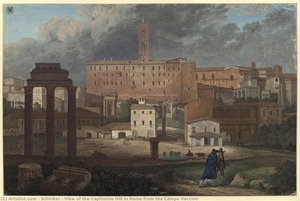 View of the Capitoline Hill in Rome from the Campo Vaccino - Karl Friedrich Schinkel
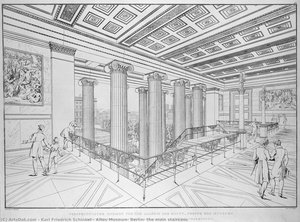
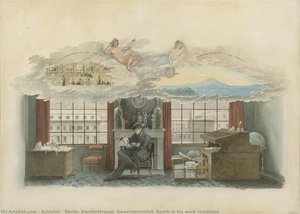
Karl Friedrich Schinkel (1781–1841) remains a central figure in German Neoclassicism, bridging the gap between rigorous architectural theory and evocative landscape painting. His work is instantly recognizable through its profound sense of order, structural precision, and a calm, balanced composition that reflects the Enlightenment's pursuit of reason. Schinkel’s aesthetic was deeply informed by his early mentorship under Friedrich Gilly and his father, David Gilly, which instilled in him a mastery of classical principles and a meticulous attention to form.
In his representative work, View of the Capitoline Hill in Rome from the Campo Vaccino, Schinkel demonstrates why he is a cornerstone of the German Neoclassical movement. The painting captures the grandeur of Roman antiquity with a sophisticated tonal gradation, focusing on the monumental Temple of Jupiter Optimus Maximus. Through a controlled use of light and a clear, rhythmic arrangement of architectural elements, he transforms a historical vista into a study of permanence and classical beauty. His ability to harmonize the mathematical precision of architecture with the atmospheric qualities of landscape allows his canvases to serve as both historical documents and idealized visions of the ancient world.
Johann Zoffany
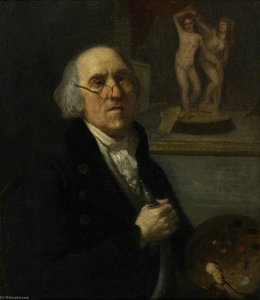 Self Portrait - Johann Zoffany
Johann Zoffany (1733–1810) represents a vital link in the development of German Neoclassicism, bridging the gap between rigorous German training and the refined elegance of the European Enlightenment. Born in Freiburg, his early education under masters like Martin Speer provided a foundation of precision that he later infused with the grace of the Italian tradition after studying in Rome under Agostino Masucci. His inclusion in the Neoclassical movement is defined by this synthesis of classical order and the sophisticated depiction of contemporary social structures.
Zoffany is most celebrated for his mastery of the "conversation piece," a genre of informal group portraiture. His works are instantly recognizable by their ability to capture intimate, social interactions with a sense of theatrical poise and clear, balanced composition. In his 1805 Self Portrait as David with the Head of Goliath, this Neoclassical sensibility is expressed through heavy classical allusion and dramatic, sculptural staging. By posing himself alongside figures reminiscent of Roman statuary, Zoffany utilizes the idealized forms of antiquity to elevate the status of the modern artist, blending historical narrative with the psychological depth of 18th-century portraiture.
Anselm Feuerbach
 Self-portrait - Anselm Feuerbach
In his 1873 Self-portrait, Anselm Feuerbach presents a contemplative study of the individual, where the subject emerges from a moody, tonalist atmosphere. The composition, characterized by a restrained palette of desaturated greys and blacks, utilizes light to carve depth into the artist's features, highlighting a distant, inward-looking gaze. This mastery of form and light underscores his position as a central figure in the German Neoclassical movement, as he successfully bridged the emotional intensity of Romanticism with the structural purity and idealized clarity of classical antiquity.
Born in Speyer in 1829, Feuerbach was the son of a renowned archaeologist, a lineage that deeply embedded the study of the ancient world into his artistic DNA. After training at the Düsseldorf Academy under Wilhelm von Schadow and later at the Munich Academy, he sought to synthesize the vibrant colorism of Venice with the rigorous aesthetics of Greek art. His work often explores mythological and poetic themes, frequently drawing inspiration from the Italian Renaissance. By blending these diverse cultural influences, Feuerbach achieved a unique visual language that prioritized elegant figure compositions and a sense of timeless, sculptural grace, making him a vital representative of Neoclassicism within the German tradition."
Joseph Karl Stieler
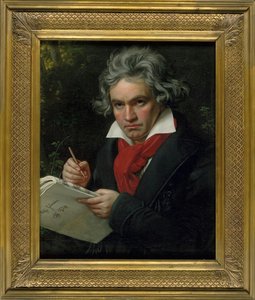 Beethoven with the manuscript of the Missa solemnis - Joseph Karl Stieler
Joseph Karl Stieler (1781–1858) stands as a preeminent figure among German Neoclassical painters, distinguished by his ability to merge the precision of his engraver father’s craft with the idealized elegance of the French school. His formal training at the Vienna Academy of Fine Arts under Heinrich Füger provided a rigorous academic foundation, but it was his time in Paris, studying under François Gérard, that truly defined his Neoclassical mastery. Influenced by the monumentalism of Jacques-Louis David, Stieler developed a signature style that balanced classical clarity with profound psychological depth, a hallmark of the movement's focus on character and form.
As the Royal Court Painter to the Bavarian monarchy from 1820 to 1855, Stieler became a vital visual chronicler of the era. His technical expertise is exemplified in Beethoven with the manuscript of the Missa solemnis (1820), a work that transcends mere portraiture. In this piece, Stieler utilizes a sophisticated interplay of light and shadow to capture the composer in a moment of intense intellectual labor. By placing the subject within a scholarly environment of manuscripts and books, Stieler employs the Neoclassical emphasis on composition and symbolic weight to elevate the portrait into a profound study of creative genius.
Johann Heinrich Wilhelm Tischbein
Johann Heinrich Wilhelm Tischbein (1751–1829) stands as a central figure in the German Neoclassical movement, a period defined by a profound reverence for the order and clarity of classical antiquity. Born into a family of artists in Haina, Germany, he received his foundational training under his father, Johann Heinrich Tischbein the Elder. His career was marked by a sophisticated ability to blend the intellectual rigor of the Enlightenment with the aesthetic grace of Greco-Roman ideals, a hallmark of the Neoclassical style.
Tischbein is perhaps most famously recognized as "Goethe Tischbein" due to his intimate connection with the literary giant Johann Wolfgang von Goethe. His representative masterpiece, Goethe in the Roman Campagna (1787), exemplifies the movement's focus on balanced composition and the harmonious relationship between humanity and the natural world. In this work, the subject is rendered with a sculptural dignity that mirrors the permanence of the classical ruins surrounding him. His versatility is further evidenced in works such as Helen and Menelaus and Ajax and Cassandra, where he applied Neoclassical principles to mythological themes, emphasizing elegant forms and dramatic, yet controlled, narratives. His legacy remains preserved in significant institutions, including the Schackgalerie in Munich."
Anselm Friedrich Feuerbach
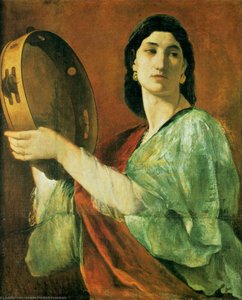 Miriam - Anselm Friedrich Feuerbach
Anselm Friedrich Feuerbach (1829–1880) stands as a pivotal figure in German Neoclassicism, distinguished by his ability to synthesize the rigorous formal clarity of antiquity with a profound Romantic sensibility. Born in Speyer into an intellectually distinguished family, his artistic evolution was shaped by the Düsseldorf Academy under Wilhelm von Schadow and later refined in the studios of Antwerp and Paris under Thomas Couture. This diverse training allowed him to transcend mere imitation of the past, instead infusing classical subjects with a palpable, emotive atmosphere.
A viewer can identify a Feuerbach composition by its elegant, sculptural figure compositions and a sophisticated use of light that sculpts the human form against often dark, atmospheric backgrounds. His brushwork is disciplined yet capable of capturing the luminous texture of skin and the heavy, rhythmic folds of drapery. In his 1862 masterpiece, Miriam, this mastery is evident; the subject is rendered with a regal dignity and a sense of divine repose that bridges the gap between historical narrative and spiritual presence. Through his meticulous layering of oil pigments, Feuerbach achieves a tonal depth that elevates his mythological and biblical scenes into timeless meditations on grace and human emotion.
Franz Xaver Messerschmidt
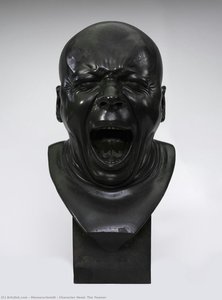 Character Head: The Yawner - Franz Xaver Messerschmidt
Franz Xaver Messerschmidt (1736–1783) occupies a singular position within the German Neoclassicism movement, acting as a bridge between the opulent traditions of the late Baroque and the emerging Enlightenment focus on psychological clarity. While his early training under his uncle, Johann Baptist Straub, and later at the Academy of Fine Arts Vienna under Jacob Schletterer, instilled in him the technical precision required for courtly portraiture, his work eventually transcended mere representation. He belongs to this era through his mastery of anatomical accuracy and his departure from the purely decorative, moving toward a more structured, intense study of the human form that aligned with the period's analytical spirit.
Messerschmidt is most renowned for his haunting "Character Heads," a series of busts that explore the extremes of human expression. His representative work, Character Head: The Yawner (1783), exemplifies this departure from classical calm. In this bronze sculpture, the artist captures a visceral, almost agonizing state of physical and psychological tension. By focusing on the raw mechanics of facial muscles and the intense distortion of features, Messerschmidt moved beyond the idealized beauty of his contemporaries to explore the profound depths of human emotion, effectively anticipating the psychological intensity of later movements.
Jean Henri Riesener
 Secretaire - Jean Henri Riesener
Born in Germany, Jean Henri Riesener (1767–1828) became a defining figure of the Neoclassical era through his mastery of the Louis XVI style. His journey from the Electorate of Cologne to the pinnacle of the French court illustrates the international reach of German craftsmanship during this period. After apprenticing under the renowned Jean-François Oeben in Paris, Riesener eventually succeeded him, becoming the ébéniste ordinaire du roi. His ability to blend structural discipline with decorative elegance placed him at the center of the Neoclassical movement, where he served as a primary provider of luxury furniture for the French Crown and a favorite of Queen Marie Antoinette.
His technical virtuosity is most evident in his use of marquetry, where he meticulously inlaid exotic woods to create intricate geometric patterns and pictorial narratives. His Secretaire (c. 1790) serves as a profound example of this skill, showcasing a sophisticated tension between stately vertical lines and organic, decorative mounts. This work exemplifies the transition of the late eighteenth century, where the opulence of the ancien régime met the refined, balanced proportions characteristic of Neoclassical design, securing Riesener's legacy as a master of form and material.
Johann Gottfried Schadow
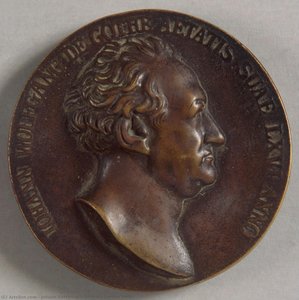 Goethe Medal - Johann Gottfried Schadow
Johann Gottfried Schadow (1764–1850) stands as a central figure among German Neoclassical painters and sculptors, embodying the movement's devotion to classical order and idealized form. His artistic journey was profoundly shaped by his apprenticeship under Antoine Tassaert and a transformative three-year study in Rome, which solidified his command of the Greco-Roman aesthetic. This dedication to the principles of antiquity allowed him to become a cornerstone of Prussian art, serving as the secretary to the Academy of Arts for over fifty years.
His mastery of the Neoclassical style is vividly captured in the Goethe Medal (1816). This bronze work, commissioned by Johann Wolfgang von Goethe, utilizes a formal profile view to convey intellectual authority—a hallmark of the era's preference for rational, dignified representation. The medal's reverse, featuring the rearing Pegasus, demonstrates Schadow's ability to weave Renaissance iconography into the Neoclassical framework. Whether crafting monumental statues or intimate portrait busts, Schadow’s work consistently sought to balance the weight of historical tradition with the refined elegance characteristic of the German Neoclassical school.
Karl Gottlieb Schweikart
 Portrait of an Unknown Man - Karl Gottlieb Schweikart
Born in Ludwigshafen in 1772, Karl Gottlieb Schweikart represents the sophisticated intersection of German training and Central European social history. His adherence to Neoclassicism is evidenced by his rigorous academic foundation at the Academy of Fine Arts in Vienna, where he mastered the clear contours and dignified composure essential to the movement. Unlike the more radical shifts seen in later romanticism, Schweikart’s work maintains the structured elegance and idealized clarity characteristic of the Neoclassical tradition, particularly in his ability to render the authority of his subjects through precise anatomical detail and controlled lighting.
His career was profoundly shaped by his relocation to Lemberg, where he became a premier chronicler of the Polish nobility and Viennese bourgeois society. This period of social upheaval provided him with a diverse array of subjects, from high-ranking military officers to the shifting aristocracy. His 1819 work, Portrait of an Unknown Man, serves as a quintessential example of this era. The painting utilizes a somber, espresso-toned palette and directional lighting to emphasize the sitter's status, marked by a heavy golden chain and a star-shaped medal. Through such meticulous attention to texture and social iconography, Schweikart captured the dignity and character of a changing European elite.
Conclusion
The legacy of German Neoclassical painters is defined by a profound commitment to the structural clarity and idealized forms of antiquity. From the architectural precision of Schinkel to the emotive portraiture of Zoffany and the sculptural rigor of Messerschmidt, these artists collectively transitioned the visual language of Central Europe toward a disciplined, rational, and harmonious aesthetic. Whether through the depiction of mythological narratives or the dignified rendering of contemporary figures, their work remains a testament to the enduring influence of Greco-Roman principles on the German artistic consciousness.
For those seeking to integrate this era of historical elegance into a modern environment, our full collection offers a gateway to these masterworks. We invite you to experience the tactile depth and timeless grace of these compositions through our museum-quality, hand-painted oil reproductions, meticulously crafted to preserve the spirit of the original masters.