The Valencian Shadow
Valencia, around 1410. A child is born into a family of artisans, a lineage defined by the steady rhythm of manual craft. This is Jaume Baçó, though history will later whisper his name as Baco or Jacomart. His early years are spent within the local Gothic scene, absorbing the rigid, formal structures of Spanish tradition. The air in his studio carries the scent of pigments and wood, a foundation of technical discipline that remains even when his surroundings change.
The trajectory shifts in 1442. A summons arrives from Alfonso V of Aragon. The painter leaves the familiar streets of Valencia for Naples. This is the hinge upon which his style turns. In the Italian south, he encounters a different light. The influence of Lorenzo Monaco and Florentine masters begins to seep into his work. He does not abandon his roots; instead, he layers the austere Valencian Gothic with new perspectives and a developing mastery of color theory.
A Life Between Courts
The movement between Spain and Italy defines his career. In 1445, he returns to Valencia, yet the pull of the Mediterranean courts remains strong. By 1446, he is back in Italy at the king's request. He moves through Rome and Tivoli, walking the same paths as cardinal Alfonso Borgia, the man who would become Pope Calixtus III. These travels are not mere excursions; they are encounters with the intellectual currents of a changing Europe.
He returns to Valencia permanently in 1451. The court painter for John II, he settles into a period of established service. While his life remains largely undocumented, his presence is felt in the commissions that populate the region's churches. He carries with him a specific synthesis: the meticulous realism of the Netherlandish tradition fused with the emerging humanist ideals of the Italian Renaissance.
The Painted Record
Much of what Baçó created has vanished into the fog of time, yet fragments remain to reconstruct his vision. His work is characterized by a refusal to fully surrender to the new Renaissance style, clinging instead to the strength of Early Netherlandish painting. The following works provide the clearest glimpses of his hand:
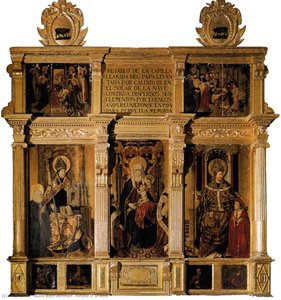
- The Retable of Catí: A late work from 1460, completed in collaboration with his follower, Juan Rexach.
- The Borgia Triptych: Located in the Collegiate Church of Xàtiva, showing his connection to papal circles.
- Cathedral Panels: Depictions of Saint Benedict and Saint Ildephonsus within the Cathedral of Valencia.
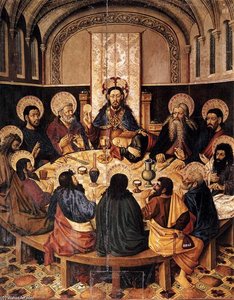
- The Last Supper: A panel held at the Cathedral Museum in Segorbe, dating to the 1450s.
He leaves behind a legacy of influence. As a mentor to younger artists, he helped steer the Valencian school through a period of intense stylistic transition. He died in Valencia in 1461, leaving a body of work that bridges the gap between the medieval and the modern.
Ερωτήσεις και Απαντήσεις
Με τι άλλα ονόματα είναι γνωστός/η ο/η Jacomart;
Ο/Η Jacomart αναγνωρίζεται και με τα εναλλακτικά ονόματα Jaime Jacomart, Jacomart Basó, Jaime Basó Jacomart, Jacopo, Jaume Baçó Jacomart.
Σε ποια ιστορική περίοδο δραστηριοποιήθηκε ο/η Jacomart;
Ο/Η Jacomart δραστηριοποιήθηκε κατά την περίοδο του/της Renaissance. Η συγκεκριμένη εποχή τοποθετεί τη δραστηριότητα του/της καλλιτέχνη/στη στην ιστορία.
Σε ποια πόλη και χώρα γεννήθηκε ο/η Jacomart;
Ο/Η Jacomart γεννήθηκε στην/στη Valencia, στο/στη Spain.