

The Digital Fragment vs. The Eternal Gaze: Why Physical Canvas Outlasts the Pixel
 Capture Every Smile: Transform Precious Family Memories into Timeless Hand-Painted Oil Masterpieces
Beyond the Digital Screen: Why Your Family's Most Precious Moments Deserve More Than a Pixel In our modern, whirlwind existence, we find ourselves navigating life through a lens of constant capture. We accumulate thousands of digital snapshots—a newb...
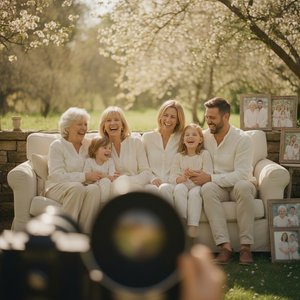
In our modern, whirlwind existence, we find ourselves navigating life through a lens of constant capture. We accumulate thousands of digital snapshots—a newborn’s first sleepy gaze, a partner’s tired but loving smile, or the exuberant laughter of a single afternoon in the park. Yet, as we scroll through these endless, glowing galleries on our smartphones, a quiet realization often settles in: despite the sheer volume of images, there is a profound sense of fragmentation. These photos are isolated fragments of time, disconnected from one another by varying lights, different angles, and the chaotic spontaneity of daily life. They capture the event, but they rarely capture the essence of a family’s enduring spirit.
A digital screen, no matter how high its resolution, lacks the tactile depth required to hold a true legacy. A photograph is often a fleeting glance, a momentary flicker of pixels that exists only as long as the battery holds charge or the cloud remains accessible. There is a profound difference between viewing a screen and standing before a canvas; one is a transient observation, while the other is an eternal gaze. To truly honor the people we love, we must move beyond the ephemeral glow of pixels and seek a medium that possesses the gravity to hold our memories for centuries. This is where the transition from a digital fragment to a physical masterpiece begins, turning a momentary flicker into a permanent fixture of family history.
The Alchemy of Oil: How Layered Pigments and Texture Create Lasting Depth
A glaze is a thin transparent or semi-transparent layer on a painting which modifies the appearance of the underlying paint layer. Glazes can change the chroma, value, hue and texture of a surface. Glazes consist of a great amount of binding medium i...
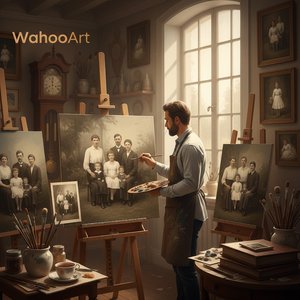
The distinction between a mere image and a true heirloom lies in the chemistry of the medium itself. Unlike the flat, two-dimensional echo of a digital print, a hand-painted oil reproduction offers a sensory dialogue that invites the viewer to pause and breathe. The magic resides in the technique of layering—the application of thin, transparent glazes that modify the appearance of underlying paint layers to change chroma, value, and hue. This process allows for a luminous quality in skin tones and an intricate richness in fabric textures that no printer can replicate.
At Mus3ums.com, our artists utilize high-quality oils specifically selected for their longevity; for instance, using safflower oil for whites to prevent the dreaded yellowing over time. The physical presence of the artwork is defined by visible brushstrokes and the subtle play of light on textured layers of pigment. This tactile resonance provides a depth of field that moves beyond representation into the realm of atmosphere. When finished with a protective coat of Damar varnish, the surface is shielded from dust, moisture, and atmospheric pollutants, ensuring that the vibrant colors and structural integrity remain intact for generations.
From Memories to Masterpieces: The Art of Custom Portrait Merging and Style Remixing
 The Art of Reunion: Creating Timeless Family Legacies Through Custom Oil Portrait Merging
The Digital Fragment: Why Modern Snapshots Fail to Capture the Family Soul In our modern, whirlwind existence, we find ourselves navigating life through a lens of constant capture. We accumulate thousands of digital snapshots—a newborn’s first sleepy...
The most profound narratives in fine art are rarely captured within the confines of a single, fleeting moment; rather, they are woven from the delicate threads of various experiences, faces, and landscapes. For many families, the desire to possess a unified legacy presents a creative challenge: how does one reconcile separate photographic fragments into a singular, breathtaking vision? This is achieved through the sophisticated art of portrait merging, where disparate images—perhaps a photo of a grandparent from decades ago and a recent snapshot of a grandchild—are meticulously recomposed into a single, cohesive oil painting.
This process goes beyond simple technical manipulation; it is an act of high-level curation. Our services allow for true "period shifts," where a modern selfie can be transformed into a 17th-century masterpiece in the style of Rembrandt, or a family group can be reimagined with the impressionistic, light-drenched brushwork of Monet. We even offer the ability to "remix" art history, allowing clients to request specific styles such as the thick, expressive impasto of Van Gogh. This flexibility ensures that the final artwork does not just look like the subjects, but embodies the emotional weight and historical grandeur the family wishes to project.
Architectural Integration: Scaling Fine Art for Grand Interiors and Multi-Panel Displays
For the discerning collector or the professional decorator furnishing large-scale hospitality spaces, art must do more than decorate; it must define the architecture. The modern trend of multi-panel paintings—splitting a single composition across three, four, or even five panels—offers a sophisticated way to command wide walls or grand staircases. These layouts create a contemporary, rhythmic flow that directs the eye through a room, ensuring that the brushstrokes and colors transition seamlessly across every edge for a unified, cinematic effect.
Beyond standard canvases, we specialize in large-format architectural art, including murals and ceiling frescoes. These works are painted on massive canvas rolls and shipped globally, allowing professionals to recreate the grandeur of historical ceilings, such as the Sistine Chapel, within modern hotel or corporate environments. Whether it is a custom MirrorWrap for a frameless, modern look or an ExtendedWrap where the artist continues the painting around the edges of the stretcher bars, the goal is to integrate fine art into the very fabric of the building's design.
Preserving the Heritage: Technical Excellence in Materials and Longevity
 Oil painting
Oil painting is a painting method involving the procedure of painting with pigments combined with a drying oil as the binder. It has been the most common technique for artistic painting on canvas, wood panel, or copper for several centuries. The adva...
An heirloom is only as enduring as the materials from which it is constructed. To prevent the structural failures common in lower-quality works, our process begins with a foundation of 100% cotton artist canvas, primed with traditional gesso to provide a flexible and durable base. Our engineers use reinforced, braced stretcher bars to prevent warping over time, ensuring the canvas remains taut and true. The chemistry of the paint itself is managed with rigorous academic standards, utilizing acid-free matting and specific binders to ensure that the pigments remain vibrant for decades.
True preservation requires attention to both the internal structure and the external environment. While we provide the technical foundation, we also advise collectors on long-term care, such as using acid-free matting to create an air gap between prints and glass to prevent moisture damage. This commitment to excellence ensures that whether a piece is a custom commission or a studio art collectible, it remains a stable, high-value asset capable of being passed down through the lineage of a family or a corporate estate.
The Commission Workflow: Ensuring Precision from Digital Mockup to Final Delivery
We understand that for procurement managers and collectors alike, certainty is as important as artistry. To remove the uncertainty inherent in custom commissions, our Professional Digital Mockup Service allows clients to see the composition before a single drop of oil touches the canvas. This stage is essential for complex orders, such as group portraits where multiple people from different photos must be integrated, or when specific color matching is required to align with an existing interior palette. Revisions are unlimited during this phase, ensuring the vision is perfected.
Our streamlined six-step process is designed for operational reliability:
- Confirmation: An immediate confirmation email follows your order, providing a clear starting point.
- Digital Mockup: A professional digital rendering is created for your review and approval of colors and composition.
- Hand-Painting: Our academy-trained artists execute the work by hand over 2–4 weeks on premium cotton canvas.
- Pre-ship Approval: We provide a high-resolution photo of the completed painting for your final inspection.
- Framing & Packaging: Once approved, the piece is professionally framed in solid wood and secured in reinforced, double-walled packaging.
- Global Logistics: The artwork is dispatched via DHL Express or FedEx with full tracking, ensuring reliable delivery to over 70 countries.