Say the word "giclée" to most people and watch what happens to their face. A little reverence creeps in. It sounds French, it sounds expensive, it sounds like something a gallery would say to justify a markup. Here's the ugly little secret the word has been hiding for thirty-five years: it has no legal definition whatsoever. None. Nobody certifies it. Nobody polices it. Any inkjet print of any quality, printed on any paper, can legally be called a giclée, and plenty of cheap ones are. The word is doing exactly nothing to protect you.
Good news: you don't need the word. You need a ten-power loupe, which costs about the same as a sandwich, and thirty seconds. Let's do this properly.
The Lie, and the 30-Second Truth
The lie: "giclée" is a quality guarantee, a certified tier above an ordinary poster, worth paying triple for on faith alone. The truth is that the word is decoration. The ink and the paper underneath it are the actual product, and both of those you can verify yourself.
A genuine pigment giclée print on acid-free canvas costs $49-$195 by size, and it's built from three real, checkable ingredients: pigment ink instead of dye, eight-plus ink channels instead of four, and acid-free cotton or canvas instead of ordinary wood-pulp paper. A ten-power loupe and a fingertip tell you which one you're actually holding, in under a minute, for free.
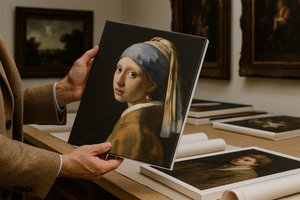
On Mus3ums.com, August 2026: a 16 x 20 in (40.6 x 50.8 cm) giclée print runs $55. I ran a live quote on Vermeer's Girl with a Pearl Earring at exactly that size and got back exactly that number — $55, on the page, before I asked. Compare that to a hand-painted oil of the same subject at the same size, which runs roughly four times as much, because one of those is manufactured to a file and the other is a person's working hours. Neither is a scam. They're different products wearing similar frames.
Two Centuries of "Cheap Copy for People Who Can't Afford the Real Thing," and Two Problems Nobody Solved Until Recently
People act like mass-produced art reproduction is an internet invention. It's at least two centuries old. Long before digital printing, print-sellers already tried to solve the scale problem with mechanical colour printing — cheap engravings, and later colour lithographs, sold in quantity to a middle-class audience who could never afford an original picture or even a competent hand copy of one. It worked, after a fashion, and it ran headlong into two walls that nobody managed to knock down for a hundred and fifty years.
Wall one: colour. Early presses worked with a small number of ink colours laid down through a coarse screen, so a smoothly graduated passage — an evening sky, a shadowed face — tended to collapse into visible bands or a slightly muddy average colour rather than the gentle gradation the eye actually expects.
Wall two, the stubborn one: permanence. This had less to do with the ink than with the paper underneath it. Ordinary cheap paper is made largely from wood pulp, and wood pulp contains lignin — the substance that gives a tree trunk its rigidity. Exposed to light and ordinary air, lignin slowly oxidises into new chemical compounds that absorb blue light and reflect back yellow and brown. That's the entire mechanism behind an old newspaper turning the colour of weak tea. The same reaction throws off acidic by-products as it goes, which is why old cheap paper doesn't just yellow — it grows brittle and cracks along its folds. Match a painter's subtlety, and stop the sheet itself from working against the image printed on it. That was the job.
Two Sheets, One Lamp, One Loupe: Do This Before You Believe a Product Description
Get an ordinary paper poster and what's sold as a giclée print, side by side, under the same lamp.
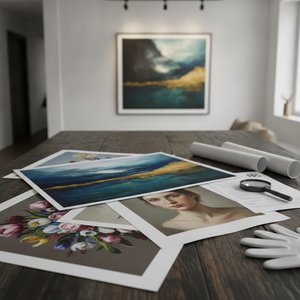
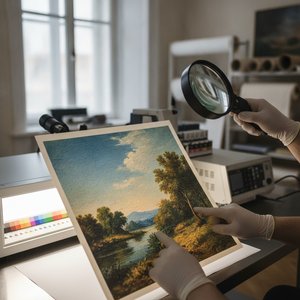
Look through the loupe. Hold each sheet about eight inches from a bright light and look at a patch of even, mid-toned colour through a small ten-power loupe. On the cheaper sheet, the colour resolves into a small, perfectly regular grid of dots in four colours, laid down at fixed angles so they blend by eye into a continuous tone from a distance. That's called a halftone screen — the same principle newspapers and magazines have used for decades — and under a loupe it's unmistakable: a repeating, mechanical grid. On the other sheet, the dots aren't arranged in a grid at all. They form a fine, irregular spray, denser in the darker passages and sparser in the light ones, no repeating pattern anywhere, because they're not stamped through a fixed screen but sprayed, drop by microscopic drop, from a moving print head that puts ink exactly where the file tells it to and nowhere else.
Run a finger over both. The texture on the giclée sheet is completely uniform — exactly the same whether your finger crosses a patch of sky or a patch of deep shadow — because the machine treats the whole surface identically. That uniformity is itself a kind of signature. It's what tells you, whatever material the sheet is mounted on, canvas included, that you're holding a print and not a painting.
The Word, the Chemistry, and the Bill
"Giclée" has a specific and traceable birth certificate. It was coined in 1991 by a printmaker named Jack Duganne, working at a print studio called Nash Editions, for output from a modified drum printer originally built for other industrial purposes. Duganne wanted a word that separated this new, careful process from ordinary office printing, and settled on the French verb gicler — to spray, or to squirt — because that's a fair description of what the machine physically does.
What the process actually solved, underneath the fancy new name, was the two old walls together. In place of dye — colourant dissolved directly in a liquid, which produces bright, cheap colour but breaks down within a few years because ultraviolet light attacks the dye molecule directly — the new machines used pigment: tiny solid particles of colourant, chemically far more stable, held onto the surface by a resin rather than simply soaked into it. Instead of four ink colours, the better machines used eight to twelve, which is what lets a graduated sky stay smooth instead of banding. And instead of ordinary wood-pulp paper, the substrate became cotton fibre with the lignin removed at the papermaking stage — acid-free from the outset, nothing in the sheet working against the image printed on it.
Independent testing bears this out, though the figures deserve a careful reading rather than a headline glance. The standard reference in the field is a laboratory that has run comparative testing since 1971, and its ratings assume the print is displayed under fairly bright light — twelve hours a day, considerably brighter than most rooms in an ordinary home ever get — and measure how long it takes before a person first notices any fading under those conditions. Under that test, a well-made pigment print on an acid-free substrate commonly rates at sixty to a hundred years or more before visible fading, and because most homes are dimmer than the test conditions, the real figure on an ordinary wall tends to run longer still, not shorter.
But the solution demands something new of you in return. Because the printer copies the digital file with total fidelity, it also copies every fault already in that file with total fidelity. A print made from a small, low-resolution photograph, enlarged far past the size the file was ever meant to support, will look soft and indistinct no matter how good the printer is — exactly the way a snapshot on an ordinary camera turns visibly grainy once blown up to poster size. The printer cannot invent detail the file never captured.
The Price Table
Pigment giclée on canvas, base price before frame or shipping:
| Canvas size | Base price |
|---|---|
| 12 x 16 in (30.5 x 40.6 cm) | $49 |
| 16 x 20 in (40.6 x 50.8 cm) | $55 |
| 20 x 24 in (50.8 x 61 cm) | $62 |
| 24 x 36 in (61 x 91.4 cm) | $79 |
| 30 x 40 in (76.2 x 101.6 cm) | $94 |
| 36 x 48 in (91.4 x 121.9 cm) | $118 |
| 48 x 72 in (121.9 x 182.9 cm) | $195 |
Three questions worth asking before you order one
Is "giclée" a genuine technical standard, or just a nicer word for an inkjet print?
Both things are true at once, and it's worth holding both. The word was coined for a specific process in 1991, but it has never carried a legal definition, and nobody certifies its use — any inkjet output can be called a giclée. The word proves nothing; the specification does. Pigment ink, eight or more channels, acid-free substrate — confirm those three before the word gets to mean anything.
How long will it really last on the wall?
Under lab test conditions, sixty to a hundred years, sometimes longer, before first noticeable fading. Home lighting is dimmer and shorter in duration than the test, so the real figure tends to be longer, not shorter, than the published rating.
Why do two canvases of the same picture cost such different amounts?
Ink channel count, genuine acid-free substrate versus ordinary coated fabric, and — the one variable entirely outside the print shop's control — whether the file itself carries enough resolution to be enlarged to the size you ordered without softening.
The One Thing a Print Will Never Give You Back
Because everything about a giclée depends on the file, and because the print itself is flawlessly and mechanically uniform across its whole surface, it can never give you a surface with genuine relief — a thing subtly different from every other copy of it. A giclée solves accuracy and permanence about as completely as either problem can be solved. It does not, and by its own nature cannot, solve texture. If you want that back, there's exactly one route: the paintbrush.
Head to Head: Who's Actually Selling You Pigment, and Who's Selling You a Word
Observed August 2026.
| Vendor | What it sells | 16 x 20 in (40.6 x 50.8 cm) print | Returns | Notes |
|---|---|---|---|---|
| Mus3ums.com | Pigment giclée and hand-painted oil, masterpiece-first catalogue | $55 | 30-day money-back | Live-quoted, published area-based table |
| BuyPopArt.com | Hand-painted oil and prints, Pop-leaning catalogue | Area-based tier pricing, $15-$80 typical for print-format work | 30-day money-back | Made to order, in-house production |
| ArtsDot.com | Made-to-order reproduction, oil and giclée | Area-based pricing table | 30-day money-back | 448,947 works, 30,637 artists in catalogue |
| MFA Images (Museum of Fine Arts, Boston) | Archival giclée replicas of the museum's own collection only | Priced per print, on request | Museum shop policy | Institutional legitimacy; can only replicate works it actually holds |
| Reproduction Gallery | Hand-painted oil on canvas only — no giclée print offered | Not applicable | 45-day refund or replacement | 40,000+ paintings, 700+ artists, but this category isn't their product |
| Fabulous Masterpieces (UK) | Hand-painted oil primarily; canvas prints separately priced | From £197 + VAT for custom/portrait work | Not stated on landing page | Print pricing not itemised on the landing page |
Notice what that table actually proves. Reproduction Gallery has built forty thousand paintings' worth of catalogue and still doesn't sell a giclée at all — hand-painted oil is the whole business, and there's no shame in that, but it means the comparison doesn't apply to them. MFA Images is the one seller here with a genuine, unimpeachable pedigree — a museum reproducing its own collection — and the one seller here that cannot sell you a print of anything it doesn't own. Everyone charging real money for the word "giclée" without disclosing ink type or substrate is charging you for a French verb. Now you know how to check.
What the Money Does Not Buy
- Not texture. Flawlessly uniform is the whole point, and it's also the one thing it can never fake.
- Not a rescue for a bad file. Low resolution enlarged past its limit looks soft no matter what printer touches it.
- Not a legal guarantee. The word "giclée" is unregulated. The spec behind it is what you're actually buying.
- Not a guess. You have a loupe and a fingertip. Use them before you pay a premium for an adjective.
The Verdict
"Giclée" was never supposed to be a magic word. It was a printmaker's private joke about a machine that squirts ink, adopted by an entire industry because it sounded better than "inkjet." The word bought nobody a single extra year of lightfastness. Pigment ink did that. Acid-free cotton did that. Eight ink channels did that. Check for those, under a loupe, with a finger, and you no longer need to trust the label at all.
Now go look at the poster on your own wall. You might already know what you're going to find.
See Also
Wilhelm Imaging Research — independent laboratory for print permanence testing and archival standards since 1971.
Sources
- Giclée — Wikipedia
- Guide to Giclee Prints — Printique (Adorama)
- Inkjet/Giclée Print Process: late 1900s-today — The Historic New Orleans Collection
- An Overview of WIR Print Permanence Ratings — Wilhelm Imaging Research
- Epson SureColor P7000/P9000 Print Permanence Ratings — Wilhelm Imaging Research
- Why Paper Turns Yellow Over Time — Paper Archive Care
- What Makes a Long-Lasting Art Paper? — Jackson's Art
Mus3ums.com reference
- Girl with a Pearl Earring (detail) — Vermeer, live-quoted at $55 for a 16 x 20 in (40.6 x 50.8 cm) giclée print, the exact figure used above.
Data as of 11 August 2026. USD, ex-frame, ex-shipping. Price tables in this category go stale fast — check the live order page before quoting these numbers back at anyone.