Introduction
Walking through a collection of Egon Schiele’s work is not merely an act of looking; it is an act of feeling. To encounter his canvases is to step into a world where the boundaries between the skin and the soul seem to dissolve, leaving behind nothing but raw, unshielded emotion. His lines do not just trace the human form; they pulse with the rhythm of a heartbeat, often jagged, frequently trembling, yet always profoundly honest. As we prepare to journey through twenty-five of his most transformative masterpieces, we invite you to leave behind the comfort of the predictable and embrace the beautiful intensity of the expressive.
Born in the twilight of the 19th century in the vibrant, turbulent heart of Vienna, Schiele emerged from the shadow of his mentor, Gustav Klimt, to forge a visual language all his own. His era was one of immense cultural shifting—a time when the rigid structures of the old world were fracturing under the weight of modern psychology and social upheaval. Schiele captured this fragmentation perfectly. His life, marked by early loss and a restless, searching spirit, found its mirror in an art style that rejected the polished beauty of the past in favor of something much more visceral. He turned his gaze inward, exploring themes of mortality, desire, and the fragile tension of existence with a courage that was as unsettling as it was breathtaking.
Why does his work continue to resonate so deeply in our modern homes and hearts? Perhaps because, in an age of digital perfection and filtered realities, Schiele offers us the beauty of the imperfect. His use of distorted figures and stark, emotive contours speaks to a universal human truth: that there is profound dignity in our vulnerabilities. Whether it is the haunting intimacy of a self-portrait or the dramatic tension of a seated figure, his work reminds us that art is at its most powerful when it dares to be vulnerable.
In the following curation, we will explore a selection of works that define his legacy. From his early, Klimt-inspired explorations to the mature, psychologically piercing compositions that cemented his place in the annals of Expressionism, this list is designed to guide you through the evolution of a master. We invite you to discover the textures, the colors, and the unmistakable spirit of Egon Schiele—a journey through twenty-five works that continue to challenge, provoke, and inspire.
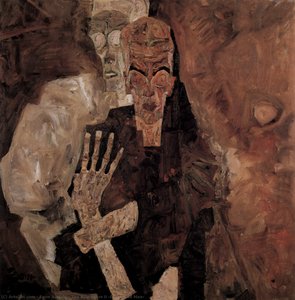
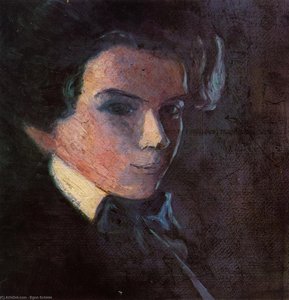
The Self-Seers II (Death and Man) - Egon Schiele
There’s a gaze in The Self-Seers II (Death and Man) by Egon Schiele that follows you—not with judgment, but with understanding . This isn’t merely a portrait; it is a mirror reflecting our most profound vulnerabilities. As one of the most haunting entries in our collection of the top 25 artworks of Egon Schiele, this piece captures the raw, visceral energy of early Expressionism through its jagged, angular lines and heavy, tactile impasto.
The palette is a somber dance of earthy ochres, deep browns, and ghostly whites, creating an atmosphere that feels both claustrophobic and deeply intimate. A skeletal hand reaches from the shadows, serving as a powerful symbol of mortality that invites us to contemplate the fragility of existence. Now, imagine that gaze in your space. Not watching you, but reminding you : you are seen. You are part of the story. Bringing this masterpiece into your home—perhaps as a textured oil reproduction on canvas—adds a layer of sophisticated introspection and dramatic flair to any modern study or gallery wall.
Mother with Two Children - Egon Schiele
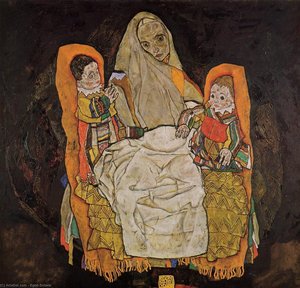 Mother with Two Children - Egon Schiele
In the quiet, heavy stillness of Mother with Two Children , Egon Schiele captures a moment where familial tenderness meets the profound shadows of an era in turmoil. This masterpiece earns its place among the top 25 artworks of Egon Schiele through its breathtaking ability to balance raw, psychological vulnerability with a hauntingly beautiful composition. The painting breathes with a palette of earthy ochres, muted beiges, and deep browns, punctuated by sudden, flickering accents of yellow and orange that suggest a resilient spark of life amidst the gloom.
Schiele’s signature angular lines and expressive, thick impasto brushstrokes create a tactile landscape of emotion, where the figures seem to emerge from a dark, textured void. For the modern collector, this piece offers more than just historical significance; it brings a sense of soulful sophistication and quiet prestige to a room. Whether placed in a minimalist study or a cozy, sunlit nook, its somber elegance and deep emotional resonance serve as a powerful anchor, inviting reflection and a deeper connection to the human condition.
The Family - Egon Schiele
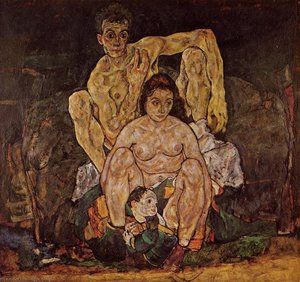 The Family - Egon Schiele
In The Family by Egon Schiele, the eye is immediately drawn to the visceral, thick impasto that defines this masterpiece. The paint is not merely applied; it is sculpted, with jagged, gestural brushstrokes creating a textured landscape of ochre and earthy browns that pulse with psychological tension. These heavy, tactile layers capture the raw, unsettling energy of Austrian Expressionism, where every ridge of paint mirrors the emotional weight of the figures within.
This work stands as a cornerstone in our collection of the top 25 artworks of Egon Schiele because it transcends mere portraiture to become an exploration of human vulnerability. At Mus3ums.com, we believe such profound materiality deserves to be felt, not just seen. Our hand-painted oil reproductions are meticulously crafted to preserve this three-dimensional quality , ensuring that the heavy textures and expressive, angular lines of Schiele’s original vision bring a sense of historical depth and soulful intensity into your own living space.
Four Trees - Egon Schiele
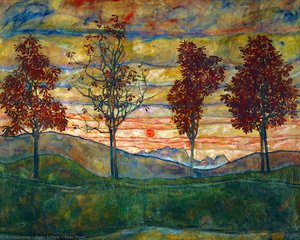 Four Trees - Egon Schiele
In Four Trees (1917), the lines of Egon Schiele aren’t merely drawn; they are choreographed in a visceral, rhythmic dance across the canvas. This masterpiece is not just a landscape; it is a dance frozen in time , where the organic forms of the trees pulse with the very heartbeat of Austrian Expressionism. As you gaze upon the vibrant interplay of autumnal reds and earthy greens against a sunset sky of burning orange, you feel a profound emotional resonance.
Schiele uses these botanical subjects as potent symbols: the robust outer trees represent societal strength, while the paler, decaying inner figures mirror our own internal struggles. It is a breathtaking symphony of Art Nouveau elegance and raw psychological depth. What if your living room could hold that same delicate balance? What if your walls could breathe rhythm and invite such deep, soulful reflection into your home? Bringing this iconic work into your space means embracing the beautiful chaos and harmony that defines Schiele’s legendary spirit.
House on a River (also known as Old House I) - Egon Schiele
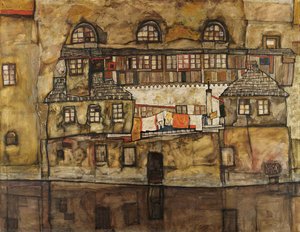 House on a River (also known as Old House I) - Egon Schiele
In House on a River (also known as Old House I) , Egon Schiele captures a moment of profound stillness where the landscape becomes a mirror for the human soul. This masterpiece earns its place among the top 25 artworks of Egon Schiele by transforming a simple architectural subject into an evocative study of melancholy and resilience. Painted in 1915 amidst the shadows of World War I, the work breathes with a heavy, atmospheric tension; the weathered textures of the aged house and the rhythmic placement of its windows seem to pulse with a quiet, historical memory.
The palette is a masterful dance of warm ochres, deep browns, and subtle earth tones, sculpted by light and shadow to create a sense of tactile depth that feels almost three-dimensional. For the modern collector, this piece offers more than just visual intrigue; it brings a sophisticated, contemplative energy to a room. Whether hung in a minimalist study or a cozy reading nook, its expressive brushstrokes and emotional gravity provide a soulful anchor, inviting a sense of introspective calm into contemporary living spaces.
Pregnant woman and Death - Egon Schiele
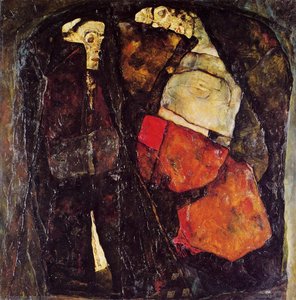 Pregnant woman and Death - Egon Schiele
To stand before Pregnant Woman and Death by Egon Schiele is to encounter a profound, breathless confrontation with the fragility of existence. Created in 1911, this masterpiece captures the raw, psychological intensity that defines Schiele’s place among the top 25 artworks of Egon Schiele . The painting pulls you into a claustrophobic, somber world where the boundaries between life and mortality blur through jagged, angular lines and a hauntingly muted palette of ochre and deep browns.
Schiele utilizes a heavy, tactile impasto technique, where visible brushstrokes lend a sculptural weight to the figures. The composition is strikingly unsettling; a pregnant woman, rendered with a sense of profound sorrow, exists in a stark, fragmented space alongside a gaunt, monk-like personification of death. This work is essential for understanding Schiele’s Expressionist breakthrough—his ability to reject traditional beauty in favor of an unflinching, emotional truth. Even today, bringing such a powerful, evocative piece into a home allows for a deep, meditative connection to the enduring mysteries of the human condition.
Portrait of Victor Ritter von Bauer - Egon Schiele
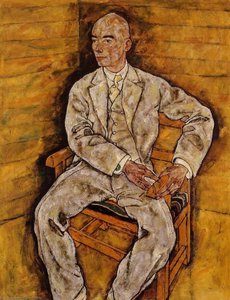 Portrait of Victor Ritter von Bauer - Egon Schiele
While the world often remembers Egon Schiele for his raw, turbulent self-portraits, the 1918 Portrait of Victor Ritter von Bauer reveals a different side of his genius: a mastery of controlled intensity. Painted during one of the most unstable years in European history, this work captures a profound stillness that feels almost heavy with the weight of an era ending. Schiele moves away from pure distortion here, instead using elongated forms and a restrained palette of deep browns and muted ochre to sculpt a subject caught in quiet contemplation.
The technical brilliance lies in his use of light and shadow; he doesn't just illuminate the man in the dark suit, but uses broken, decisive lines to create a restless energy beneath a calm exterior. The clasped hands and piercing, ambiguous gaze invite us into a psychological depth rarely seen in traditional portraiture. This sense of focused, quiet strength makes such a piece an incredible anchor for a modern home office or study, providing a sophisticated atmosphere of deep thought and intellectual presence.
Dead City (City on the Blue River) - Egon Schiele
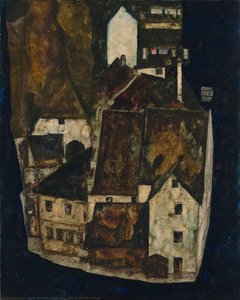 Dead City (City on the Blue River) - Egon Schiele
In 1911, as Vienna teetered between imperial grandeur and the shadows of modernity, Egon Schiele captured a hauntingly beautiful moment in “Dead City (City on the Blue River).” This monochrome masterpiece is far more than an urban landscape; it is a psychological meditation on mortality. When you look closely at this work, you realize the lines aren’t merely drawn; they are choreographed . The sharp, angular architecture and skeletal steeples create a rhythm of tension and release, making the chaos of a crumbling civilization feel like a delicate, frozen dance.
Through masterful hatching and dramatic contrasts, Schiele transforms stone and shadow into an emotional landscape that breathes with anxiety and grace. For those looking to infuse their homes with profound depth, this piece offers a way for your walls to breathe rhythm . It is a striking addition to any collection of the top 25 artworks of Egon Schiele, bringing a sophisticated, existential energy to a modern living space. Imagine the balance this moody, nocturnal silhouette could bring to a minimalist room—a quiet, powerful echo of history.
Moa - Egon Schiele
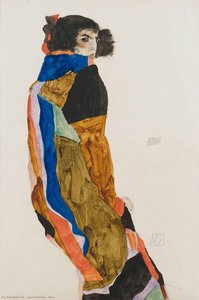 Moa - Egon Schiele
Step into the quiet, introspective world of 1911 Vienna with Moa , a breathtaking watercolor that captures the very moment Egon Schiele began to break free from the decorative elegance of Gustav Klimt. As you gaze upon this piece, you aren't just looking at a portrait of a dancer; you are witnessing the raw, pulsing energy of early Expressionism. The artwork presents a striking silhouette, where the subject’s face remains tender and realistic, yet she is enveloped in a robe of dramatic, geometric abstraction.
The watercolor technique offers a beautiful, fluid texture—loose, gestural washes of color that create a sense of movement and mystery. There is a profound, melancholic beauty in the way the angular shapes of her garment seem to fragment the space around her, inviting deep reflection. For the modern collector, bringing a Schiele reproduction into your home offers more than just decor; it introduces a sophisticated focal point of psychological depth. Whether placed in a sunlit reading nook or a minimalist studio, Moa inspires a sense of creative contemplation and timeless elegance.
untitled (938) - Egon Schiele
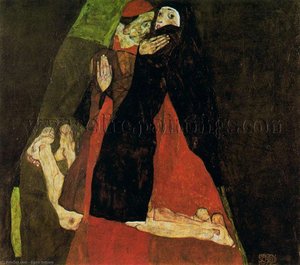 untitled (938) - Egon Schiele
What story does the shadowed, turbulent atmosphere of Untitled (938) by Egon Schiele tell us about the human heart? Created in 1917 amidst the profound upheaval of wartime Vienna, this piece emerges from a period of intense personal and social fragility. As one of the most powerful entries in our collection of the top 25 artworks of Egon Schiele , it breaks ground by transforming a private moment of intimacy into a universal study of vulnerability. The figures, entwined in a passionate embrace, feature the artist's signature elongated limbs and restless, expressive lines that vibrate with raw emotion.
The striking contrast of vibrant red clothing against a somber, dark palette creates a visual anchor that is both tender and haunting. For those looking to curate a meaningful space, this painting offers more than just decor; it provides an emotional escape into a world of profound depth. Bringing such an intense masterpiece into your home allows you to embrace the beauty of human connection and the delicate balance between passion and mortality, making it a breathtaking focal point for any modern gallery wall.
Setting Sun - Egon Schiele
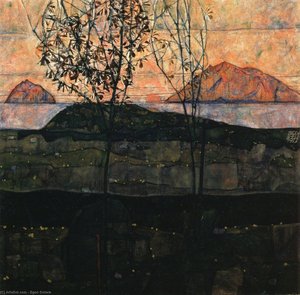 Setting Sun - Egon Schiele
There is a profound, quiet ache in witnessing the end of a day, a moment where light and shadow dance in a final, desperate embrace. This evocative atmosphere is captured perfectly in Setting Sun by Egon Schiele . As one of the most poignant entries in our collection of the top 25 artworks of Egon Schiele , this 1913 masterpiece moves beyond simple landscape to touch the very soul of Austrian Expressionism.
Schiele utilizes a striking palette of muted reds and deep blues, where thick, textured impasto brushstrokes bring a visceral energy to the fiery sky. A solitary, weathered tree stands as a silent sentinel against distant mountains, while two subtle figures appear lost in contemplation. The painting vibrates with themes of mortality and the fleeting nature of time, yet it possesses a serene, captivating beauty. Bringing a piece like this into your home does more than decorate a wall; it introduces a window into deep human emotion, offering a sophisticated focal point that invites quiet reflection and transforms any modern living space into a sanctuary of thought.
Crouching Woman with Green Headscarf - Egon Schiele
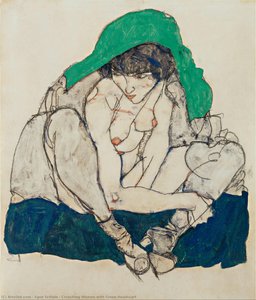 Crouching Woman with Green Headscarf - Egon Schiele
What story does the quiet, shadowed environment of Crouching Woman with Green Headscarf by Egon Schiele tell us about the hidden corners of the human soul? Created in 1914, this work emerged from the turbulent heart of Viennese Expressionism, a period where artists began to peel back the layers of social decorum to reveal raw, psychological truths. As one of the top 25 artworks of Egon Schiele, this piece broke ground by replacing traditional beauty with an honest, often unsettling intimacy.
The vibrant green of the headscarf acts as a striking anchor amidst a more somber, muted palette, drawing the eye to a figure caught in a moment of profound introspection. In modern interior design, bringing such a piece into your home offers a curated escape—a way to introduce a sense of historical depth and emotional complexity to a room. Whether you are decorating a quiet reading nook or a bold living space, Schiele’s mastery of charcoal and pastel textures provides a captivating focal point that invites viewers to linger in the mystery of the subject's gaze.
Secession 49. Exhibition - Egon Schiele
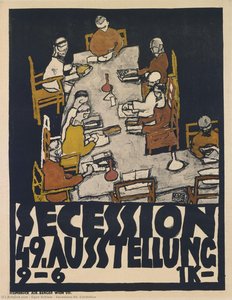 Secession 49. Exhibition - Egon Schiele
In the twilight of 1918, as the world grappled with the heavy shadows of the Great War, Egon Schiele captured a hauntingly still moment in Secession 49. Exhibition . While many associate Schiele with raw, distorted figures, this masterpiece reveals his ability to find profound psychological depth within a seemingly mundane café setting. Through a masterful use of monochrome, Schiele strips away the distractions of color, leaving only the sharp, angular lines and somber greys that define his Expressionist genius.
The painting breathes with a quiet tension; the scattered vases and everyday objects on the table serve as delicate metaphors for the fragility of human existence. Every shadow and stark contour invites us to contemplate the heavy atmosphere of a fracturing era. For those looking to curate a sophisticated sanctuary, this piece is an extraordinary choice. Its intense focus and emotional gravity provide a powerful, contemplative energy, making it a commanding centerpiece that inspires deep thought and a productive, dignified atmosphere in a modern home office or private study.
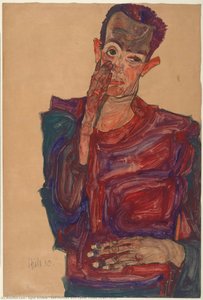
Self-Portrait with Eyelid Pulled Down, 1910 - Egon Schiele
Imagine standing before a mirror in a dimly lit room, where the reflection staring back is not just a face, but a map of raw, unshielded vulnerability. In Self-Portrait with Eyelid Pulled Down (1910), Egon Schiele invites us into this intimate, unsettling space. The painting captures a profound moment of psychological excavation; through the deliberate gesture of pulling down his eyelid, Schiele creates a barrier between his inner turmoil and the outside world.
This work earns its place among the top 25 artworks of Egon Schiele because it transcends mere portraiture to become a visceral study of grief and mortality. Using muted ochres and frantic, expressive watercolor washes, he translates the shadows of his personal losses into visible, trembling lines. It is a masterpiece of Expressionism that reminds us how art can give form to our most hidden anxieties. Bringing such a powerful piece into a modern home does more than decorate a wall; it introduces a profound layer of meaning and a conversation about the beautiful, complex resilience of the human spirit.
Krumau - Egon Schiele
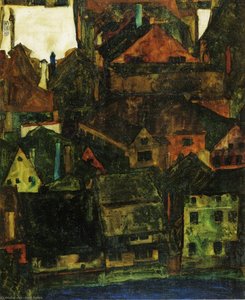 Krumau - Egon Schiele
In Egon Schiele’s 1911 masterpiece, "Krumau," a deep, earthy red anchors the composition, immediately setting a mood of grounded intensity and historical weight. This isn't just a landscape; it is a visceral window into Viennese Expressionism. Schiele’s mastery lies in his ability to use a bold, emotive palette—intertwining vibrant yellows with somber browns—to transform a Bavarian townscape into a psychological study. The thick, tactile impasto brushstrokes create a rhythmic energy that makes this work a standout among the top 25 artworks of Egon Schiele .
For those looking to curate a sophisticated modern interior, "Krumau" offers incredible versatility. The painting’s warm, autumnal tones and dramatic interplay of light and shadow make it an ideal focal point for a dining room or a study, where it can anchor the emotional lighting of the space. Whether you are drawn to its architectural detail or its restless spirit, bringing this piece into your home adds a layer of profound narrative depth and intellectual conversation to your decor.
Black-Haired Girl with Lifted Skirt - Egon Schiele
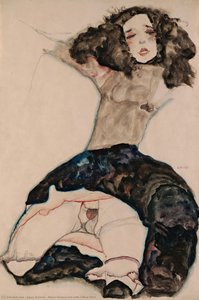 Black-Haired Girl with Lifted Skirt - Egon Schiele
In the hauntingly beautiful Black-Haired Girl with Lifted Skirt , Egon Schiele invites us into a moment of profound, raw vulnerability. Created in 1911, this work is far more than a mere portrait; it is a visceral dance between joy and unease. As you gaze upon the subject, her dark hair cascades like a turbulent storm around a face caught in a pose that feels simultaneously defiant and fragile. Schiele’s signature Expressionist technique shines through his bold, gestural lines and the complex, sculptural texture of charcoal and pastel.
The elongated limbs and skeletal precision serve as symbolic whispers of the artist's own preoccupations with mortality and the fleeting nature of life. Bringing a piece like this into your home is an act of transformation . It moves beyond simple decoration, turning a quiet corner of your living space into a gallery of the soul . To possess a reproduction of such intensity is to surround yourself with the very essence of human emotion and the enduring genius of Schiele.
Old Gable - Egon Schiele
 Old Gable - Egon Schiele
What story does the weathered architecture in Old Gable by Egon Schiele tell us about the beauty of transformation? Created in 1913, this piece serves as a profound meditation on decay and the relentless march of time. Rather than capturing a pristine landscape, Schiele focuses on a structure in flux, using scaffolding and exposed beams to symbolize the labor and vulnerability inherent in existence. This work stands out among the top 25 artworks of Egon Schiele because it moves beyond his famous psychological portraits to showcase his mastery of texture and architectural tension.
The muted palette of earthy reds and deep browns creates a melancholic, soulful atmosphere that is perfect for adding a sense of history and depth to a modern interior. For those looking to curate a home that feels like an emotional escape, this painting offers a window into the Expressionist spirit—reminding us that there is profound grace found within imperfection and the process of rebuilding. It is a sophisticated choice for collectors seeking art with true narrative weight.
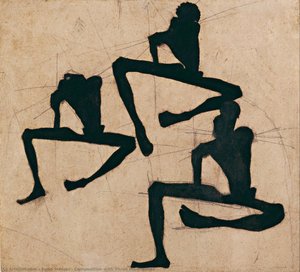
Male Nude, Propping Himself Up - Egon Schiele
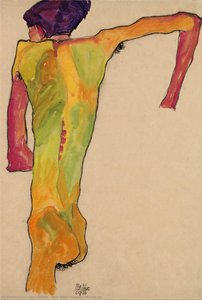 Male Nude, Propping Himself Up - Egon Schiele
In the quiet, trembling stillness of Male Nude, Propping Himself Up , Egon Schiele captures a moment where breath seems to pause against the weight of existence. This 1910 masterpiece earns its place among the top 25 artworks of Egon Schiele by daring to strip away the decorative, leaving only the raw, psychological truth of the human form. The composition is a masterclass in tension; the figure’s limbs, rendered with Schiele's signature angularity, stretch across the canvas amidst a vibrant, almost feverish palette of warm yellows and sun-drenched oranges.
The texture of the work feels alive, with visible energy that breathes life into the subject's vulnerability. There is a profound, modern sophistication in how this piece interacts with light and shadow, making it a breathtaking focal point for a contemporary room. Whether displayed as a bold canvas print or a textured oil reproduction, the painting brings an intellectual depth and an avant-garde spirit to a home, inviting viewers to find beauty in the delicate, unshielded moments of our shared humanity.
scornful woman 1910 - Egon Schiele
 scornful woman 1910 - Egon Schiele
There is a gaze in Scornful Woman (1910) by Egon Schiele that follows you—not with judgment, but with a profound, unsettling understanding . This isn’t merely a portrait; it is a mirror reflecting the rawest parts of our own psychological landscape. As you stand before this masterpiece, you encounter a woman captured in a moment of defiant detachment, her piercing eyes and set mouth conveying a silent declaration of rejection.
Schiele utilizes his signature Expressionist style to create an atmosphere of intense vulnerability. The dramatic interplay of light and shadow across her features, paired with the striking contrast between her dark attire and that vibrant red hat, pulls you into his world of emotional turbulence. To have this piece in your home is to invite a conversation about resilience and the human condition. It serves as a powerful reminder: even in moments of disdain or sorrow, you are seen. You are part of the story. This work remains one of the most essential pieces in the top 25 artworks of Egon Schiele for its ability to make the invisible emotions of the soul visible.
Two Women Embracing - Egon Schiele
 Two Women Embracing - Egon Schiele
In the hauntingly beautiful realm of Austrian Expressionism, few works capture the raw, pulsating essence of human intimacy quite like Egon Schiele’s Two Women Embracing . This masterpiece stands as a profound pillar among the top 25 artworks of Egon Schiele, offering a window into a moment that feels simultaneously eternal and fleeting. The painting depicts two figures locked in a tender embrace, their forms draped in vibrant shades of crimson and rose that glow with an almost spiritual intensity against the muted surroundings.
Schiele moves away from decorative opulence to embrace a visceral, unvarnable truth through jagged, expressive lines and a delicate blend of gouache and watercolor. In today’s curated interiors, this piece serves as a powerful emotional anchor; its themes of connection and vulnerability resonate deeply with the modern desire for meaningful, soul-stirring decor. To display such a work is to invite a silent dialogue of gesture and emotion into your home, making it a captivating conversation starter that bridges the gap between historical tension and contemporary aesthetic warmth.
Kneeling Girl, Resting on Both Elbows - Egon Schiele
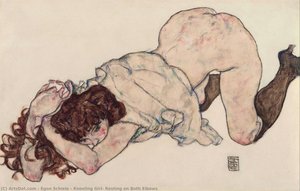 Kneeling Girl, Resting on Both Elbows - Egon Schiele
In Kneeling Girl, Resting on Both Elbows , Egon Schiele achieves a breathtaking structural harmony that defines his place among the top 25 artworks of Egon Schiele. The composition is built upon a captivating geometry of angular limbs and soft curves; the way the figure’s weight rests upon her elbows creates a rhythmic, triangular stability that feels both precarious and perfectly balanced. This deliberate use of jagged, expressive lines against a muted, neutral void directs all focus to the raw, anatomical truth of the subject.
There is a profound, quiet strength in this piece that resonates beautifully with modern minimalist design. Much like a contemporary, clean-lined interior, Schiele’s mastery of negative space and stripped-back detail allows the emotional essence of the work to breathe. The interplay of light and shadow across the skin provides a soulful anchor for any room, offering a sense of historical gravity and avant-garde elegance. It is a timeless study in vulnerability that grounds a contemporary aesthetic with deep, psychological texture.
schiele agonia 1912 - Egon Schiele
 schiele agonia 1912 - Egon Schiele
In the hauntingly intimate masterpiece Agonia , painted in 1912, Egon Schiele invites us into a psychological landscape where physical struggle and existential dread dissolve into one. There is a gaze in Schiele Agonia 1912 that follows you—not with judgment, but with a profound, heavy understanding . This isn’t merely a depiction of two men in a moment of confrontation; it is a mirror reflecting the raw vulnerability and the turbulent conflicts of the human soul.
As you stand before this work, notice how the bold, angular brushstrokes and thick, textured impasto create a palpable sense of unease. The muted palette of deep reds and earthy browns grounds the scene in a world of shadow and introspection, while the standing figure’s contemplative cigarette serves as a poignant symbol of fleeting solace amidst chaos. Within the top 25 artworks of Egon Schiele, Agonia stands out for its ability to make the invisible visible. Now, imagine that intense, expressive energy in your own space. It does not just decorate a wall; it reminds you that you are seen, and that you are part of this enduring human story.
Reclining Semi-Nude with Red Hat (Gertrude Schiele) - Egon Schiele
 Reclining Semi-Nude with Red Hat (Gertrude Schiele) - Egon Schiele
In Reclining Semi-Nude with Red Hat (Gertrude Schiele) , Egon Schiele captures that profound, breathless moment where vulnerability meets striking beauty. There is a haunting intimacy in the way the figure rests against the earthy, muted tones, their pale skin appearing almost translucent. The sudden, vibrant splash of the red hat acts as a heartbeat within the composition—a symbol of passion and life amidst a landscape of quiet contemplation. This piece earns its place among the top 25 artworks of Egon Schiele because it perfectly embodies his ability to transform raw human emotion into a visual language of exquisite tension.
Schiele’s mastery lies in his jagged, expressive lines and his refusal to idealize the human form, choosing instead to reveal its fragile truth. At Mus3ums.com, we believe such evocative power belongs in your personal sanctuary. Our hand-painted oil reproductions are meticulously crafted to preserve these very textures—the visible, emotive brushstrokes and the deep, tonal contrasts that make this Expressionist masterpiece so captivating. Bringing a piece of Schiele’s soul into your home allows you to surround yourself with art that speaks of depth, history, and the enduring beauty of the human spirit.
The Vision of St. Hubert - Egon Schiele
 The Vision of St. Hubert - Egon Schiele
In the hauntingly beautiful The Vision of St. Hubert , Egon Schiele captures a moment where the earthly and the divine collide in a breathtaking display of spiritual transformation. This masterpiece earns its place among the top 25 artworks of Egon Schiele by transcending mere religious narrative to explore the raw, psychological depths of human awe. The canvas breathes with an unsettling energy; deep, bruised purples and saturated reds pulse through a claustrophobic forest, where light and shadow dance to reveal a stag bearing a stark, luminous cross.
Schiele’s signature expressionistic brushwork creates a textured, visceral experience, making the viewer feel the very tension of the hunter's encounter. The dynamic composition—featuring a man in a striking red robe and his loyal companion—draws the eye into a whirlwind of emotion and movement. For the modern collector, bringing this piece into a home offers more than just decor; it introduces a profound conversational anchor. Its dramatic interplay of light and dark provides a sophisticated, moody elegance that inspires deep reflection and adds a layer of soulful complexity to any contemporary interior.
River Landscape - Egon Schiele
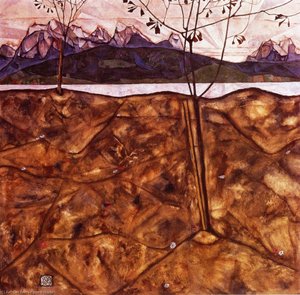 River Landscape - Egon Schiele
In River Landscape , the lines of Egon Schiele aren’t merely drawn; they are choreographed . This 1913 masterpiece is not just a composition of earth and water; it is a dance frozen in time . As you gaze upon the winding river carving through the valley, you feel the rhythmic pulse of the landscape, where thick, expressive brushstrokes create a textured ground that seems to breathe with the vitality of the soil itself.
Schiele moves beyond mere scenery, utilizing a layered, almost surrealist approach to divide the world into bands of dark earth, cool blue waters, and a pale, dreamlike sky. The way the jagged mountain peaks meet the soft pink horizon creates a profound sense of introspection. It is a work that makes chaos feel like harmony, offering a serene yet psychologically charged vista. What if your living room could hold that same balance? What if your walls could breathe rhythm ? Bringing this piece into your home allows you to capture Schiele's unique ability to find spiritual connection within the raw, organic forms of nature.
Conclusion
As we draw the curtain on this journey through Egon Schiele’s evocative world, we are left with more than just a collection of images; we carry with us the raw, pulsing energy of a soul that refused to look away from the truth. To wander through these twenty-five masterpieces is to witness a profound dialogue between the artist and the human condition—a conversation written in jagged lines, vulnerable poses, and the haunting beauty of existence. Schiele’s work reminds us that art is never truly static or confined to the past; it is a living, breathing presence that continues to pulse with relevance in our modern lives.
These paintings do not merely hang on walls; they breathe within our homes, transforming quiet corners into spaces of deep reflection and emotional resonance. Whether through the stark intensity of a self-portrait or the delicate tension of a figure in repose, Schiele’s legacy invites us to find beauty in vulnerability and strength in honesty. His brushstrokes bridge the centuries, connecting his turbulent Viennese era to our contemporary hearts, proving that the most personal expressions often become the most universal treasures.
We invite you to continue your own discovery and bring this timeless emotional depth into your personal sanctuary. You can explore the full collection of his works, where every hand-painted reproduction serves as a window into this extraordinary artistic legacy. May these works continue to inspire your space, your creativity, and your soul, much as they have inspired the world for generations.