Introduction
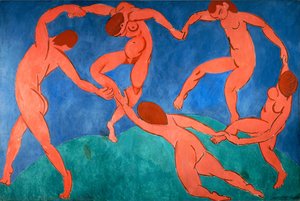
"Dance (II)" by Henri Matisse (1910), kept at Hermitage Museum, depicts five figures in a rhythmic circle of movement. These twenty-five works span from 1905 to 1952 and showcase his evolution from the bold colors of "Woman with a Hat" to the simplified forms found in "Blue Nude III." While "Harmony in Red" focuses on intense saturation, other pieces explore different compositions and subjects. These paintings remain significant today because they established the fundamental principles of Fauvism and modern color theory.
Dance (II) - Henri Matisse
 Dance (II) - Henri Matisse
Sergei Shchukin, the influential Russian collector, sought a monumental decorative panel to anchor his private collection, leading to this iconic creation. While the title suggests a simple rhythmic activity, Henri Matisse actually presents a primal, ritualistic circle of five figures. These forms are stripped of unnecessary detail, focusing instead on the raw energy of the group. The palette relies on a striking contrast between the deep blue of the sky, the earthy green of the ground, and the warm pink-orange tones of the skin. This bold use of non-naturalistic color defines the Fauvist movement, where the artist prioritizes emotional impact over realistic representation. The composition creates a continuous loop of movement that feels both ancient and modern. By simplifying the human anatomy into fluid, expressive lines, the work achieves a powerful sense of unity. This piece remains a central pillar of modern art history, showcasing the radical shift toward abstraction and expressive color that defined the early twentieth century.
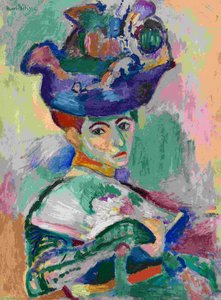
Woman with a Hat - Henri Matisse
Light hits the subject through a fractured, non-naturalistic palette that defies traditional logic. Where viewers once saw a chaotic explosion of color that earned the label of "wild beasts," modern eyes recognize a deliberate liberation of the brush. Henri Matisse uses swirling strokes of green and blue to define the contours of Amélie's face, breaking away from the structured, disciplined draughtsmanship of his earlier training. This portrait of his wife rejects the expected tones of skin, opting instead for a bold, expressive application of pigment that prioritizes emotional energy over photographic accuracy. The heavy, textured layers of paint create a physical presence on the canvas, making the vibrant colors feel structural rather than just decorative. It remains a pivotal moment where the artist moved from precise, academic methods toward the radical, colorful freedom that would define his legacy. This work is currently kept at the San Francisco Museum of Modern Art.
Harmony in Red - Henri Matisse
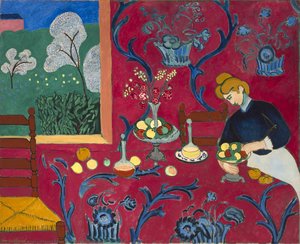 Harmony in Red - Henri Matisse
Matisse sought a more intense emotional resonance by replacing the original blue background with a vibrant, saturated red, a decision that transformed the work into a defining moment for Fauvism. This shift from the cool tones of his earlier exhibition to a warm, dominant red created a striking tension between the interior space and the dark green landscape visible through the window. The composition relies on the sharp contrast between the rich red walls and the dark blue swirls decorating the tablecloth. By prioritizing these bold, non-naturalistic colors over traditional perspective, the artist moved away from the Impressionist roots of his earlier years. This pursuit of expressive color required a radical departure from realistic representation, favoring a flattened, patterned aesthetic that redefined modern interior scenes. The resulting harmony relies on the deliberate friction between the domestic setting and the overwhelming power of the pigment.
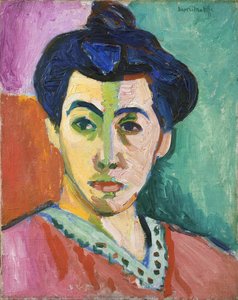
Portrait of Madame Matisse. The Green Line - Henri Matisse
By slicing through the center of a face with a bold, vertical green stripe, Henri Matisse broke away from the rules of naturalism to explore how color can define form. This striking decision marks a pivotal shift in his career, signaling the birth of Fauvism through an experimental use of non-naturalistic hues. The portrait presents his wife, Amélie, through a series of vibrant, unexpected blocks of pink, orange, and blue that flatten the space and ignore traditional perspective. Rather than following the actual colors of her skin, the artist uses these intense pigments to build her features, creating a composition where color dictates the structure of the subject. This approach reflects a period of intense exploration in Collioure, where the use of bright, blotched colors became a signature of his evolving style. The work is currently held at the National Gallery of Denmark.
Blue Nude III - Henri Matisse
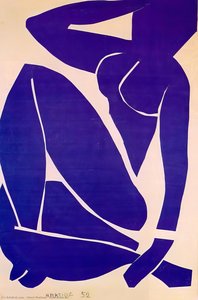 Blue Nude III - Henri Matisse
Through the deliberate arrangement of hand-painted paper cut-outs, a seated figure emerges with a striking, simplified grace. This work belongs to a celebrated series created after the artist turned to collage to navigate the physical limitations following his surgery for stomach cancer. While the title suggests a specific hue, the composition relies on the stark, rhythmic interplay of shapes that define the human form without the need for traditional shading. One can see the artist's signature approach to Modernist Abstraction in the way he stripped away unnecessary detail to focus on pure silhouette. The pose, featuring an arm reaching behind the neck and legs that intertwine, became a favorite motif throughout the series. Currently held at the Centre Pompidou, this piece reflects a period where the artist found a new way to compose art through direct, tactile intervention. It remains a significant example of how the French Fauvist master adapted his vibrant style to a new, more manageable medium.
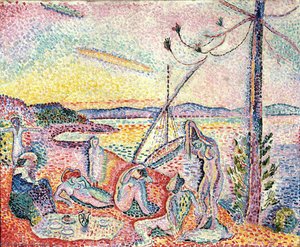
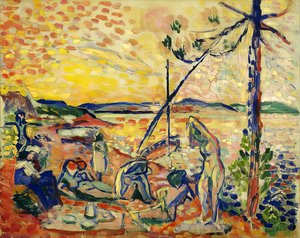
Luxe, calme et volupté - Henri Matisse
A dreamlike landscape unfolds where figures rest in a state of tranquil indulgence. This composition marks a pivotal shift in the career of Henri Matisse, moving away from the rigid structures of his legal training toward a world of fantasy and leisure. By blending Neo-Impressionist techniques with a new, subjective way of seeing, the artist created a scene that prioritized personal sensation over literal representation. For the viewers of the early twentieth century, these vibrant hues and simplified shapes signaled a liberation from traditional rules, helping to spark the Fauvist movement. The palette relies on a soft, greyish beige that anchors the more expressive elements of the scene. Every brushstroke contributes to a sense of calm, focusing on the pleasure of the moment. This work remains a foundational piece of his oeuvre, showing how he transitioned from studying the old masters to defining a modern visual language through color and form.
Music - Henri Matisse
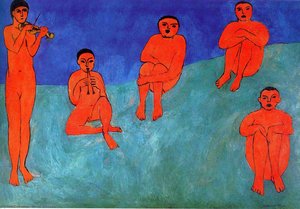 Music - Henri Matisse
Creating a wall-sized canvas without the safety net of preparatory sketches requires a rare kind of artistic courage. Henri Matisse embraced this spontaneous energy, allowing the physical traces of his modifications to remain visible on the surface. This raw approach strikes a balance between spontaneous emotion and structural innovation, leaving behind a record of his creative decisions. The work explores the idea of a person reaching a state of completeness through the act of creation. Instead of following a rigid plan, the artist worked directly with the medium to find the intended effect. The composition features musicians and instruments that create a visual rhythm across the large scale. For those looking to add a high-voltage pulse to a room, this piece provides a rhythmic focal point that injects movement into any space.
Goldfish - Henri Matisse
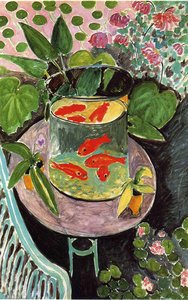 Goldfish - Henri Matisse
The series of paintings featuring goldfish emerged from a period of intense creative exploration for Henri Matisse. Following a trip to Tangier, Morocco, where he observed the local fascination with fish in bowls, the artist began producing these works in his garden conservatory. This 1911 creation sits as a key part of that early 1910s fascination, marking a moment when the artist integrated these aquatic motifs into his studio settings. His Fauvist approach is evident in the way he uses bold, non-naturalistic color to define the forms. Instead of focusing on realistic representation, he prioritized the expressive power of the pigment. The painting is currently held at the Pushkin State Museum. For those looking to bring a touch of this tranquil energy into a home, our handmade oil reproductions offer a way to experience the tactile texture of his brushwork on linen canvas.
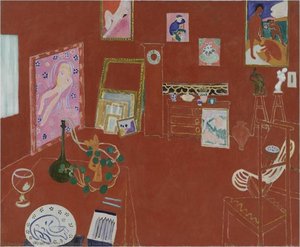
L'Atelier rouge Huile sur Toile - (181x219) - Henri Matisse
Thin, unassertive yellow lines trace the silhouettes of furniture, carving recognizable shapes out of a vast, immersive sea of vibrant red. This bold approach to space defines the interior of a studio, where objects appear to float within a saturated, monochromatic environment. A grandfather clock stands near the center, acting as a vertical axis that brings a sense of balance to the composition's spatial discontinuities. By using these delicate outlines against the expansive red, Henri Matisse creates a layered effect that suggests depth despite the flattened perspective. This work represents a pivotal moment in Fauvism, where color functions as the primary structural element rather than a tool for realistic depiction. The arrangement of paintings and decorative objects within the room establishes a rhythmic, almost collage-like quality. It remains a significant part of the collection at the Museum of Modern Art, New York.
Landscape viewed from a Window - Henri Matisse
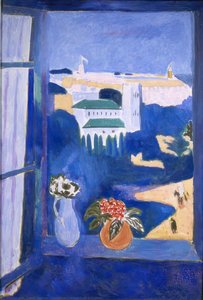 Landscape viewed from a Window - Henri Matisse
The vibrant energy of North Africa, particularly the Islamic art encountered during his travels to Morocco, fundamentally reshaped the way Henri Matisse approached the world. This view from a bedroom in Tangier uses a flat perspective and bold color to bridge the gap between the interior and the distant St Andrew's Church. A deep blue window frame organizes the composition, directing the eye toward the landscape while framing the scene with a modern, structural clarity. The artist uses broad planes of color and energetic brushstrokes to suggest the buildings and trees outside, prioritizing emotional impact over photographic detail. This approach reflects the revolutionary spirit of Fauvism, where color is used to express a personal vision rather than a literal imitation of nature. The work remains at the Pushkin Museum of Fine Arts, representing a pivotal moment in his evolution toward a more liberated use of pigment and form.
Portrait of Mme. Matisse - Henri Matisse
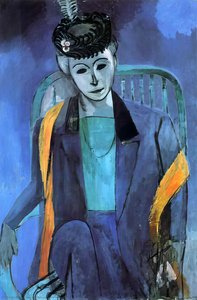 Portrait of Mme. Matisse - Henri Matisse
A heavy sense of melancholy settles over the subject, pulling the viewer into a moment of deep, private reflection. This 1905 work marks a pivotal shift for the artist, as he began to move away from traditional representation toward the bold, non-naturalistic color choices that would define the Fauvist movement. Instead of using color to mimic reality, he employed vibrant, unexpected hues to express internal states. The brushwork is fluid and energetic, creating a textured surface that feels alive under the light. This approach to color and form is a hallmark of the style developed by Henri Matisse during this revolutionary period. His decision to prioritize emotional truth over photographic accuracy changed the trajectory of modern art forever. The portrait remains a significant example of how he used the expressive power of pigment to navigate the complexities of the human experience.
Basket with Oranges - Henri Matisse
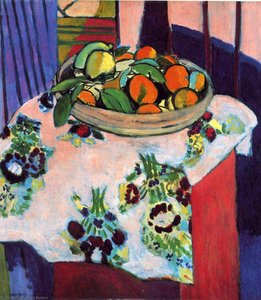 Basket with Oranges - Henri Matisse
The way expressive brushwork transforms a simple basket of fruit turns a mundane household object into a vibrant explosion of energy. For the early twentieth-century public, these bold, non-naturalistic strokes signaled a radical break from the rigid academic traditions of the past. This piece highlights the Fauvist spirit that defined the career of Henri Matisse, using color to prioritize emotional impact over literal representation. Instead of following the strict rules of light and shadow, the artist applied thick, visible marks that give the scene a rhythmic, lively quality. A decisive use of orange and deep blue creates a visual tension that makes the composition vibrate. This work is currently held at The Louvre. It remains a vital example of how a painter can use pure pigment to redefine the boundaries of modern art.
Blue Nude - Henri Matisse
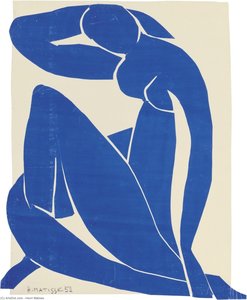 Blue Nude - Henri Matisse
The Blue Nude series emerged from a period of major physical change for Henri Matisse. Following surgery for abdominal cancer in 1941, the artist found himself largely confined to his bed or a chair, making traditional painting and sculpture difficult. This limitation led him to develop his famous "cut-outs," a method of creating art by cutting shapes from hand-painted paper and arranging them into collages. This 1952 work marks a turning point in that evolution, as the artist used these paper shapes to explore the human form through a more direct, graphic language.
Matisse spent weeks refining the composition of these figures, often working through notebooks of sketches to find the perfect arrangement. He eventually settled on a signature pose characterized by an arm reaching behind the neck and legs that intertwine. This particular piece is a part of a series that includes both the original paper cut-outs and subsequent lithographs that the artist supervised until his death. It remains a significant example of how he transformed his physical constraints into a new, expressive medium.
Red Studio - Henri Matisse
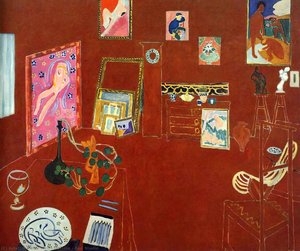 Red Studio - Henri Matisse
By omitting paint in certain areas, Matisse uses unassertive yellow lines to carve out the shapes of furniture and objects against a vast, rusty red expanse. This radical approach to space allowed future generations of painters to treat color as a structural element rather than a descriptive tool. The composition relies on a central grandfather clock to act as a vertical axis, bringing a sense of balance to the seemingly floating items in the room. Henri Matisse transforms his studio into a vibrant, monochromatic environment where depth is created through perspective and angle rather than traditional shading. This work is held in the collection of the Museum of Modern Art, New York.
Open Window, Collioure - Henri Matisse
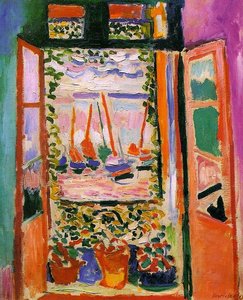 Open Window, Collioure - Henri Matisse
The salmon and lavender hues reflecting off the interior walls create a vibrant dialogue with the Mediterranean blue visible through the frame. This interplay of color marks a radical departure from traditional representation, establishing the Fauvist movement's core principle: that color can exist independently of the objects it describes. Henri Matisse uses the window as a structural device, layering the view of bobbing sailboats and coastal greenery against the domestic details of flowerpots and vases on the sill. Instead of using light to create depth, he uses bold, non-naturalistic blocks of color to organize the space. This approach changed the trajectory of modern art by prioritizing the artist's subjective vision over the literal appearance of the world. The composition remains a balanced arrangement of shapes and tones, where the interior and the landscape merge into a single, rhythmic experience of the French coast.
Conversation - Henri Matisse
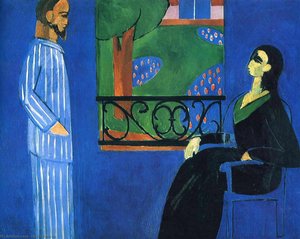 Conversation - Henri Matisse
By appearing in striped pajamas, Matisse strips away the formal pretenses of the traditional portrait, opting instead for a moment of domestic intimacy. He chose to abandon the spontaneous, swirling brushwork of his earlier Fauvist years, opting for a flatter, more decorative approach that emphasizes shape over texture. This decision highlights the artist's shift toward a more structured style, where the composition relies on bold color blocks rather than rapid movement. He stands in profile on the left, while his wife, Amélie, sits facing him, both set against a wall of intense blue. A window behind them offers a glimpse of a garden landscape, breaking the solid color of the interior. This work, once part of the celebrated Sergei Shchukin collection, now resides in the Hermitage Museum. It shows a man who had already mastered the use of vibrant, non-naturalistic color, yet here uses it to frame a simple, private dialogue.
Seated Woman, Back Turned to the Open Window - Henri Matisse
 Seated Woman, Back Turned to the Open Window - Henri Matisse
By turning the subject away from us, Henri Matisse shifts our focus from a personal encounter to the expansive horizon beyond. This composition directs the eye past the woman's silhouette and through the window frame toward a vast ocean vista. The muted greyish beige of her robe provides a soft anchor against the bright blues and greens of the sea and sky. Small figures appear near the water's edge, adding life to the distant shoreline. This arrangement creates a balance between the stillness of the interior and the open world outside. The artist uses a layering of color to define her form, making her a steady presence amidst the shifting light. Through this choice, the painting becomes an exploration of reflection and the boundary between private space and the infinite coast.
Bees - Henri Matisse
 Bees - Henri Matisse
The rhythmic patterns of his family's weaving heritage found a new life in this 1948 cut-out, influenced by the textures shared with his sister Jacques-Marie. This playful approach to composition allowed Henri Matisse to reshape his creative language through expressive paper shapes. The joyful arrangement of the bees reflects a shift toward the vibrant, non-naturalistic style that defined his later years.
Icarus - Henri Matisse
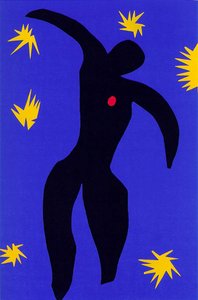 Icarus - Henri Matisse
A luminous expanse of light blue stretches across the background, applied with wide, airy brushstrokes that suggest a vast, open sky. This bright backdrop makes the stark black silhouette of the falling figure appear even more sudden and absolute. While viewers once saw this as a radical departure from traditional painting, modern eyes recognize the power of its simplified geometry. A single, brilliant red heart pulses within the dark form, a detail that shifts the focus from a tragic fall to the internal passion driving the descent. Henri Matisse used a technique of cutting paper to achieve these sharp, rhythmic shapes, creating a composition that feels weightless despite its heavy themes. The work is kept at the Scottish National Gallery of Modern Art in Scotland.
The Family of the Artist - Henri Matisse
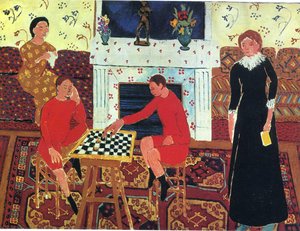 The Family of the Artist - Henri Matisse
Matisse uses a simplified, flattened perspective to arrange his loved ones within the composition, stripping away traditional depth to focus on the essential shapes of the figures. This approach allows the artist to prioritize the emotional weight of the gathering over realistic spatial accuracy. By reducing the background to broad, rhythmic planes, he creates a scene that feels both intimate and structurally bold. The way the figures are positioned suggests a shared, serene moment, a characteristic often found in the works of Henri Matisse when he sought to balance modern expression with classical stability. A simple wooden fence provides a structural boundary in the mid-ground, grounding the group within their environment. This work remains a vital example of how Fauvist principles can be applied to portraiture to achieve a sense of calm and togetherness. It is a piece that brings a gentle, comforting energy to any space it inhabits.
The lute - Henri Matisse
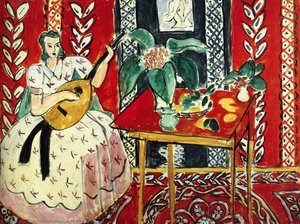 The lute - Henri Matisse
By placing a smaller painting within the background, the artist creates a reflective layer that adds unexpected depth to this musical scene. This clever use of artistic reflexivity allows the composition to expand, making the space feel larger and more complex. A seated figure, absorbed in the music of her instrument, anchors the work with a serene presence. The palette relies on bold, expressive strokes, where fiery reds meet lush greens to create a visual rhythm. Henri Matisse uses these colors to mimic the vibration of sound, making the canvas feel alive with melody. Patterns on the figure's white attire echo the surrounding greenery, creating a cohesive design that links the subject to her environment. This piece remains in a private collection, a hidden gem of expressionism that showcases a sophisticated balance of color and form. The way the hues interact gives the entire scene a luminous quality, as if the light itself is part of the music.
Polynesia, The Sea - Henri Matisse
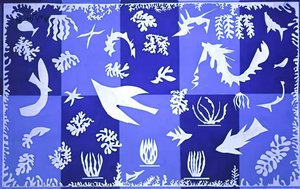 Polynesia, The Sea - Henri Matisse
The presence of this deep blue work in the Baltimore Museum of Art collection highlights a pivotal moment in modern art history. Henri Matisse broke away from the traditional, descriptive use of pigment, opting instead to use color as an independent, expressive force that does not rely on naturalism. This energetic approach to Fauvism allowed him to prioritize the emotional impact of a scene over its literal appearance. By stripping away the need for realistic shading, he achieved a flattened, decorative quality that redefined the boundaries of the canvas. His fluid draughtsmanship is evident in every line, showing the confidence of an artist who had mastered the rules of classical training only to intentionally disrupt them. This work remains a vital example of his ability to use bold, non-naturalistic tones to structure a composition. It represents the era when he was first recognized as a "wild beast" for his radical departure from the muted palettes of the past.
Pink Nude - Henri Matisse
 Pink Nude - Henri Matisse
The application of gouache on paper lends a soft, matte texture to this 1935 nude, allowing the pigment to sit with a unique, velvety weight on the surface. This choice of medium highlights the fluid draughtsmanship that defined the career of Henri Matisse, a man who revolutionized how we perceive color and form. By stripping away unnecessary detail, the artist focused on the essential lines of the body, a decision that influenced generations of modernists seeking to simplify visual language. The composition achieves a serene quality through its economy of means, relying on the directness of the brushstroke rather than complex shading. This work is currently kept at the Museum of Modern Art. For those looking to bring this energy into a home, our artists can recreate the expressive, impasto-style brushwork of such Fauvist works on high-quality linen canvas.
The Flowing Hair - Henri Matisse
 The Flowing Hair - Henri Matisse
The Flowing Hair by Henri Matisse uses a striking silhouette to explore the intersection of shape and color. While the title suggests a focus on movement, the work relies on the sharp contrast between a deep blue figure and a soft pink backdrop to create its visual impact. This piece highlights the artist's signature ability to simplify the human form into elegant, rhythmic lines that feel both modern and graceful. Instead of focusing on intricate details, Matisse utilizes bold, non-naturalistic colors to define the subject, a technique that became a hallmark of his Fauvist style. The composition centers on a stylized female figure, where the interplay of the dark blue silhouette against the warm background creates a striking, graphic quality. This approach allows the viewer to focus on the purity of the form and the balance of the color palette, making it a powerful example of his late-career mastery of shape and hue.
corner of studio - Henri Matisse
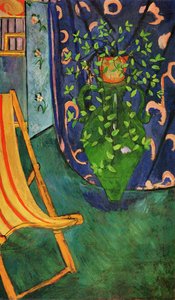 corner of studio - Henri Matisse
While many associate the depiction of an artist's workspace with the literal precision of Realism, this particular view by Henri Matisse shifts the focus toward the emotional weight of color and form. He moved away from mere documentation to explore how a private environment can be reconstructed through a Fauvist lens, prioritizing the expressive power of the palette over strict anatomical accuracy. This work reflects the artist's unique ability to organize space through bold, non-naturalistic tones that define the atmosphere of his creative sanctuary. The composition relies on a careful balance of shapes that suggests a reflective mood within the studio. Currently held at the Pushkin State Museum, the piece remains a vital example of how the French master used color to redefine the boundaries of modern painting. His approach to this scene demonstrates the fluid draughtsmanship that would eventually make him a central figure in the evolution of twentieth-century art.
Conclusion
"corner of studio" by Henri Matisse (1912), kept at Pushkin State Museum, shows a glimpse of the artist's personal workspace. These twenty-five works, spanning from 1905 to 1952, reveal a life dedicated to color, from the bold tones in "Woman with a Hat" to the flowing shapes of "Blue Nude III." We invite you to bring these textures and colors into your own home to live with them every day. Explore our full collection to find your favorite piece.