
Introduction
Capturing the bustling energy of Paris required a vantage point high above the street, leading the artist to the studio of Félix Nadar at 35 Boulevard des Capucines to observe the urban flow. These twenty-five selections span from 1865 to 1920, showcasing a progression from early landscapes like Cart on the Snow Covered Road with Saint-Simeon Farm to the complex textures of Rouen Cathedral, Symphony in Grey and Rose. While some pieces focus on the fleeting movement of water in Water Lilies (or Nympheas), others document the solid structures of the city or the soft colors of a garden. These works remain central to art history because they established the technical foundations of the Impressionist movement through the direct observation of natural light. A single decision to paint outdoors changed how the world perceives color and atmosphere.
Water Lilies (or Nympheas) - Claude Monet
 Water Lilies (or Nympheas) - Claude Monet
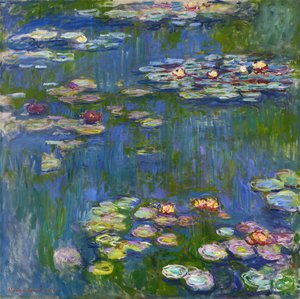
The symbols of purity and enlightenment found in these blossoms reflect a lifelong pursuit of peace through the observation of nature. By dissolving the distinction between the surface of the water and the sky above, this approach paved the way for the abstract movements of the next century. Claude Monet spent the final thirty years of his life dedicated to this series, often working through the physical challenges of cataracts to translate his vision of the Giverny gardens onto canvas. This particular piece, held at the National Museum of Western Art, represents a moment in a massive collection of nearly 250 works. The artist's decision to focus on the repetitive, shifting patterns of the water lilies allowed him to explore how light changes the perception of a single subject over time. His method of working outdoors, or plein air, ensured that the atmosphere of the garden remained the central focus of his creative output.
Impression, Sunrise - Claude Monet
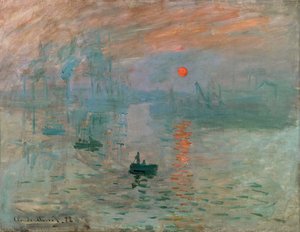 Impression, Sunrise - Claude Monet
It is rare that a single canvas provides the very name for an entire revolution in art history. By focusing on the hazy, atmospheric reality of a harbor at dawn, Claude Monet inadvertently defined the Impressionist movement. This work depicts the port of Le Havre, his hometown, where the sun breaks through a morning mist in shades of pinkish brown and soft blue. Rather than detailing every ship or pier, the artist used loose, expressive brushstrokes to record a fleeting moment of light. Astronomers have even used the specific angle of the sun and the direction of the smoke plumes to pinpoint the exact morning this scene was painted. The composition relies on a balanced horizon, where boats sit upon calm waters under an expansive sky. This piece is kept at the Musée Marmottan Monet, representing a pivotal shift toward painting the world as it is perceived through light and atmosphere.
Haystacks: Snow Effect - Claude Monet
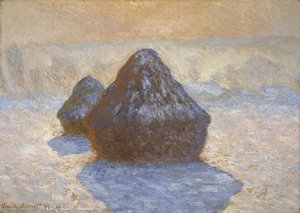 Haystacks: Snow Effect - Claude Monet
Strategically placed rocks anchor the landscape, guiding the eye through the composition to establish a clear sense of depth and perspective. This arrangement allows the viewer to navigate the snowy terrain of Normandy, where the heavy, textured forms of the boulders contrast with the soft, ethereal atmosphere of the winter scene. Claude Monet focused on these stacks of harvested wheat to explore how shifting weather and light could transform a single subject into a series of different visual experiences. The palette relies on subtle greyish beige and muted tones, applied with thick, visible brushstrokes that mimic the tactile quality of fallen snow. By working en plein air, the artist prioritized the immediate sensory reality of the cold, white landscape over precise outlines. This approach turned a common agricultural sight into a study of atmosphere, where the interplay of light on the snow-covered mounds becomes the primary subject of the work.
The Walk. Lady with a Parasol - Claude Monet
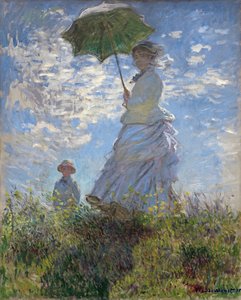 The Walk. Lady with a Parasol - Claude Monet
A summer stroll in Argenteuil becomes a fleeting moment of movement in this work. Looking up from a low perspective, we see Camille and young Jean amidst a meadow of pale green grass. The wind catches her white dress and veil, while the underside of her parasol echoes the vibrant hues of the meadow. Jean appears partially hidden behind a grassy rise, adding a layer of depth to the scene. This piece reflects the artist's dedication to Claude Monet's signature approach to painting outdoors, where the sky transitions through soft blues and bright whites above the family. Rather than a formal portrait, this is a casual snapshot of everyday life, defined by spontaneous, energetic brushstrokes that suggest a breezy, sun-drenched afternoon. The composition relies on these quick, visible marks to define the textures of fabric and foliage against the expansive sky.
Rouen Cathedral, Symphony in Grey and Rose - Claude Monet
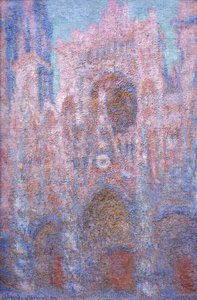 Rouen Cathedral, Symphony in Grey and Rose - Claude Monet
Thick layers of impasto transform the stone facade into a living, breathing texture that shifts with the atmosphere. This technique allowed Claude Monet to move away from static representation, introducing the revolutionary idea of the series—a method that changed how future generations perceived the relationship between subject and time. By revisiting the same subject under different conditions, he proved that an object's appearance is never fixed but is constantly redefined by the environment. In this particular piece from the series, the interplay of grey and rose creates a mysterious, ethereal quality. He achieved this by renting a temporary studio directly across from the cathedral to observe the changing light firsthand. This dedication to plein-air observation ensures that the work remains a vital part of the Impressionist legacy. The painting is currently kept at the Musée d'Orsay.
The Magpie - Claude Monet
 The Magpie - Claude Monet
A single magpie perched upon a wattle fence provides the focal point for this snowy landscape, grounding a scene of immense atmospheric detail. Claude Monet achieved a rare balance of technical innovation and emotional stillness while painting near Étretat, a period marked by the presence of his family in Normandy. The canvas uses short, thick brushstrokes to depict the effect of snow across a field, prioritizing the way light interacts with the frozen terrain over meticulous, academic precision. This approach allowed the artist to explore the natural textures of winter, a theme he revisited frequently. The composition relies on a palette of pinkish brown and white to define the landscape, creating a visual rhythm that emphasizes the immediate reality of the outdoors. This work resides within the Musée d’Orsay's permanent collection.
Terrace by the Sea at Sainte-Adresse - Claude Monet
Sunlight warms the figures of a family enjoying a summer afternoon on a flower-filled terrace high above the Normandy coast. This scene, which includes two flags fluttering in the breeze, reveals a moment of domestic leisure set against the vastness of the sea. Claude Monet uses a high horizon line to compress the view, making the blue water and the sky feel immediate and present. Red geraniums, orange-red gladioli, and nasturtiums spill over the edges of the garden, creating a vibrant, patterned foreground that leads the eye toward the choppy green-blue waves below. The composition is structured in three distinct horizontal bands: the lush terrace, the rhythmic sea, and a broad sky transitioning from deep blue to soft gray and white clouds. By working outdoors, the artist focuses on the direct observation of the coastal atmosphere, where the salt air feels almost tangible through the visible, textured brushstrokes. This work remains a key example of how the artist began to prioritize the perception of light and atmosphere in his landscapes.
Women in the Garden - Claude Monet
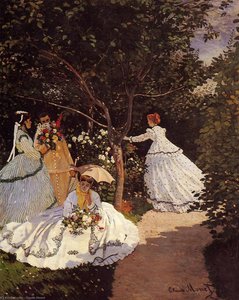 Women in the Garden - Claude Monet
To maintain a single perspective while working on such a massive scale, Claude Monet actually dug a trench to lower his canvas, allowing him to paint the upper half from a seated position. This unconventional method was part of a risky experimentation with plein air techniques that eventually led to the work being rejected by the Salon for its perceived lack of narrative strength. Instead of following academic rules, he focused on the interplay of atmosphere and the way sunlight hits a garden setting. The scene features three women, including his companion Camille Doncieux, amidst lush greenery and trees. He even used magazine illustrations to ensure the fashionable clothing looked accurate. While the heavy brushstrokes initially caused controversy, they became a defining characteristic of his style. This piece remains a vital example of how he began prioritizing the immediate perception of nature over traditional, structured compositions.
Wild Poppies, near Argenteuil - Claude Monet
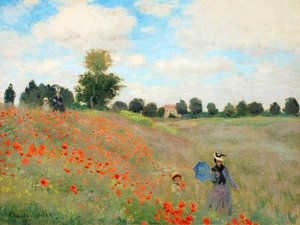 Wild Poppies, near Argenteuil - Claude Monet
A warm setting sun bathes the French countryside in a soft, greyish beige glow, illuminating a field of vibrant red poppies. This scene emerged during a pivotal moment in the career of Claude Monet, as he moved away from traditional studio constraints to embrace the spontaneity of the outdoors. By working en plein air, he broke from academic rigidity to focus on how atmosphere actually looks in a fleeting moment. The loose, sketched details of the landscape reflect a fascination with the way light shifts across a rural setting. After being presented at the First Impressionist Exhibition, the work eventually entered the French state collection and is now kept at the Musée d'Orsay. Every brushstroke contributes to the vitality of the Argenteuil landscape, making it a cornerstone of the Impressionist movement.
Monet's Garden, the Irises - Claude Monet
 Monet's Garden, the Irises - Claude Monet
Rows of irises in shades of purple and pink sweep diagonally across the canvas, pulling your eyes through the lush landscape. This rhythmic arrangement helped define the Impressionist approach to composition, where the subject becomes inseparable from the way it is perceived. Claude Monet spent decades tending to his garden at Giverny, and this work reflects his deep obsession with how different light conditions alter the appearance of his plants. Dappled light filters through the trees, shifting the tones of the flowers as they line the paths. You can catch a glimpse of his house tucked behind the greenery, grounding this vibrant scene in a real, lived-in space. The way the colors interact on the surface shows how he began to treat the sensation of sight as the primary subject of his art. This piece is currently kept at the Musée d'Orsay, Paris.
Bathers at La Grenouillere - Claude Monet
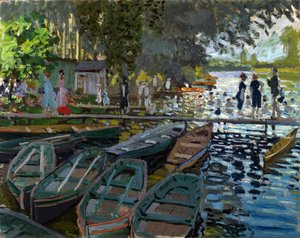 Bathers at La Grenouillere - Claude Monet
During a summer spent near the Seine, Claude Monet lived alongside his partner Camille and their young son, finding inspiration in the riverside life of La Grenouillère. This work emerged from a period of intense, direct painting, where he worked alongside Pierre-Auguste Renoir to document the floating café and the bustling activity of the boating resort. The composition uses broad, constructive brushstrokes that suggest a rapid, spontaneous execution, likely serving as a preparatory sketch for a larger, more ambitious canvas. Small dots of color in the background represent bathers in the river, while darker tones define the boats moored in the shadows. By prioritizing the immediate impression of the scene over rigid detail, Claude Monet utilized a fresh, unmediated technique that favored the play of light on water. This approach allowed him to translate the atmosphere of a Parisian leisure escape into a vivid, textured reality on the canvas.
Woman in a Garden - Claude Monet
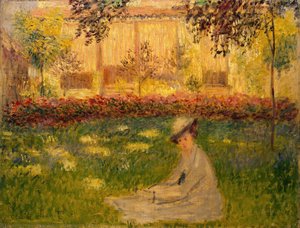 Woman in a Garden - Claude Monet
Jeanne-Marguerite Lecadre’s bright white dress creates a sharp, luminous contrast against the lush greens and vibrant reds of the garden. This deliberate use of color allows the figure to stand out from the surrounding foliage, a technique that predates the more blurred, atmospheric style later associated with Claude Monet. While his later works often dissolved forms into light, this piece maintains a structured composition, using the rose bushes and the central figure to anchor the scene. The artist worked en plein air to observe the natural environment, a practice that would eventually define his entire career and lead to his famous series of water lilies. X-ray analysis shows that he actually painted this over a previous canvas, revealing the layers of his evolving process. Today, this work is kept at the Hermitage Museum in St Petersburg, Russia.
Camille Monet On Her Deathbed - Claude Monet
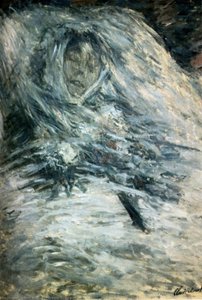 Camille Monet On Her Deathbed - Claude Monet
A sudden flash of bruised scarlet near the eye suggests a moment of intense agony, perhaps where a red kerchief was clutched in a final struggle against pain. This haunting work by Claude Monet moves away from his famous landscapes to confront a raw, private reality. He uses rapid, hurried brushstrokes to depict his wife amidst a fog of white and gray, her form appearing almost like a ghost emerging from a blizzard. The composition feels like a dream one cannot wake from, with a white cloth tied under her chin and her hand resting like a claw against the blue-tinted bedclothes. Rather than focusing on the clarity of a formal portrait, the artist uses smudges of pigment and blurred edges to record the fleeting, heavy atmosphere of loss. It remains a rare, visceral glimpse into the personal life of Claude Monet, where the technical precision of his style gives way to the chaotic textures of grief.
Clifftop Walk at Pourville - Claude Monet
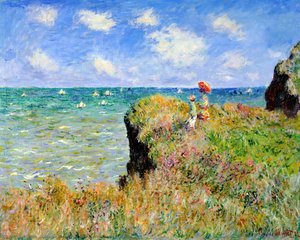 Clifftop Walk at Pourville - Claude Monet
A brisk breeze sweeps across the Normandy coast, carrying the salt of the English Channel toward the grassy heights of Pourville. This landscape marks a pivotal moment in the career of Claude Monet, as he retreated to the cliffs to refine his signature approach to atmosphere and light. Two figures stand atop the precipice, their presence juxtaposed against the distant, working fishing boats on the horizon. This composition creates a subtle tension between the leisure of the bourgeois stroll and the daily labor of the sea. By focusing on the immediate, shifting weather of the coast, Monet paved the way for modernism through his commitment to painting exactly what the eye perceives in a fleeting moment. The palette relies on cool blues and vibrant greens, applied with loose, energetic strokes that suggest the movement of wind through the grass. It remains a serene coastal scene, perfect for adding a touch of seaside charm to your home.
The Thames below Westminster - Claude Monet
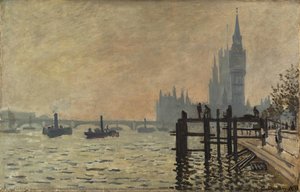 The Thames below Westminster - Claude Monet
A misty spring atmosphere envelops the river, softening the edges of the city. This scene emerged while the artist lived in London during the Franco-Prussian War, a period of displacement that led him to explore the Thames and the parks of the capital. Rather than focusing on rigid architectural lines, the work emphasizes the hazy, shifting light of an urban landscape. The silhouette of the Houses of Parliament and Westminster Bridge emerges from the background, partially obscured by the fog. Claude Monet uses loose, visible brushstrokes to build the composition, layering muted blues and grays against the pinkish brown tones of the water. Small boats float on the surface, their forms defined by quick, rhythmic applications of color. This approach prioritizes the immediate perception of the environment over precise detail, marking a significant departure from the structured academic traditions of the time.
Poplars at Giverny - Claude Monet
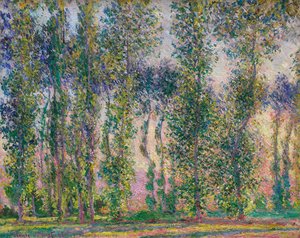 Poplars at Giverny - Claude Monet
The verticality of the tree trunks creates a rhythmic structure that anchors the entire composition, drawing the eye upward through the frame. By applying unmediated colors directly to the canvas, Claude Monet achieved a vibrancy that earlier painters, who relied on traditional blending and darker underpaintings, could not reach. This approach allowed him to record the immediate atmosphere of the River Epte, turning the landscape into a living record of a specific moment. After finding sanctuary in Giverny, he became obsessed with how the environment changed under different skies. His decision to focus on these specific poplars shows his commitment to the plein air method, where the artist works outdoors to catch the shifting environment. The way the trunks break the horizon line provides a structured, tranquil energy to the scene. This work remains a significant part of his legacy, showcasing the technical precision of a man who lived for the outdoors.
le bassin aux nympheas - reflets verts - Claude Monet
 le bassin aux nympheas - reflets verts - Claude Monet
Part of the celebrated Water Lilies series, le bassin aux nympheas - reflets verts emerged from the artist's lifelong obsession with the shifting atmosphere of his Giverny garden. Claude Monet spent the final three decades of his life focused on these aquatic scenes, often working outdoors to record the immediate reality of nature. This 1920 creation reflects a period when the artist's vision was shaped by his personal struggle with cataracts, which altered how he perceived the world around him. The work is currently held at the Foundation E.G. Bührle Collection.
The series consists of approximately 250 oil paintings that explore how light interacts with water and flora. While many of these works eventually found a permanent home in the oval rooms of the Musée de l'Orangerie, this particular piece remains a significant part of the artist's late-career output. It offers a way to bring the serene atmosphere of the French countryside into a modern living space through a high-quality reproduction.
The Road Bridge at Argenteuil - Claude Monet
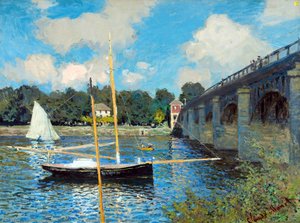
By using the dark mass of the stone bridge as a structural anchor, Claude Monet creates a striking contrast that pushes the sunlit elements of the Seine into the foreground. This composition directs the eye toward the far bank, using the bridge to frame a narrative of modern life along the river. A low perspective on the right lends a sense of weight to the static architecture, while the vertical lines of the boat masts guide the gaze through the scene. The presence of boats on the water reflects the growing popularity of leisure activities in Argenteuil during this era. Through his characteristic use of loose brushstrokes, Monet focuses on the immediate atmosphere of the landscape. This work is currently kept at the National Gallery of Art in Washington.
Boulevard of Capucines - Claude Monet
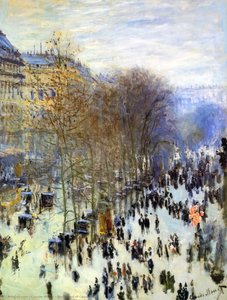 Boulevard of Capucines - Claude Monet
Looking down from a high balcony, the bustling energy of the city transforms into a rhythmic blur of movement. This elevated perspective, likely captured from a photography studio, allows us to observe the frantic pace of urban life from a distance. For the people of the late 19th century, these wide, newly constructed boulevards represented the very heartbeat of a modernizing Paris, a symbol of progress and the rapid shift toward industrial urbanity. Claude Monet uses loose, rapid brushstrokes to translate this commotion into a visual impression of motion. Rather than focusing on individual faces, the artist prioritizes the atmosphere of the street, where pedestrians and carriages become fleeting marks of color. This approach to capturing shifting light and the immediate sensation of a scene is a hallmark of his style. The horizontal version of this work is kept at The Pushkin State Museum of Fine Arts in Moscow.
The Studio Boat - Claude Monet
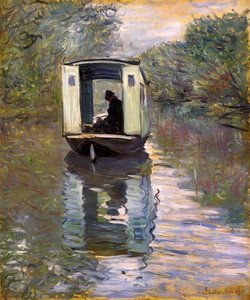
By adopting a floating workspace, Claude Monet gained access to the shifting perspectives of the Seine that remained out of reach from the riverbanks. He transformed a small cabin made of planks into a mobile studio, a practical solution that allowed him to position his easel directly amidst the water. This setup, inspired by the methods of his contemporary Charles François Daubigny, turned the river into an immersive environment rather than just a distant view. In this work, the artist focuses on the tranquil atmosphere of Argenteuil, using loose brushstrokes to define the textures of the foliage and the surface of the river. The palette relies on earthy greens, browns, and blues, punctuated by soft yellows and whites within the boat's interior. This piece is currently held at the Barnes Foundation.
The Pont de l'Europe, Gare Saint-Lazare - Claude Monet
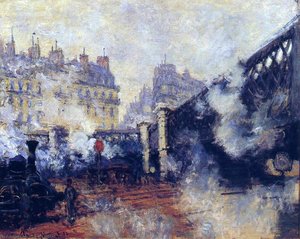 The Pont de l'Europe, Gare Saint-Lazare - Claude Monet
Mist and fog weave through the iron structures, creating an atmospheric mystery that obscures the hard edges of the industrial age. Rather than defining the locomotive or the station with sharp, clear lines, the artist chose to prioritize the way steam and smoke dissolve form into pure perception. This approach marks a pivotal moment in the career of Claude Monet, as he turned his attention away from the open fields to the bustling, soot-filled energy of the city. As part of a larger series, this work explores how a single location changes under different weather conditions and times of day. The series itself reflects the rapid modernization of the nineteenth century, finding beauty in the hazy, shifting air of a busy transit hub. You can find this particular view at the Musée Marmottan Monet. It remains a significant example of how the artist used repetitive subjects to explore the fleeting nature of light and atmosphere.
Monet's Garden at Vetheuil - Claude Monet
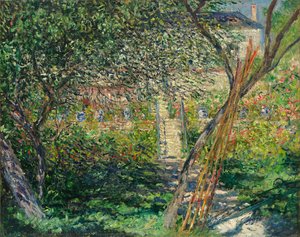
Claude Monet found a sanctuary in the village of Vetheuil, where the landscape became a primary collaborator in his search for visual truth. This work reveals a lush, green world where a winding path leads toward a distant house nestled among dense foliage. Rather than focusing on static forms, the artist prioritized the way atmosphere interacts with the physical environment. He utilized loose, rapid brushstrokes to record the immediate perception of the garden, a technique central to the Impressionist movement. The composition relies on unmediated colors to suggest the shifting conditions of the outdoors. By working directly from nature, he moved away from the controlled constraints of a studio to embrace the spontaneous reality of the Seine region. This approach allowed him to document the subtle changes in the environment through a direct, observational method. The painting remains a significant example of his commitment to the practice of painting outdoors to catch the fleeting qualities of the natural world.
Cart on the Snow Covered Road with Saint-Simeon Farm - Claude Monet
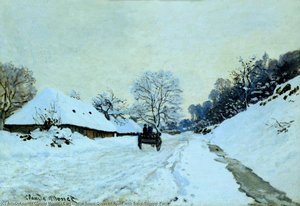 Cart on the Snow Covered Road with Saint-Simeon Farm - Claude Monet
Japanese woodblock prints by Utagawa Hiroshige left a distinct mark on this early snowscape, particularly through the use of a single vanishing point and the varied colors found within the snow. This work represents one of the first completed winter scenes by Claude Monet, establishing a recurring interest in how frost and ice transform the French countryside. A man travels along a snow-laden road in Honfleur, his wooden cart cutting through the pale green and white landscape. The composition relies on a diagonal path that leads the eye toward the distant Saint-Simeon Farm. Rather than using flat white, the artist applied different hues to the ground to show the shifting texture of the drifts. This approach to capturing the atmosphere of a snowy day became a hallmark of his later, more famous series. The scene remains a quiet observation of rural life, where the cool tones of gray and blue meet the earthy browns of the road and cart.
Irises in Monet's Garden - Claude Monet
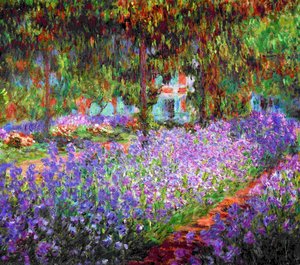 Irises in Monet's Garden - Claude Monet
Thick layers of impasto build a physical texture that makes the petals feel tangible, as if the flora itself is reaching out from the canvas. This heavy application of paint allows the artist to define the weight and form of the irises through the sheer presence of the medium. Claude Monet focused his attention on the way light interacts with the natural world, and this work reflects his lifelong commitment to plein air observation. By working directly in his garden, he translated the immediate reality of the plants into a vibrant visual language. The composition focuses on the organic shapes of the flowers, using varied brushwork to suggest the life within the garden. This piece is currently held at the Musée d'Orsay. It remains a significant example of how a painter can translate a specific moment of growth into a lasting visual record.
Red Boats, Argenteuil - Claude Monet
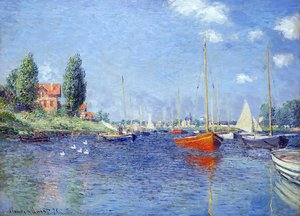 Red Boats, Argenteuil - Claude Monet
A gentle ripple breaks the surface of the Seine, catching the pale green of the riverbank and the bright sky. In this 1875 scene from Argenteuil, Claude Monet focuses on the way water reflects the world around it. The red boats act as vibrant anchors amidst a shimmering field of blues and whites. Rather than using sharp lines, he applies broken strokes of color to suggest the movement of the current and the breeze. A red house sits on the left, grounding the composition while the rest of the view opens toward distant sails. This work highlights his commitment to plein air painting, where the goal was to record the immediate, shifting atmosphere of the French countryside. By prioritizing the way light hits the water over rigid detail, he changed how we perceive the natural landscape.
Conclusion
Red Boats, Argenteuil (1875) shows the movement of small vessels on the water near the riverbank. These twenty-five works, spanning from 1865 to 1920, reveal how Monet followed the changing atmosphere of the French landscape, from the bright colors of "Impression, Sunrise" to the soft textures of "Water Lilies (or Nympheas)". Mus3ums.com acts as a creative partner for professionals designing hotels, villas, and refined interiors — providing custom collections, art mockups, and museum-quality reproductions that turn every project into an artistic statement. Explore our full collection to find your favorite.