


Introduction
"Portrait of Giovanni Arnolfini and his Wife" by Jan van Eyck (1434) depicts a private moment of domestic union and symbolic detail. These twenty-five selections represent the vast history of Western art, spanning from the mid-13th century to 1900. While they share a home in London, they vary by origin and style, ranging from the Italian precision of "The baptism of Christ" to the British landscapes of "The Hay Wain." These works remain essential because they document the evolution of technical skill and visual perspective across centuries. The Rokeby Venus by Diego Velázquez (1648) and "Rain Steam and Speed, The Great Western Railway" by J. M. W. Turner (1838) offer distinct views of their respective eras.
Portrait of Giovanni Arnolfini and his Wife - Jan van Eyck
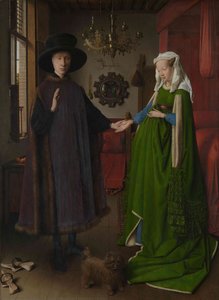 Portrait of Giovanni Arnolfini and his Wife - Jan van Eyck
Jan van Eyck was active in Bruges during the early 15th century, a period when his technical innovations changed the course of Northern Renaissance art. In this double portrait, he depicts the Italian merchant Giovanni Arnolfini and his wife within their domestic residence. The work functions as a visual record of a marriage contract, documented through the artist's signature and the specific details of the couple's surroundings.
The painting is a cornerstone of the collection at the National Gallery, London, having been acquired in 1842. Van Eyck utilized translucent oil glazes to achieve a level of detail that was revolutionary for the time. You can see the texture of the heavy green fabric and the fine fur trim on their garments. Every element, from the small convex mirror in the background to the single candle in the chandelier, carries specific meaning regarding the social and religious status of the subjects. This meticulous approach allows the viewer to observe the precise textures of 15th-century Flemish life.
Virgin of the Rocks - London - Leonardo da Vinci
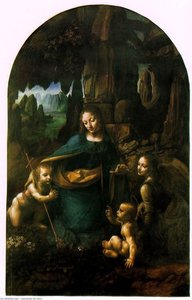 Virgin of the Rocks - London - Leonardo da Vinci
Leonardo da Vinci achieves a startling three-dimensional presence by softening the edges of the Virgin’s temples and nose with a smoky, blurry technique. This precision creates a balance of scientific innovation and ethereal beauty, though such meticulous detail required immense patience from the artist. In the National Gallery, London, this work reveals a mystical grotto where the landscape feels alive with invented, hybrid plants sprouting from the dark rocks. The figures emerge from the shadows through a careful contrast of light and dark, appearing almost spot-lit against the deep brown tones of the cavern. While the mountains recall the ruggedness of the Tuscan landscape, the water remains strikingly still. This composition places the Virgin Mary, the infant Jesus, and John the Baptist in a harmonious, pyramidal arrangement, guided by the presence of an angel. Every botanical detail and anatomical curve contributes to a scene of sacred intimacy, making the natural world feel both fertile and mysterious.
The Rokeby Venus - Diego Velázquez
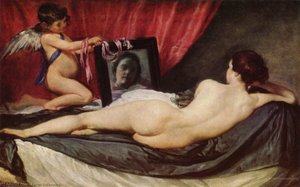 The Rokeby Venus - Diego Velázquez
After surviving a violent attack by a suffragette in 1914, this painting underwent a full restoration before returning to its place in the National Gallery, London. It remains the only surviving female nude by Diego Velázquez, a rare occurrence given the strict religious policing of seventeenth-century Spanish art. The artist used loose, vivid brushwork to achieve a level of realism and complex perspective that his contemporaries struggled to replicate. By depicting the goddess Venus reclining on a bed with her back to us, while Cupid holds a mirror to reflect her face, Velázquez created a composition that challenged traditional views of the female form. The deep green tones of the setting provide a rich backdrop for the soft textures of the skin. This work traveled from the private homes of Spanish courtiers to Rokeby Park in Yorkshire before being acquired for the public. It remains a vital part of the museum's narrative of Western art history.
The Hay Wain - John Constable
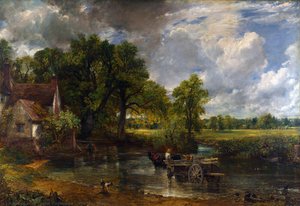 The Hay Wain - John Constable
Constable chose a grand, large-scale format for his summer exhibitions to command attention, transforming a local river scene into a significant statement of the Romantic movement. This work depicts a wood wain being pulled by three horses across the River Stour, positioned between the borders of Suffolk and Essex. Near the water, Willy Lott's Cottage sits nestled in the landscape, grounding the scene in the reality of rural life. The painting relies on textured impasto and a palette of pale green and earthy browns to build a palpable sense of atmosphere. Recent restoration efforts at the National Gallery, London, have revealed even finer details beneath the aged varnish, uncovering the subtle nuances of the artist's hand. Every brushstroke contributes to the depiction of the shifting sky and the movement of the water, making it a cornerstone of the institution's Western European collection. The composition remains a vital part of the museum's permanent display, showcasing the artist's deep affection for the Dedham Vale region.
The Fighting 'Temeraire' Tugged to Her Last Berth to be Broken Up - J. M. W. Turner
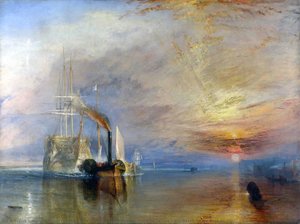 The Fighting 'Temeraire' Tugged to Her Last Berth to be Broken Up - J. M. W. Turner
The public's deep affection for this work, which led it to be voted the nation's favorite in a major BBC poll, stems from its ability to turn a historical transition into a visual poem. This painting marks a pivotal moment in maritime history, showing the 98-gun HMS Temeraire, a veteran of the Battle of Trafalgar, being towed by a small steam tug toward its final destination for scrap. Turner’s expressive use of color and atmosphere directly influenced later Impressionist painters like Monet, who sought to replicate the way light interacts with the air. Held within the National Gallery, London, the canvas presents a sunset sky of fiery oranges and yellows that contrasts against the pale, ghostly grey of the decaying warship. The small, dark paddle-wheel tug represents the arrival of a new industrial age, pulling the majestic sailing vessel toward its end. This scene remains a central part of the Turner Bequest, preserved for the public to witness the sunset of the age of sail.
The Execution of Lady Jane Gray - Paul Delaroche
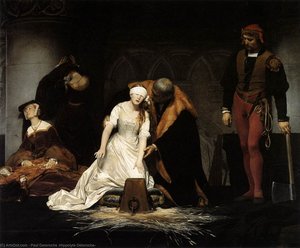 The Execution of Lady Jane Gray - Paul Delaroche
After falling out of critical favor during the 20th century, this work spent many decades in storage, leading many to believe it was lost to history until its rediscovery and return to the National Gallery, London. Paul Delaroche presents the final moments of the "Nine Days Queen," a young woman caught in the violent shifts of the 16th-century English throne. The scene focuses on her reaching for the executioner's block, her pale hands searching for the wood in the dim space.
Delaroche utilizes a stark palette dominated by black and white to heighten the drama of the historical event. Sharp shafts of light strike her white gown, creating a high contrast against the heavy, dark shadows of the surrounding figures. His Academic style produces a smooth, detailed surface where the texture of stone and fabric appears tangible. This theatrical approach to history brings the political upheaval of 1554 into a sharp, immediate focus for the modern observer.
Rain Steam and Speed, The Great Western Railway - J. M. W. Turner
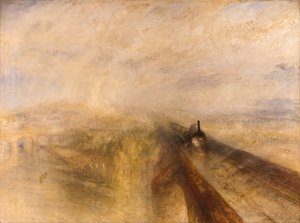 Rain Steam and Speed, The Great Western Railway - J. M. W. Turner
By positioning the train tracks along a steep, aggressive diagonal, the artist creates an immediate sensation of an impending collision, pulling the viewer directly into the path of the locomotive. This work marks a radical departure for academic painting, as it was the first to treat a steam engine as a legitimate subject. The scene is a hazy, atmospheric collision of greyish beige and golden tones, where the steam from the engine dissolves into the mist of a summer rainstorm. Thick, textured brushstrokes define the Maidenhead Railway Bridge, anchoring the composition amidst the swirling weather. While the locomotive cuts through the landscape with industrial force, small figures and a fleeing hare suggest the disruption of traditional rural life during the expansion of the railways. This evocative scene is a highlight of the collection at the National Gallery, London, where the raw power of the Industrial Revolution meets the atmospheric volatility of the natural world.
Venus and Mars - Sandro Botticelli
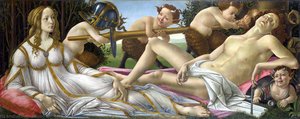 Venus and Mars - Sandro Botticelli
While many of Botticelli's most famous mythological works remain in Florence, this particular panel has called London home since 1874. The scene depicts the goddess Venus and the god Mars reclining together in a lush forest setting, accompanied by playful baby satyrs. Botticelli uses graceful, flowing lines to define the youthful figures, creating a sense of lyrical elegance characteristic of the Early Renaissance. The composition focuses on the interplay between the goddess of love and the god of war, using a palette of soft pinkish brown tones and intricate textures to build the landscape. This work highlights the artist's ability to blend mythological allegory with a delicate, ethereal beauty. Visitors to the National Gallery, London can observe the precise brushwork and the harmonious arrangement of the figures directly on the panel, which remains a significant piece of the institution's Western art narrative.
Bañistas en Asnieres, 1889 - Georges Seurat
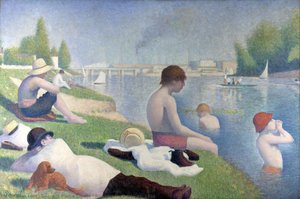 Bañistas en Asnieres, 1889 - Georges Seurat
The Salon jury's initial rejection of this work spoke to a radical shift in how artists approached the canvas, as it defied the rigid standards of the time. Instead of traditional blending, the artist utilized a meticulous application of color theory to reconstruct form through tiny dots of pure pigment. This suburban Parisian riverside scene features isolated figures and clothes piled sculpturally on the riverbank, set against the austere boundary walls and buildings of the Seine. The composition relies on a formal layout, where trees and distant structures provide a structured depth to the leisure activity unfolding by the water. Now a highlight of the National Gallery, London, the painting uses a palette of pinkish brown and soft blues to define the landscape. While contemporaries initially found the technique puzzling, the work eventually gained widespread acclaim for its unique way of building light through pointillism. It remains a vital example of Neo-Impressionism, showing a quiet moment of summer relaxation through a revolutionary technical lens.
The Feast of Belshazzar - Rembrandt
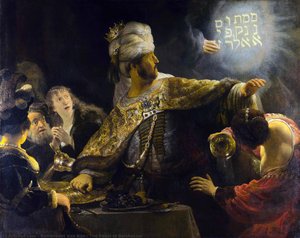 The Feast of Belshazzar - Rembrandt
The ominous Hebrew inscription appearing on the wall, "mene, mene, tekel, u-farsin," carries a heavy weight of divine judgment, signaling that a kingdom has been measured and found wanting. Rembrandt uses this biblical moment to assert his command over large-scale history painting, moving away from intimate portraits toward grand, theatrical narratives. The scene unfolds with a sudden, jarring tension as a spectral hand writes the prophecy of King Belshazzar's downfall amidst a lavish feast. Dark brown tones dominate the composition, punctuated by the sudden, supernatural glow of the message that disrupts the Babylonian celebration. This work is a cornerstone of the collection at the National Gallery, London, where its monumental scale and dramatic movement command the viewer's attention. By focusing on the psychological shock of the king and his guests, the artist transforms a moment of ancient scripture into a visceral display of Baroque power and sudden, inevitable change.
Surprise! - Henri Rousseau
 Surprise! - Henri Rousseau
A sudden flash of lightning pierces the dark, revealing a tiger poised to pounce amidst a raging gale. This dramatic illumination transforms a chaotic jungle scene into a moment of high tension, marking the beginning of a celebrated series of tropical works. While the painting's naive composition initially drew mockery from critics who viewed his style as childish, it actually presented a radical new way of seeing. The artist, a customs officer by trade, achieved a striking balance of raw emotion and visual innovation, though he had to bypass traditional academies to find an audience. Today, this work is a highlight of the National Gallery, London, where its bold, flattened perspectives and saturated greens offer a departure from academic realism. The way the predator emerges from the storm challenges established ideas of technical competency, proving that a simplified, dreamlike approach can hold immense power. It remains a vital part of the museum's diverse narrative of Western art history.
Bacchus and Ariadne - Titian
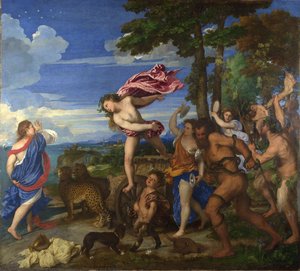 Bacchus and Ariadne - Titian
Following the death of Raphael in 1520, the commission for the Duke of Ferrara's private chamber shifted from a preliminary drawing to the hands of Titian. This transition allowed the Venetian master to infuse the mythological scene with a distinct, muscular energy. The work depicts the moment Bacchus arrives to find Ariadne on the island of Naxos, a narrative drawn from the writings of Ovid and Catullus. Deep blues and vibrant reds dominate the composition, creating a striking visual tension between the figures. You can see the artist's signature approach to texture through the way the colors interact across the canvas. Now held in the National Gallery, London, this painting remains a vital part of the museum's Renaissance holdings. The way the figures are positioned creates a sense of sudden, divine movement that fills the space of the gallery.
Venus, Cupid and Time (Allegory of Lust) - Bronzino
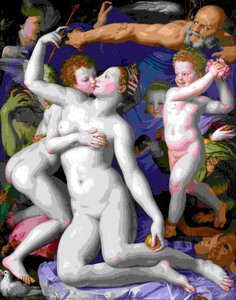 Venus, Cupid and Time (Allegory of Lust) - Bronzino
A complex web of desire and consequence unfolds in this Mannerist marvel. Agnolo Bronzino presents a scene where the figures of Venus, Cupid, and Time interact in a highly stylized arrangement. The skin of the central figures possesses an enamel-like precision, appearing almost like polished marble against a backdrop of greyish beige and muted tones. This work, held within the National Gallery, London, relies on a counterpoint of opposing movements to create its tension. While the faces are rendered with the meticulous detail of a court portraitist, the overall composition feels deliberately cold and intellectual. Scholars continue to debate the exact meaning of this allegory, yet the interplay of the figures remains striking. The smooth, porcelain textures and the fluid, elongated limbs reflect the sophisticated elegance of the Florentine court, making every detail a puzzle of Renaissance thought and technical skill.
The baptism of Christ, approx.1442, NG LONDON - Piero della Francesca
 The baptism of Christ, approx.1442, NG LONDON - Piero della Francesca
Piero della Francesca applies his mathematical mastery of perspective to create a scene of remarkable geometric clarity and balance. In this early work, the artist uses a precise vertical axis—running from the white dove through the trickle of water to Christ’s heel—to organize the sacred moment. The composition feels incredibly still, as if time has paused in the shallow, winding riverbed. On the left, three angels with colorful wings observe the ritual, while on the right, a young man prepares for his own baptism, acting as a mirror for the observer. The palette relies on soft, luminous tones, with the pinkish brown of the landscape providing a calm backdrop to the central figures. This tempera on poplar wood panel is a highlight of the National Gallery, London, where its structured, serene humanism remains a key example of Early Renaissance precision. The way the water droplets fall from the bowl adds a delicate, tactile detail to the entire arrangement.
Vincent's Chair with His Pipe - Vincent van Gogh
 Vincent's Chair with His Pipe - Vincent van Gogh
While living in Arles, France, Vincent van Gogh painted this intimate scene of his own belongings. The work features a rustic wooden chair with a woven straw seat resting on a tiled floor. A decorated pipe and a pouch of tobacco sit atop the seat, while an onion box marked with his name rests in the background. This arrangement creates a presence through the absence of the artist himself. Thick, expressive brushstrokes define the textures of the wood and the straw, giving the objects a physical weight. The National Gallery, London, holds this evocative piece, where the warm yellows of the chair contrast against the cool tones of the surroundings. It remains one of his most discussed images, offering a glimpse into his daily life and the simple objects that surrounded him during his time in the south of France.
Portrait of a Man (Man in a Turban) - Jan van Eyck
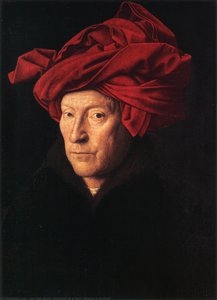 Portrait of a Man (Man in a Turban) - Jan van Eyck
The original inscription on the frame, featuring the clever pun Als Ich Can—suggesting "as only I, van Eyck, can"—reveals an artist operating with immense confidence in his technical skill. This small oil painting strikes a rare balance between meticulous innovation and a startlingly direct presence, achieved through the groundbreaking use of luminous oil glazes. The subject meets your eyes with a weathered, confrontational gaze that feels intensely personal, leading many to believe you are looking at a self-portrait. His vibrant red chaperon dominates the upper composition, its complex folds rendered with a precision that highlights the sitter's high social standing. Held within the National Gallery, London, this work showcases the early Netherlandish mastery of realism. Every detail, from the tightly pursed lips to the dark garment and white collar, demonstrates the artist's ability to render individual identity with incredible clarity. It remains a significant example of how the Northern Renaissance transformed the way we see the human face.
Bathers at La Grenouillere - Claude Monet
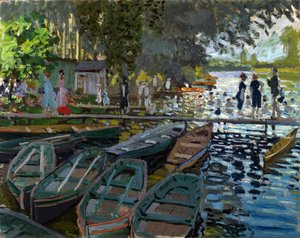 Bathers at La Grenouillere - Claude Monet
Claude Monet and his close friend Pierre-Auguste Renoir shared the riverside resort of La Grenouillere during a summer in 1869, each working to capture the same lively scene. This oil on canvas, held within the National Gallery, London, likely began as a rapid sketch for a much larger, more ambitious composition. Monet used broad, constructive brushstrokes to record the immediate atmosphere of the Seine, working with a directness that a studio setting could never replicate.
The painting focuses on the floating restaurant and the gangplank near Croissy-sur-Seine. While boats sit moored in the dark shadows, small dots of color in the bright water represent bathers enjoying the river. Pale green tones and quick strokes define the water's surface, showing the scene with a fresh, unpolished energy. This work remains a vital piece of the collection, offering a glimpse into the spontaneous, plein air methods that defined the early years of Impressionism.
Umbrellas - Pierre-Auguste Renoir
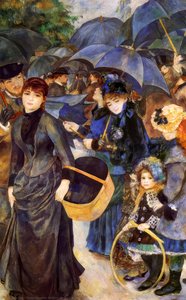 Umbrellas - Pierre-Auguste Renoir
Renoir’s Umbrellas offers a glimpse into a Parisian moment, yet the title hides the complex evolution of the canvas itself. While the name suggests a simple scene of rain, the work actually reflects a shift in the artist's technical approach. Originally begun with loose, Impressionist brushwork, the painting was later reworked in a more classical, linear style. This second phase introduced more muted colors and a structured focus on the principal female figure on the left, blending his interest in classical art with his earlier spontaneity.
Currently held by the National Gallery in London as part of the Lane Bequest, the large-scale oil on canvas measures over 180 centimeters high. The composition features a mix of dark and bright tones that define the figures and the background. This piece remains a significant part of the museum's collection, alternating its presence between London and Dublin. The interplay of the umbrellas and the figures creates a layered view of 19th-century social life.
Samson and Delilah - Peter Paul Rubens
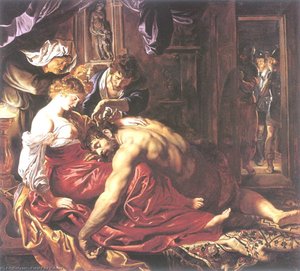 Samson and Delilah - Peter Paul Rubens
The composition relies on a heavy, diagonal tension that pulls your gaze from the slumbering, muscular form of Samson toward the sharp movement of the shears. Delilah’s figure creates a central, stabilizing curve, yet the presence of the withered woman behind her introduces a secondary, unsettling line that disrupts the harmony. This geometric arrangement forces the eye to follow the path of betrayal, from the strength of the hero to the inevitable loss of his power. Rubens uses deep reddish brown tones and stark contrasts to define the scene, a technique influenced by his time in Italy. At the National Gallery, London, this work stands out through its tactile realism; you can see the specific texture of the fabric and the pale, luminous skin of the figures. The painting focuses on the exact moment an accomplice prepares to cut the hair, while outside, soldiers wait to complete the capture.
Salome with the Head of St. John the Baptist - Caravaggio
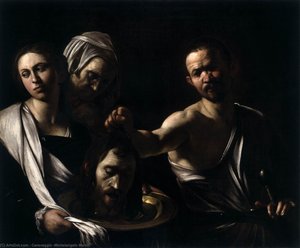 Salome with the Head of St. John the Baptist - Caravaggio
While some historians suggest Caravaggio may have sent a different version of this scene to the Grand Master of the Knights of Malta to seek favor, the version held at the National Gallery in London remains a striking study of a biblical moment. Salome stands holding the head of John the Baptist, a scene from the Bible. The composition focuses on the stark reality of the severed head and the presence of Salome, rendered with a grit that defines the Baroque style. Dark brown tones dominate the background, pushing the figures forward through intense contrasts. This work arrived in the collection after being discovered in a private home in 1959 and later acquired from the estate of Alfred Ernest Allnatt. It offers a direct look at the dramatic tension of the story, where political intrigue and personal desire lead to a violent end.
untitled (229) - John William Waterhouse
 untitled (229) - John William Waterhouse
A solitary figure emerges from the mist of myth, caught between the rhythmic surge of the sea and the rugged edges of a remote coastline. This work by John William Waterhouse presents a mermaid in a dreamlike scene, her presence a quiet intrusion upon the wild elements. The artist uses fluid, atmospheric brushwork to render the subject with luminous skin, a hallmark of his Pre-Raphaelite style. Dark brown tones and the movement of water define the composition, creating a moment of mythic stillness. While many of his most famous supernatural scenes, such as those featuring sorceresses, reside in other collections, this mermaid remains a key part of the narrative found within the National Gallery, London. The painting focuses on the psychological weight of a creature suspended between the watery depths and the air of the human world. For those looking to bring this mystical atmosphere into a home, our artists can recreate this exact impasto texture on linen canvas.)
Whistlejacket - George Stubbs
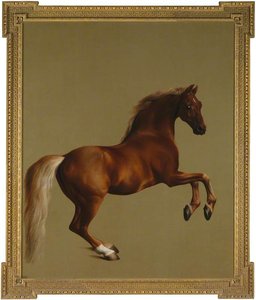 Whistlejacket - George Stubbs
George Stubbs presents a magnificent bay Thoroughbred that seems to surge from the fabric of the canvas. This 1762 oil-on-canvas features the Marquess of Rockingham's horse rearing up in a powerful, life-size movement against a minimalist, patterned backdrop. By stripping away the landscape and leaving only discreet shadows beneath the hooves, Stubbs changed how equine portraiture was perceived, focusing entirely on anatomical precision and kinetic energy. The horse's head turns toward you, breaking its upward momentum to establish a direct connection. This work arrived at the National Gallery, London, in 1997 after being held by the Fitzwilliam family for decades. The light catches the muscular frame and the bay coat, revealing the intricate anatomy that Stubbs, a specialist in equine subjects, rendered with scientific accuracy. It remains a striking display of vitality, appearing as though the animal might step out of its atmospheric space at any second.
Allegory of Time Governed by Prudence - Titian
 Allegory of Time Governed by Prudence - Titian
By directing their gazes toward the past, present, and future, the three animal heads—a wolf, a lion, and a dog—transform a simple grouping into a complex map of time. This clever use of iconography, where the animal's directionality mirrors the human experience of aging, influenced how later painters approached allegorical storytelling. Kept at the National Gallery, London, the work features three human heads representing the stages of life, from youth to old age, positioned above the beasts. Titian’s Venetian mastery is evident in the rich, dark brown tones and the way the figures emerge from the shadows. This composition uses the concept of prudence to show how wisdom requires looking in all directions to navigate life's progression. The interplay of these elements creates a visual riddle that remains a central part of the museum's collection of Renaissance art.
Annunciation with Saint Emidius - Carlo Crivelli
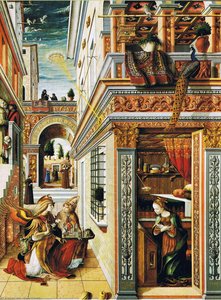 Annunciation with Saint Emidius - Carlo Crivelli
Originally commissioned for the Church of SS. Annunziata in Ascoli Piceno, this altarpiece celebrates the civic autonomy granted to the town by Pope Sixtus IV. Carlo Crivelli, a Venetian painter known for his jewel-like Madonnas and intricate trompe l'oeil details, anchors this sacred event to the local landscape. By including Saint Emidius, the city's patron saint, the work functions as a visual intersection of divine narrative and regional pride.
The composition unfolds within a complex architectural stage where the Archangel Gabriel kneels before the Virgin Mary. Beside them, Saint Emidius offers a detailed physical model of his town, bridging the gap between the earthly and the celestial. A white dove descends to represent the Holy Spirit, while a peacock emerges from a potted plant in the foreground. Every object, from the patterned ceiling to the receding perspective of the courtyard, is rendered with a heavy, tactile certainty that defines the Early Renaissance style found in the National Gallery, London.
A Young Woman seated at a Virginal - Johannes Vermeer
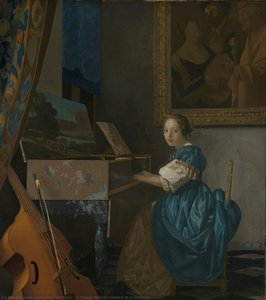 A Young Woman seated at a Virginal - Johannes Vermeer
A landscape painted on the inside lid of the virginal finds a visual echo in the artwork on the wall, which appears to be a copy of Dirck van Baburen’s The Procuress. This connection links the musical scene to the domestic history of the artist's own circle. The woman faces left, her attention fixed on the instrument as she plays. In the foreground, a viola da gamba rests with its bow placed between the strings. The composition relies on a palette of dark brown and soft tones to define the interior space. Visitors to the National Gallery, London, can observe how the artist uses precise details, such as the texture of the wood and the woman's posture, to build a scene of focused activity. This work remains a significant part of the museum's Dutch Golden Age holdings, showcasing a specific moment of private leisure through careful observation of light and form.
Conclusion
A young woman sits in a quiet moment of musical practice in "A Young Woman seated at a Virginal" by Johannes Vermeer (1670), National Gallery. These twenty-five selections, including the soft textures of "The Rokeby Venus" by Diego Velázquez (1648), National Gallery, represent the vast history held within the walls of the National Gallery, London. These paintings continue to change the character of the rooms they hang in and hold a special place in the hearts of visitors today. Explore our full collection to find your favorite.


