
The Age of Enlightenment: The Rational Foundations of Neoclassicism
 Reason vs. Emotion: The Epic Clash of Neoclassicism and Romanticism in Art History
The Age of Enlightenment: The Rational Foundations of Neoclassicism Reason vs. Emotion: The Epic Battle Between Neoclassicism and Romanticism The Age of Enlightenment: The Rational Foundations of Neoclassicism Reason vs. Emotion: The Epic Clash of Ne...
To understand the seismic shift that occurred in the late 18th century, one must first contemplate the profound stillness of the Enlightenment. It was an era defined by the triumph of human reason, a period where the intellect sought to categorize, illuminate, and bring order to the perceived chaos of the natural world. In this intellectual landscape, truth was not something to be felt in a sudden burst of passion, but something to be discovered through logic, observation, and the rigorous application of scientific thought. This philosophical rigor provided the bedrock for Neoclassicism, an artistic movement that mirrored the era's desire for stability and clarity.
As the Age of Enlightenment flourished, it sought to strip away the frivolous ornamentation and perceived decadence of the preceding Rococo period. The goal was to replace excess with a sense of moral gravity and civic duty. This was not merely an aesthetic choice but a political and social necessity during a time when the foundations of modern democracy were being laid. Neoclassicism emerged as the visual manifestation of this desire for structure, offering a window into a world where the intellect reigned supreme and the unpredictable whims of human emotion were tempered by the strength of disciplined, structured thought.
The Aesthetic of Order: Precision, Virtue, and Greco-Roman Influence
 Reason vs. Emotion: The Epic Battle Between Neoclassicism and Romanticism
The Age of Enlightenment: The Rational Foundations of Neoclassicism Reason vs. Emotion: The Epic Clash of Neoclassicism and Romanticism in Art History The Age of Enlightenment: The Rational Foundations of Neoclassicism French Revolutionary Army The F...
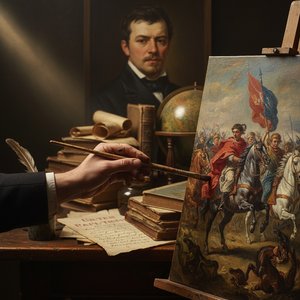
In the realm of visual arts, Neoclassicism looked backward to find its forward momentum. The movement drew profound inspiration from the disciplined grandeur of Greco-Roman antiquity, seeking a language of virtue that could speak to the contemporary struggles of the French Revolution and beyond. This was an age of clarity, where artists utilized the classical past to anchor the present in values of heroism, self-sacrifice, and the bon patriot—the good patriot. The aesthetic was characterized by an almost mathematical precision in composition, creating a sense of eternal permanence.
The technique employed by Neoclassical masters was one of remarkable restraint. Painters sought to create windows into a perfected reality, utilizing smooth, almost invisible brushwork that minimized the presence of the artist's hand to emphasize the subject itself. A controlled palette and anatomically perfect forms were essential to achieving this ideal of beauty found in the harmonious balance of structure and truth. Every line was intended to be purposeful, every shadow calculated, ensuring that the viewer’s experience was one of contemplation rather than distraction. It was a style designed to inspire awe through its very perfection and its unwavering commitment to the principles of logic and form.
The Romantic Rebellion: Embrulting Subjectivity and the Sublime
 Romanticism
Romanticism (also known as the Romantic movement or Romantic era) was an artistic and intellectual movement that originated in Europe towards the end of the 18th century. The purpose of the movement was to advocate for the importance of subjectivity,...
As the gears of the Industrial Revolution began to turn and the smoke of progress clouded the horizon, a new spirit began to stir—a rebellion against the cold, calculated precision of the rationalist era. Romanticism emerged towards the end of the 18th century as a profound response to the perceived limitations of the Enlightenment. Where Neoclassicism sought order, Romanticism sought the wild, untamed essence of the human soul. It advocated for the importance of subjectivity, imagination, and an unbridated appreciation for the power of nature, rejecting social conventions in favor of a deeply personal, individualistic outlook.
The Romanticists argued that passion and intuition were far more crucial to understanding the world than mere logic. They found beauty not just in symmetry and proportion, but in that which evokes a strong, often overwhelming emotional response. This led to a fascination with the sublime—the feeling of awe mixed with terror when confronted by the vastness of the natural world or the mysteries of the supernatural. For the Romantic artist, the landscape was not a specimen to be categorized, but a living, breathing entity capable of reflecting the deepest depths of human longing and fear.
A Revolution Embodied: Delacroix and the Pulse of Emotion
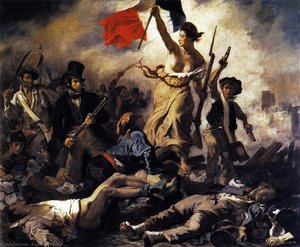
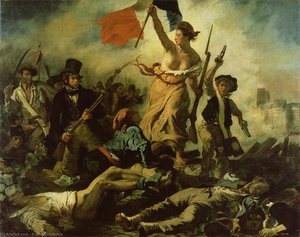 Liberty Leading the People, Louv
A Revolution Embodied: Delacroix’s Liberty Leading the People Eugène Delacroix’s 1830 masterpiece, Liberty Leading the People , is far more than a historical depiction; it's an enduring and visceral allegory of freedom. Measuring an imposing 260 x 32...
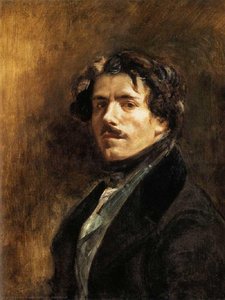
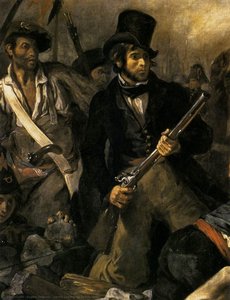
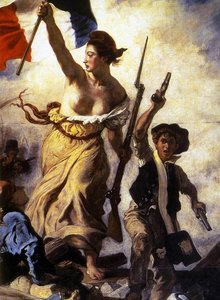
Perhaps no artist embodies this transition from the calculated to the visceral as powerfully as Eugène Delacroix. His 1830 masterpiece, Liberty Leading the People, stands as a monumental departure from the detached observations of Neoclassicism. In this work, we are not presented with a remote, idealized goddess, but with a powerfully built woman of the people, fearlessly leading a charge amidst the smoke and rubble of the July Revolution. Delacroix does not offer us a window into a stable world; he plunges us directly into the heart of conflict, making the viewer a participant in the struggle for freedom.
Delacroix’s technique was a deliberate rejection of Neoclassical restraint. He embraced loose, expressive brushwork and a vibrant, dramatic color palette—most notably the striking tricolor of the French flag—to radiate energy and embody the spirit of republicanism. Drawing inspiration from the Baroque masters like Rubens, he prioritized emotive impact over strict realism. Through his use of light to illuminate key figures amidst chaos, Delaciente demonstrated that art could be a living, breathing allegory of human struggle, where the pulse of emotion is felt in every textured stroke of the brush.
The Great Divergence: Comparing Technique, Palette, and Philosophy
--- title: Neoclassism v.s. Romanticism - Google Arts & Culture url: https://artsandculture.google.com/exhibit/neoclassism-v-s-romanticism/2gLi25OiOLA4KA hostname: google.com description: Google Arts & Culture features content from over 2000 leading ...
When we place these two titans of art history side by side, the divergence becomes strikingly apparent. Neoclassicism is a movement of the line; it relies on sharp contours, clear boundaries, and a sense of sculptural solidity. Its palette is often subdued, favoring tones that support the clarity of form. In contrast, Romanticism is a movement of the color and the mass; it utilizes soft edges, atmospheric perspective, and dramatic chiaroscuro to create depth and mood. The Romantic palette is often much more intense, designed to stir the senses and evoke the heat of passion or the chill of despair.
Philosophically, the battle is between the objective and the subjective. Neoclassicism seeks a universal truth that can be understood by all through reason—a truth that is stable, timeless, and communal. Romanticism seeks a personal truth that is found within the individual's unique perception and emotional response—a truth that is fleeting, intense, and deeply private. While one offers the comfort of order and the dignity of civic duty, the other offers the thrill of the unknown and the liberation of the imagination.
Legacy of the Clash: How the Battle Shaped Modern Artistic Expression
The epic clash between Neoclassicism and Romanticism was not merely a period of stylistic disagreement; it was a fundamental reshaping of the human experience through art. This tension between the rational and the emotional, between structure and spontaneity, laid the groundwork for much of the modern art that followed. The Romantic emphasis on subjectivity and the expressive power of the brushstroke paved the way for the Impressionists, who would later seek to capture the fleeting light and sensory impressions of a single moment, much like the soft, luminous works we cherish at Mus3ums.com.
Even today, we see the echoes of this battle in our contemporary aesthetic sensibilities. We oscillate between the desire for minimalist, structured design and the craving for expressive, textured, and emotionally resonant art. The legacy of these movements reminds us that art is never static; it is a continuous dialogue between the mind and the heart. Whether we find solace in the disciplined beauty of a classical form or lose ourselves in the turbulent seas of a romantic landscape, we are participating in a historical conversation that has been unfolding for centuries.
For those who wish to bring these profound historical echoes into their own homes, Mus3ums.com offers exquisite, hand-painted reproductions that capture the very soul of these eras. From the structured elegance of classical portraiture to the emotive textures of the masters, our artists breathe new life into history on 100% cotton canvas. Explore our collection and find the piece that speaks to your own balance of reason and emotion.