
The Unfiltered Lens: Defining the Soul of Naïve Art
 Naive Art Unveiled: The Charming Beauty of Simple Masterpieces
The Essence of Naive Art: Defining the Beauty of Unfiltered Vision To step into the world of Naive Art is to rediscover a sense of wonder that often escapes the rigorous confines of academic training. Unlike the highly structured movements born from ...
To step into the world of Naïve Art is to rediscover a sense of wonder that often escapes the rigorous, sometimes heavy, confines of academic training. For those of us who have spent decades wandering through the hallowed halls of museums, admiring the structured light of Monet or the rhythmic brushstrokes of Van Gogh, Naïle art offers a different kind of sanctuary. It is an invitation to look at the world not through the lens of what we know to be technically correct, but through what we feel to be fundamentally true. At its heart, this genre celebrates the beauty of the unlearned, emerging from a spontaneous and unfiltered connection between the artist and their subject.
Unlike the highly structured movements born from prestigious academies, Naïve art is characterized by a profound sincerity. It does not seek to impress with anatomical precision or the complex mathematical illusions of Renaissance perspective. Instead, it finds its strength in an unadulterated observation of life. When we gaze upon these works, we are not looking for the mastery of chiaroscuro, but for the pulse of a moment captured with unstudied honesty. It is a genre where the absence of traditional technique does not signify a lack of skill, but rather a deliberate focus on emotional resonance and the pure, vibrant essence of existence.
Beyond the Academy: A Rebellion Against Tradition and Perspective
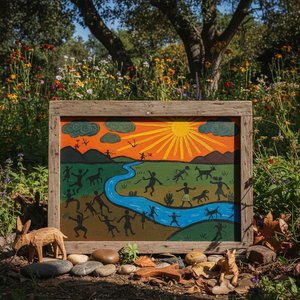 The Untamed Vision: Exploring Naïve Art & Primitivism's Rejection of Convention
The Seeds of Rebellion: Challenging Academic Art Traditions Wikipedia: Primitivism In the arts of the Western world, Primitivism is a mode of aesthetic idealization that means to recreate the experience of the primitive time, place, and person, eithe...
For centuries, the Western art world operated under a strict hierarchy, governed by academies that dictated proper technique, subject matter, and even acceptable emotional expression. The Renaissance ideals of anatomical accuracy and historical narrative held a firm sway, leaving little room for deviation. However, as the 19th century progressed, a quiet rebellion began to brew—a rejection of these established norms fueled by a desire for authenticity and a connection to something more primal. This movement, often intertwined with Primitivism, sought to recreate the experience of a simpler time and place, bypassing the intellectualized layers of academic art.
This rebellion was not merely about breaking rules; it was about finding a new way of seeing. While the academies focused on the meticulous copying of classical models, Naïve artists embraced a flattened rendering and an unconventional use of space. This rejection of traditional perspective creates a dreamlike, almost ethereal quality that allows the viewer to bypass intellectual analysis. By escheting the weight of art-historical precedent, these creators allowed their personal visions to take center stage, proving that the most profound truths are often found when we set aside the rules of the classroom and listen to the whispers of our own intuition.
The Beauty of the Unlearned: Sincerity, Color, and Emotional Truth
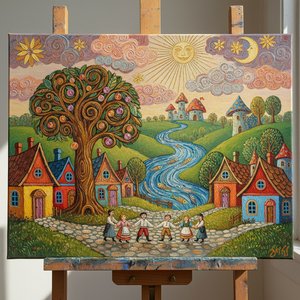 The Unconventional Vision: Exploring the Characteristics, History & Enduring Appeal of Naïve Art
Defining Naïve Art: Beyond 'Primitive' – Characteristics & Distinctions The term “naïve art” often evokes images of charming, childlike depictions—pastoral scenes brimming with life, portraits radiating an unstudied sincerity. Yet to categorize it si...
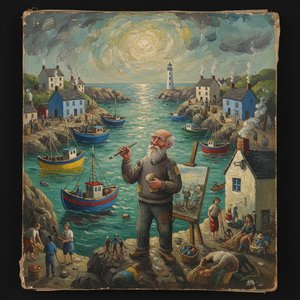
There is a certain liberation in the way Naïve artists approach their canvas, unburdened by the weight of classical rules regarding light, shadow, or scale. In these works, we find a unique kind of storytelling where colors are chosen for their emotional resonance rather than their optical accuracy. The palettes tend to be vibrant and unmodulated, eschewing subtle shading in favor of bold, declarative hues that command attention. This use of color creates a luminous, sun-drenched atmosphere that can feel as much like a memory as it does a depiction of reality.
The technical hallmarks of this style—the simplified forms and the endearing, sometimes slightly off-kilter proportions—serve to emphasize the narrative impact of the piece. Every detail is included with love and intention, even if it defies the laws of physics or anatomy. This approach allows for a directness of emotion that speaks directly to the viewer's heart. It is art that does not strive for photorealism, but rather for a truth as perceived by the artist’s soul. For the seasoned collector, this provides a refreshing departure from the heavy shadows of the Baroque, offering instead a sense of joy and lightheartedness that is increasingly rare in our modern, complex world.
Masters of the Moment: From Picasso’s Introspection to Folk Visionaries
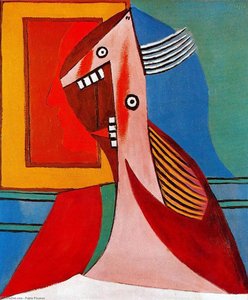
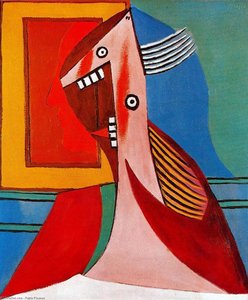 Bust of a woman and self-portrait
The Enigmatic Embrace: Picasso’s “Bust of a Woman and Self-Portrait” Pablo Picasso, a titan of 20th-century art, perpetually challenged the boundaries of representation, relentlessly pursuing innovation through a kaleidoscope of styles. Among his mos...
While we often think of Naïve art as being created by those entirely outside the professional sphere, some of history's greatest titans have looked toward this aesthetic to find deeper meaning. Consider the enigmatic Pablo Picasso. In works such as his “Bust of a wonderful Woman and Self-Portrait” (1929), we see a fascinating blend of Cubist deconstruction and Naïve directness. Picasso, despite his immense formal training, utilized bold brushstrokes and simplified forms to engage in a deeply personal, fragmented self-examination. He integrated the raw energy of the primitive with the intellectual complexity of Cubism, creating a visual dialogue that remains captivating to this day.
Beyond the giants of modernism, we find the enduring legacy of visionaries like Justin McCarthy. His work, which blended Naïve expressionism with pop culture fascination and biblical storytelling, anticipated movements like Pop Art decades before they emerged. His journey—a response to personal life events rather than academic pursuit—mirrors the very essence of the genre. From the cherished collections in the Croatian Museum of Naïve Art to the individual folk artists whose works populate our most intimate galleries, these masters remind us that true artistic power lies in the ability to capture the spirit of a subject through a lens of pure, unadulterated passion.
Finding Serenity in Simplicity: Why Naïve Art Resonates in a Complex World
 Croatian Museum of Naïve Art
The Croatian Museum of Naïve Art (Croatian: Hrvatski muzej naivne umjetnosti) is a fine art museum in Zagreb, Croatia dedicated to the work of naïve artists of the 20th century. The museum holdings consist of over 1,900 works of art - paintings, scul...
In an era defined by digital saturation and overwhelming complexity, there is a profound, almost spiritual pull toward the simplicity of Naïve art. As we navigate a world of constant noise, these paintings offer a quiet space for contemplation. They remind us of the beauty found in the everyday—the pastoral scene, the portrait radiating sincerity, the vibrant landscape that feels untouched by the anxieties of modern life. There is a restorative quality to this art; it invites us to slow down and engage with the world through an innocent, yet deeply perceptive, lens.
Ultimately, the enduring appeal of Naïve art lies in its ability to bridge the gap between the artist's inner experience and our own. It celebrates a universal human connection to nature, family, and storytelling. For those of us who have spent a lifetime appreciating the nuances of the Impressionists, finding beauty in the unadorned truth of Naïve art feels like coming home. It is a reminder that even in the absence of formal perfection, there is an unmistakable, soul-stirring perfection to be found in simplicity.
At Mus3ums.com, we share this lifelong passion for the emotive power of paint. While our specialty remains the luminous world of Monet, Renoir, and Van Gogh, we deeply respect the profound sincerity found in all movements that prioritize emotional truth. Whether you are looking to adorn your home with a hand-painted oil reproduction of an Impressionist masterpiece or seeking a custom commission that captures a personal milestone, our mission is to bring the soul of art into your living space. We invite you to explore our collections and find the piece that speaks to your own sense of wonder.