The Unfiltered Lens: Rediscovering Wonder Through Naïve Art
 Naïve Art & Primitivism: A Definitive Guide to the Power of Raw, Unfiltered Expression in Art History
Defining the Unfiltered Lens: The Essence of Naïve Art and Primitivism Unveiling the Untamed Vision: The Profound Beauty and Soulful Simplicity of Naive Art and Primitivism The Unfiltered Lens: Defining the Soulful Essence of Naïve Art The Pure Charm...
To step into the world of Naïve art is to embark on a journey of rediscovery, much like wandering through the hallowed, quiet halls of a museum only to pause before a canvas that feels less like a window into a realistic world and more like a vivid, half-remembered dream. For those of us who have spent decades admiring the sophisticated interplay of light in Monet’s gardens or the rhythmic brushstrokes of Van Gogh, Naïve art offers a different, perhaps more intimate, kind of enchantment. It is an aesthetic that invites us to set aside our learned expectations of anatomical precision and mathematical perspective to embrace something far more profound: an unadulterated, soulful sincerity.
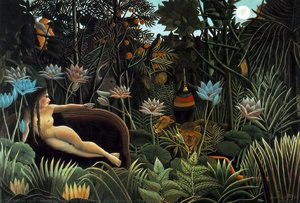
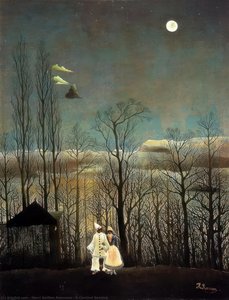
At its very heart, this movement is defined not by what it lacks—the formal academic training or the complex shadows of the masters—but by what it possesses in abundance. It is the work of the dreamer and the observer who approaches the canvas without the heavy weight of proper technique. In these works, we find a sense of wonder that bypasses the intellectualized layers of art history to reach something primal. It is an invitation to see the world through an unfiltered lens, where a lush jungle or a quiet village square is rendered with a profound, unstudied honesty that speaks directly to the human heart.
Beyond the Academy: The Soulful Essence of Self-Taught Mastery
 jorelus joseph
A Life Painted in Vibrant Hues: The Story of Jorelus Joseph Jorelus Joseph, a name synonymous with the bright spirit and untamed beauty of Haitian folk art, lived a life as colorful and compelling as the canvases he brought to life. Born on December ...
The history of art is often told through the triumphs of academies and the rigorous discipline of masters, yet some of its most poignant voices emerge from the margins. Naïve art is traditionally the domain of the self-taught, those individuals who lack formal education in anatomy or the intricate rules of graphical perspective. This absence of academic doctrine allows for a unique kind of freedom, where the artist is not bound by the "correct" way to render a face or a landscape, but is instead guided by pure emotion and visual instinct.
Consider the vibrant spirit found in the works of artists like Jorelus Joseph, whose life was painted in hues as bright as the Haitian landscapes he captured. Though his roots were in the rhythms of rural existence rather than the halls of a fine arts academy, his canvases burst with an energy that no amount of formal training could manufacture. His work, much like the broader Naïve tradition, prioritizes storytelling and color over strict realism. In this way, the self-taught artist reminds us that true mastery is not always found in the precision of a line, but in the ability to convey the very essence of life through bold outlines and flattened, captivating forms.
A Dance of Styles: When Primitivism Meets the Masters
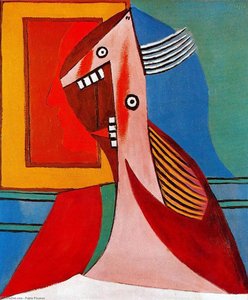 Bust of a woman and self-portrait
The Enigmatic Embrace: Picasso’s “Bust of a Woman and Self-Portrait” Pablo Picasso, a titan of 20th-century art, perpetually challenged the boundaries of representation, relentlessly pursuing innovation through a kaleidoscope of styles. Among his mos...
There exists a fascinating layer of nuance when we explore the boundary between Naïve art and its cousin, Primitivism. While Naïve art is typically the spontaneous expression of the self-taught, Primitivism often involves trained artists who deliberately emulate these "primitive" aesthetics to capture a sense of raw, untamed energy. This creates a beautiful tension between the accidental and the intentional—a dialogue between the academic and the primal.
Perhaps no artist illustrates this intersection more brilliantly than Pablo Picasso. A titan of innovation, Picasso was known for his relentless pursuit of new forms, yet he frequently returned to the simplicity of Naïve influences. In his 1929 masterpiece, Bust of a Woman and Self-Portrait, we see a potent blend of Cubist deconstruction and Naïve directness. He utilizes bold brushstrokes and a vibrant palette to create a fragmented self-examination that feels both modern and ancient. By integrating the fractured perspective of Cubism with the simplified, almost childlike forms of the Naïve style, Picasso proves that even the most sophisticated minds can find profound truth in the rejection of complexity.
The Beauty of the Unstudied: Finding Emotion in Flatness and Bold Color
 Unveiling Naive Art: The Raw Beauty of Primitivism and its Masterpieces
Defining the Unfiltered Lens: The Essence of Naïve Art and Primitivism Naïve Art & Primitivism: A Definitive Guide to the Power of Raw, Unfiltered Expression in Art History Defining the Unfiltered Lens: The Essence of Naïve Art and Primitivism Unveil...
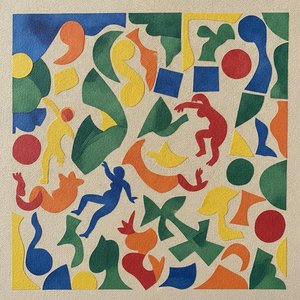
In our pursuit of art, we often seek the sophisticated interplay of light and shadow found in Impressionism, yet Naïve art teaches us to find beauty in the unexpected. There is a profound charm in flatness, where the lack of traditional depth creates a sense of immediacy and intimacy. Without the distraction of complex shading, the eye is drawn instead to the rhythm of color and the strength of the composition.
This aesthetic relies on a palette that often bursts with energy, using color not just to represent reality, but to evoke feeling. The figures are rendered with a charming directness, where a single bold stroke can convey more emotion than a thousand meticulously blended gradients. It is an art of presence. When we look at these works, we are not looking through a window into a distant world; we are standing right there in the middle of the marketplace or the tropical forest, caught in a moment of pure, unadulterated feeling.
Timeless Simplicity: Bringing the Spirit of Naïve Art into the Modern Home
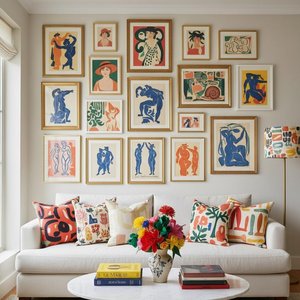
The enduring appeal of this style lies in its ability to transform any space into a sanctuary of reflection. The simplicity of Naïve art does not diminish the grandeur of a room; rather, it provides a soulful anchor. Whether it is a large-scale mural that recreates a dreamlike landscape or a small, intimate portrait that captures a moment of quiet introspection, these works bring a sense of peace and unpretentious beauty to our contemporary lives.
At Mus3ums.com, we believe that art should be a lasting memory, a way to "remix" history and bring the emotions of the past into your present. Just as the Naïve masters used bold colors to tell their stories, our artists use the rich textures of oil on canvas to breathe life into every brushstroke. Whether you are seeking a custom reproduction that captures the light-drenched spirit of an Impressionist master or a personalized tribute to a cherished memory, we invite you to rediscover the beauty of simplicity and let the unfiltered heart of art transform your home.