A Master of Hungarian Etching Tradition
Csaba Rékassy (1937 – 1989) stands as a singular figure in Hungarian art history, recognized for his unwavering dedication to the etching technique and his ability to distill classical artistic ideals into strikingly complex compositions. Born in Hungary during a period of significant cultural upheaval, Rékassy’s artistic journey unfolded largely independently, fueled by an innate talent and a profound respect for the heritage of Hungarian painting. Despite limited formal training—he was primarily self-taught—his output demonstrates an astonishing command of printmaking, cementing his place among Hungary's most accomplished artists.
Details about Rékassy’s formative years remain somewhat scarce, reflecting the challenges faced by artists operating outside established academic circles during that era. However, this independence allowed him to cultivate a voice that was uniquely his own, unburdened by the rigid dictates of contemporary movements. His artistic style is immediately identifiable by its meticulous attention to detail and its masterful manipulation of texture. He eschewed grand narratives or overtly expressive gestures, instead favoring scenes imbued with quiet contemplation and symbolic resonance.
The Convergence of Myth and Technique
Rékassy’s works frequently revisit themes drawn from Greco-Roman mythology and literature—particularly the transformative tales of Ovidius—demonstrating a deep engagement with Western intellectual tradition. This fascination translated into compositions populated by figures rendered with painstaking accuracy, bathed in diffused light that evokes the atmosphere of ancient frescoes. The artist’s technique involved layering multiple plates with intricate lines and hatching, achieving astonishing tonal gradations and creating surfaces that appear to shimmer with subtle variations in color.
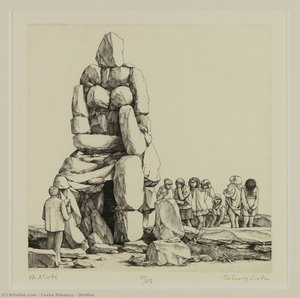
In his most celebrated achievement, the 1970 etching “Ovidius,” we are transported to a realm where history and myth converge. This masterful work of printmaking does not merely depict a scene; it invites the viewer into a profound moment of human discovery. At the heart of the composition stands an imposing, monolithic rock formation, reminiscent of an ancient Egyptian obelisk or a forgotten monument from a lost civilization. As a group of figures gathers around this colossal structure, their presence serves as a scale for the monumental task of understanding the past.
The technical brilliance of Rékassy lies in his command over the etching medium, a technique that allows for an unparalleled level of textural detail. Through the meticulous application of fine lines and cross-hatching, he breathes life into cold stone and soft fabrics alike. His use of a monochromatic palette—a sophisticated dance of black, white, and infinite shades of gray—strips away the distraction of color to focus our attention on form, light, and shadow. This deliberate restraint emphasizes the rugged, angular textures of his central monuments, contrasting them against more organic human forms.
Legacy and Symbolic Resonance
The title Ovidius suggests a deep connection to the classical poet whose Metamorphoses explored the fluid boundaries between the human and the divine. In Rékassy's hands, the rock formation acts as a powerful symbol of permanence, power, and the enduring weight of history—an unyielding witness to the passage of time. His work captures that fleeting, breathless instant when humanity encounters the sublime mysteries of antiquity.
Rékassy’s contribution to the art world is defined by several key elements:
- Technical Mastery: An unparalleled ability to manipulate the etching process to create depth and texture.
- Classical Engagement: A profound connection to Greco-Roman mythology and the intellectual traditions of the West.
- Atmospheric Depth: The creation of spaces that feel both physically grounded and spiritually ethereal.
- Historical Significance: Maintaining a high standard of classical printmaking within the complex cultural landscape of 20th-century Hungary.
Though his life was tragically short, the legacy of Csaba Rékassy remains etched in the annals of Hungarian art, offering a window into a world where the precision of the line meets the infinite mystery of the mythic past.