A Voice of Conscience: The Multifaceted Legacy of Dele Jegede
In the vibrant tapestry of Nigerian and American art, few figures possess the intellectual depth and social resonance of dele jegede. A true polymath of the visual arts, his identity spans the roles of painter, art historian, cartoonist, curator, and critic. Born in Ikere-Ekiti, Nigeria, his journey from a humble beginning—working as a housekeeper selling firewood while sketching portraits for customers—to becoming a distinguished Professor Emeritus is a testament to an unyielding passion for the creative spirit. His work does not merely exist for aesthetic contemplation; it serves as a profound commentary on the human condition, weaving together the traditional aesthetics of Africa with the sharp, biting wit of political satire.
The foundations of his artistic mastery were laid in Nigeria, where he pursued formal training at the Yaba College of Technology and later earned a First Class Honors degree in Fine Arts from Ahmadu Bello University in 1973. This period marked the beginning of his influential career as a cartoonist for the Nigerian press. Through series such as 'Flower Power' and 'Kole Omole', he utilized the medium of caricature to lend a powerful voice to the social and political challenges facing his nation. His cartoons were often described by scholars as copious sketches of the very skeleton of a nation, capturing the tensions, excesses of the privileged, and the struggles of the common people with unparalleled clarity.
Scholarship and Global Influence
As his career expanded beyond the borders of Nigeria, Jegede’s intellectual pursuits led him to the United States, where he further refined his understanding of art history. Studying under the tutelage of Professor Roy Sieber at Indiana University, Bloomington, he earned both his MA and PhD. His doctoral dissertation, which focused on contemporary Nigerian art, remains a landmark achievement, as it was the first work to focus solely on the evolution of this specific movement. This scholarly rigor allowed him to bridge the gap between African artistic traditions and the global art discourse, making him a pivotal figure in promoting Nigerian art to the Western world.
His academic journey took him through some of the most prestigious institutions in the United States. He served as a Senior Post-Doctoral Fellow at the Smithsonian Institution in Washington, DC, and held significant teaching positions at Spelman College, Atlanta, where he was a Visiting Fulbright Scholar, and Indiana State University, where he served as Professor and Chair of the Department of Art. His tenure at Miami University in Oxford, Ohio, further solidified his reputation as an educator and administrator. Throughout these roles, he remained deeply committed to the intersection of art and society, curating exhibitions like Art By Metamorphosis that challenged viewers to look deeper into the transformative power of the image.
The Art of Social Reflection
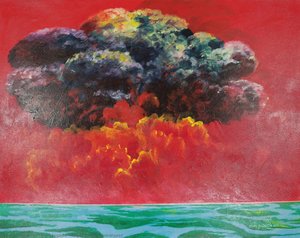
The essence of Jegede’s painting lies in its ability to address the most pressing environmental and political catastrophes of his time. His work often draws inspiration from traditional African painting and sculpture, yet it is uniquely infused with contemporary influences, including the energy of hip-hop subculture. A poignant example of his thematic depth is found in Niger Delta Apocalypse, a powerful expression of the terror and devastation caused by pipeline vandalism and oil exploration in the Niger Delta. Through this work, he invites viewers to reflect on the man-induced disasters that threaten human, plant, and animal life, highlighting the ecological negligence of large corporations.
Ultimately, the significance of dele jegede lies in his refusal to separate art from activism. Whether through the sharp lines of a political cartoon or the evocative colors of a landscape in crisis, his oeuvre remains a steadfast witness to history. His contributions are recognized not only through his academic accolades, such as the Distinguished Africanist Award from the University of Texas, but through his enduring impact on the development of Nigerian newspaper cartoons and his role as a bridge between continents. He remains a towering figure whose work continues to demand attention, reflection, and social responsibility.
Questions & Answers
What are the birthplace and birth year of Dele Jegede?
Dele Jegede was born in Ikere Ekiti in 1945.
What are the birth city and country of Dele Jegede?
Dele Jegede was born in Ikere Ekiti, in Nigeria.
In which historical period did Dele Jegede work?
Dele Jegede worked in the Modern period. The period situates the artist's activity in history.