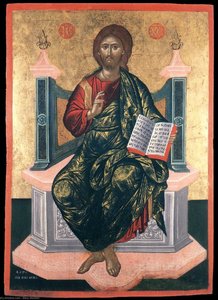
A Bridge Between Two Worlds
The life of Elias Moskos stands as a testament to the cultural fluidity of the seventeenth-century Mediterranean. Originally hailing from Rethymno on the island of Crete, Moskos was far more than a mere painter; he was an educator and a shipping merchant whose artistic journey mirrored the turbulent shifts of his era. As the struggle for Crete forced many intellectuals and creators into exile, Moskos navigated the transition from the Cretan school to the Heptanese school of the Ionian Islands. His movement from Crete to islands such as Zakynthos and Kefalonia allowed him to act as a vital conduit, carrying the venerable traditions of his homeland into new territories.
His artistry is defined by a masterful synthesis of disparate influences. In his hands, the maniera greca—the traditional Byzantine style—met the sophisticated elegance of the Venetian style. This fusion created a unique visual language that breathed new life into sacred iconography. Inspired by the works of masters like Angelos Akotantos, Moskos infused his compositions with a profound spiritual depth, often utilizing egg tempera on wood to achieve a luminous, enduring quality. His ability to blend these two distinct worlds allowed him to participate in the evolution of Greek painting, moving it toward a more refined and decorative aesthetic.
Legacy and Artistic Mastery
The surviving body of work attributed to Moskos offers a window into a period of immense religious and cultural significance. With approximately fifty-two paintings known to have survived, his oeuvre provides a substantial record of his devotion to both technique and subject matter. His most celebrated achievement, Christ Pantocrator, remains a profound spiritual centerpiece, capturing a divine presence through rich colors and a meticulous approach to detail. Other notable works, such as The Dormition and Assumption of the Virgin and Jacob’s Ladder, demonstrate his ability to handle complex theological narratives with both grace and dramatic intensity.
Beyond his individual canvases, Moskos's historical significance lies in his role as a teacher and a cultural pioneer. By bringing the art and style of Crete into the Heptanese school, he helped shape the artistic identity of the Ionian Islands for generations to come. His life, marked by both commerce and creativity, reflects the interconnectedness of the Greek maritime world, where the movement of goods and people inevitably led to the movement of ideas, styles, and souls.
Questions & Answers
Where is Elias Moskos from?
Elias Moskos was born in Germany.
What are the birthplace and birth year of Elias Moskos?
Elias Moskos was born in Cologne in 1552.
In which historical period did Elias Moskos work?
Elias Moskos worked in the Renaissance period. The period situates the artist's activity in history.