The Urban Tapestry of Fidel Évora
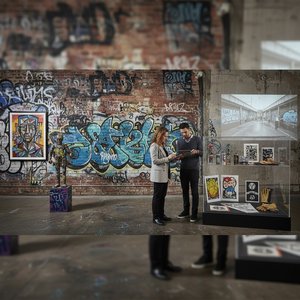
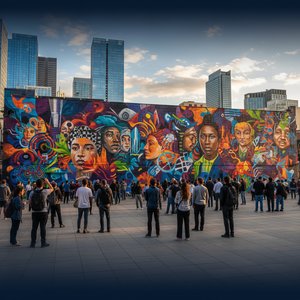
Fidel Évora, born in 1984 in the vibrant landscape of Cidade da Praia, Cape Verde, stands as a profound voice in contemporary visual art, weaving together the raw energy of street culture with the sophisticated precision of graphic design. His artistic identity is deeply rooted in his formative years in Barreiro, Portugal, where the pulse of graffiti culture first ignited his creative spirit. This early immersion in urban aesthetics provided more than just a stylistic foundation; it instilled in him a lifelong fascination with the textures of the city and the narratives hidden within its walls. As he matured, Évora transitioned from the spontaneous markings of street art to a rigorous academic pursuit, earning a Master’s degree in Graphic Design and Motion Graphics from ETIC. This technical mastery allows him to approach the canvas not merely as a surface for expression, but as a complex site for layered communication.
The essence of Évora’s work lies in his ability to navigate the delicate intersection of memory, identity, and historical reclamation. He does not simply paint; he excavates. Through his distinctive use of silkscreen printing, he creates compositions that feel like archaeological layers of time, where reality and imagination are inextricably intertwined. His pieces often serve as a bridge to forgotten histories, seeking to reconnect the viewer with displaced narratives and collective remembrances. By blending the grit of urban aesthetics with the meticulous detail of printmaking, he invites an emotional dialogue regarding how we preserve cultural heritage in an increasingly transient world.
Technique and the Alchemy of Silk Screen
What distinguishes Évora within the contemporary landscape is his masterful synthesis of diverse mediums. While his roots are firmly planted in the spontaneous energy of street art—seen in works that utilize chalk and raw, chaotic strokes to offer social commentary—his professional evolution has led him toward the disciplined beauty of the silkscreen. This technique allows for a unique layering process, where each pass of ink adds a new dimension of meaning and depth. His work often incorporates elements of photography and even literary collaboration, such as his poignant projects with the poet SillyBentes, creating a multi-sensory experience that engages both the eye and the intellect.
A significant milestone in his technical and conceptual development was his 2021 residency at the prestigious Atelier Idem in Paris. Immersed in a studio steeped in the traditions of masters like Picasso and Miró, Évora was able to refine his craft within the lineage of great printmakers. This experience bridged the gap between his contemporary urban sensibilities and the historical weight of classical printmaking, further enriching the complexity of his compositions. His ability to harmonize these disparate worlds—the ephemeral nature of graffiti and the permanence of fine art printing—is what gives his work its enduring resonance.
Legacy and Artistic Vision
The significance of Fidel Évora’s contribution to modern art can be found in his commitment to challenging established conventions. Since his pivotal participation in the 2011 exhibition featuring “Freedom’s Exhumation,” he has consistently pushed the boundaries of how much narrative a single image can hold. His work serves as a mirror to broader societal concerns, reflecting on themes of displacement and the enduring struggle for identity. Through his art, the forgotten is made visible, and the ephemeral is given form.
To understand the breadth of his impact, one might consider the core pillars of his creative output:
- Urban Narratives: The use of street-inspired aesthetics to explore complex social and historical themes.
- Technical Synthesis: The seamless integration of graphic design, motion graphics, photography, and traditional printmaking.
- Cultural Preservation: A dedicated focus on reclaiming lost histories and exploring the nuances of collective memory.
- Global Dialogue: An artistic journey that connects the landscapes of Cape Verde and Portugal with the prestigious art circles of Paris.
Questions & Answers
In which historical period did Fidel Évora work?
Fidel Évora worked in the Contemporary period. The period situates the artist's activity in history.
Where is Fidel Évora from?
Fidel Évora was born in Portugal.
What are the birth city and country of Fidel Évora?
Fidel Évora was born in Praia da Vitória, in Portugal.
What are the birthplace and birth year of Fidel Évora?
Fidel Évora was born in Praia da Vitória in 1984.