The Master of Fontainebleau
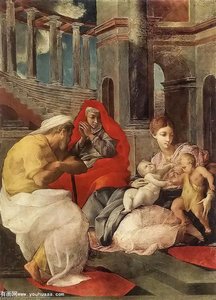
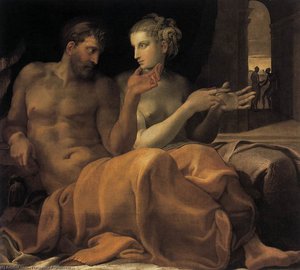
Francesco Primaticcio stands as a towering figure of the Italian Mannerist tradition, a polymath whose creative reach extended far beyond the canvas to encompass the realms of architecture and sculpture. Born in Bologna, Italy, his artistic journey began under the rigorous guidance of Giulio Romano in Mantua, where he absorbed the complex, tension-filled aesthetics that would later define his career. This early training instilled in him a profound understanding of classical forms, yet Primaticcio was never content with mere imitation; instead, he sought to infuse these classical ideals with a sense of Mannerist intensity, characterized by elongated limbs, emotional extremity, and a deliberate departure from the serene balance of the High Renaissance.
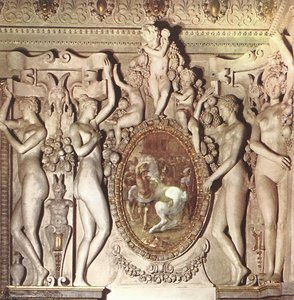
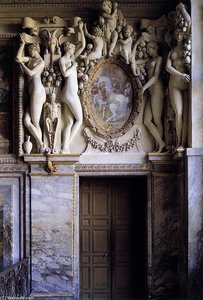
His career reached its most significant zenith in France, where he became a central pillar of the First School of Fontainebleau. After securing a position in the court of Francis I in 1532, Primaticcio worked alongside Rosso Fiorentino to transform the Chateau Fontainebleau into a pinnacle of European elegance. Following the death of Rosso, Primaticcio assumed leadership of the artistic direction at the palace, managing a talented team of painters and stuccators. His influence was instrumental in shaping the French courtly aesthetic, as he provided designs for tapestries, ephemeral decorations for grand masques, and even directed the creation of bronze casts of Roman sculptures to adorn the royal gardens.
A Legacy of Line and Motion
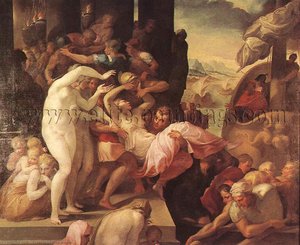
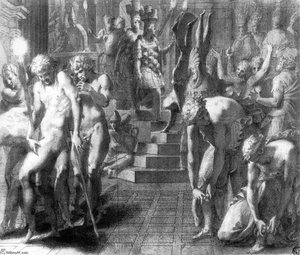
The work of Primaticcio is a captivating study in controlled chaos and opulent grandeur. His compositions often feature a swirling vortex of human figures, where the boundaries of order are frequently breached by dramatic movement and psychological upheaval. In masterpieces such as The Rape of Helene, one observes his masterful use of chiaroscary, where deep shadows swallow the periphery to cast a harsh, dramatic light upon central struggles. This technique, combined with the characteristic long-legged canon of beauty, created an atmosphere of thick, palpable tension that would influence French art for the remainder of the century.
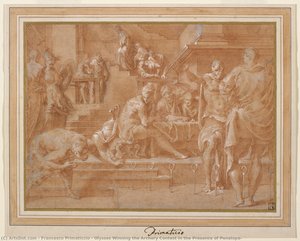
Beyond his narrative paintings, Primaticcio’s versatility allowed him to leave an indelible mark on the physical landscape of France through architecture. His later years were marked by a transition toward architectural pursuits, most notably seen in his work on the Valois Chapel at the Abbey of Saint-Denis. Whether through the delicate line work of a chalk drawing like Ceres or the monumental scale of fresco fragments such as Ulysses Winning the Archery Contest in the Presence of Penelope, Primaticcio’s oeuvre remains a testament to an artist who could navigate the complexities of myth, majesty, and the human psyche with unparalleled grace.
Questions & Answers
In which historical period did Francesco Primaticcio work?
Francesco Primaticcio worked in the Renaissance period. The period situates the artist's activity in history.
What are the birthplace and birth year of Francesco Primaticcio?
Francesco Primaticcio was born in Bologna in 1504.
What are the birth city and country of Francesco Primaticcio?
Francesco Primaticcio was born in Bologna, in Italy.