
A Visionary of the World's Edges
Georg Braun was not a painter in the traditional sense, but rather a profound topo-geographer and editor whose work defined how the Renaissance world perceived itself. Born in Cologne, Germany, his life was deeply rooted in the spiritual and intellectual traditions of his home city, where he served for many years as a Catholic cleric, specifically as a canon and dean at the church of St. Maria ad Gradus. While his primary vocation was religious, his legacy is etched into the very fabric of historical cartography. He possessed a unique ability to curate the known world, acting as the principal editor of the monumental Civitates Orbis Terrarum, an ambitious project that sought to capture the essence of global urban life through a series of breathtaking prospects and maps.
His work was characterized by a meticulous orchestration of talent and information. As an editor, Braun did not merely compile data; he acted as a conductor of geographical knowledge, acquiring essential tables, hiring skilled artists, and composing the descriptive texts that accompanied each plate. His monumental six-volume atlas, published between 1572 and 1618, was heavily inspired by the works of Sebastian Münster and sought to complement the famous Theatrum Orbis Terrarum by Abraham Ortelius. Through this massive undertaking, Braun provided a window into the social, cultural, and economic vitality of the sixteenth century, documenting everything from the bustling commerce of London to the intricate street plans of Venice and Frankfurt.
The Artistry of the Atlas
The significance of Braun’s contribution lies in the exquisite level of detail found within his publications. The Civitates Orbis Terrarum stands as a landmark achievement in printmaking, containing hundreds of bird's-eye views and maps that served as a definitive record of the era. His editorial vision allowed for a diverse range of contributors to lend their expertise to the project, including figures such as Frans Hogenberg, who created the essential tables for the early volumes, and Simon van den Neuwel. This collaborative spirit resulted in a collection of works that were not only geographically informative but possessed a painterly quality that transcended simple documentation.
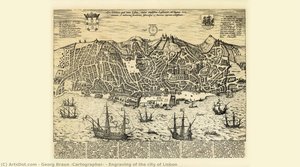
The maps and engravings produced under his direction captured the very soul of the Age of Discovery. One might gaze upon his depictions of coastal India, where the rhythmic movement of maritime life meets the majesty of distant mountains, or observe the detailed 1598 engraving of Lisbon, which portrays a cityscape alive with historical significance and maritime activity. These works functioned as more than mere navigational tools; they were visual chronicles of an era when the horizon was an invitation to exploration. By blending precise topographical accuracy with evocative imagery, Braun helped set new standards in cartography that would endure for over a century, leaving behind a legacy that remains a vital testament to the human desire to map, understand, and celebrate the world.
Questions & Answers
Where is Georg Braun (Cartographer) from?
Georg Braun (Cartographer) was born in Germany.
What are the birth city and country of Georg Braun (Cartographer)?
Georg Braun (Cartographer) was born in Cologne, in Germany.
What aliases or alternate names does Georg Braun (Cartographer) have?
Georg Braun (Cartographer) appears under the alternate names Georg Braun.



![Title (original): Calechut Celeberrimum Indiae [with] Ormus [with] Cananor — Georg Braun (cartographer)](/media/artworks/images-thumb/38/76/387690b53e28b1f835a98e77d7212f19.jpg)
