A Voice from the Camerino School
In the heart of the Italian Renaissance, amidst the rugged beauty of the mountain village of Bolognola, emerged the talent of Giovanni Angelo D'Antonio. A painter belonging to the esteemed Camerino school, his life and work represent a profound intersection of provincial devotion and the burgeoning sophistication of the Florentine influence. Born into a peasant community between 1415 and 1420, D'Antonio’s journey from a small mountain settlement to the heights of religious commissions is a testament to the transformative power of the era's artistic spirit. His early years were marked by a connection to his roots, yet his trajectory was irrevocably altered by travels that brought him into contact with the great masters of the age.
The first significant records of his presence in the art world emerge around 1443, following a pivotal journey to Florence. This excursion was not merely a change of scenery but a profound intellectual and aesthetic encounter, notably including a meeting with Giovanni di Cosimo de' Medici. Such connections suggest an artist whose reach extended far beyond the borders of his home region. Upon returning to Camerino in 1444, he began to produce works that would establish his reputation, such as the Madonna e santi, which showcased a burgeoning mastery of the Florentine style and the delicate influence of Filippo Lippi.
The Evolution of Light and Devotion
As D'Antonio’s career progressed, his technique underwent a remarkable metamorphosis. While his early works were deeply rooted in the traditions of his local school—working alongside contemporaries like Giovanni Boccati and Girolamo di Giovanni—the 1450s brought a shift toward a more luminous and structured approach. It is hypothesized that a visit to Padua may have played a crucial role in this stylistic evolution, introducing him to new ways of perceiving space and light. This period saw his work begin to mirror the profound understanding of light achieved by masters such as Piero della Francesca, lending a celestial quality to his sacred subjects.
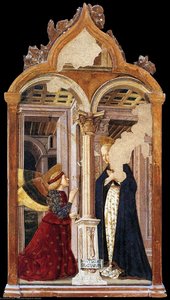
His most celebrated achievements are often characterized by a breathtaking use of tempera and gold leaf, creating windows into the divine. In masterpieces like The Annunciation, painted around 1456, D'Antonio achieved a sense of suspended, breathless grace. Through the careful application of gold, he transformed wood panels into shimmering visions of heavenly splendor, where the Angel Gabriel’s descent feels both physically present and spiritually ethereal. This ability to blend the architectural grandeur of the Gothic style with an intimate, human scale allowed him to capture the very essence of 15th-century spiritual life.
Legacy of the Sacred Narrative
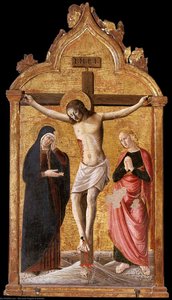
The significance of Giovanni Angelo D'Antonio lies in his ability to bridge the gap between the earthly and the eternal. His oeuvre, which includes poignant depictions such as The Crucifixion and various Madonna compositions, serves as a vital link in the development of the Early Renaissance. Whether working on large-scale panels or returning to his beloved Bolognola to fresco roadside shrines, his art remained a vessel for deep religious devotion and technical innovation.
His contributions to the Camerino school helped define a regional identity that was both uniquely local and broadly connected to the great movements of Italy. Through his mastery of:
- Luminous Clarity: Utilizing tempera to achieve a translucent, divine glow.
- Symbolic Depth: Integrating complex theological narratives through color and iconography.
- Light and Shadow: Adopting the sophisticated light-handling techniques of the mid-15th century.
Questions & Answers
Where is Giovanni Angelo D'Antonio from?
Giovanni Angelo D'Antonio was born in Italy.
What are the birth city and country of Giovanni Angelo D'Antonio?
Giovanni Angelo D'Antonio was born in Bologna, in Italy.
What are the birthplace and birth year of Giovanni Angelo D'Antonio?
Giovanni Angelo D'Antonio was born in Bologna in 1617.
In which historical period did Giovanni Angelo D'Antonio work?
Giovanni Angelo D'Antonio worked in the Early-Modern period. The period situates the artist's activity in history.