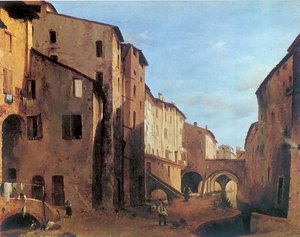
A Vision of Nineteenth-Century Parma
Giuseppe Alinovi was an Italian painter whose delicate hand captured the fleeting essence of a vanished era. Born in Parma, his life and art were deeply intertwined with the landscapes and urban rhythms of his home region. Specializing primarily in vedute—detailed views of cities and landscapes—Alinovi possessed a remarkable ability to transform topographical records into emotive experiences. His work often utilized light watercolors and oils to render the atmosphere of the Italian lowlands, creating scenes that breathed with a sense of spontaneous movement and historical weight.
The artist’s technical foundation was laid in Parma, where he trained under Giuseppe Boccaccio. This mentorship helped shape his mastery of the Neoclassical style, characterized by an exquisite manipulation of light and shadow. Alinovi had a particular talent for avoiding harsh outlines, opting instead for soft transitions that mimicked the hazy, humid air of the region. Whether depicting the bustling confluence of canals or the quiet dignity of a mountain village, his brushstrokes evoked a specific atmospheric mood, inviting viewers to witness the rhythmic vitality of 19th-century life.
Mastery of Landscape and Vedutismo
Alinovi’s repertoire was deeply rooted in the tradition of vedutismo, focusing on the architectural and natural beauty of the Appennino Parmense and the Lunigiana. His compositions often featured the streets of Parma, small towns, and historic castles, populated by figures that added a layer of human narrative to the scenery. In his masterpieces, such as B.go del Naviglio, he captured the historical significance of waterways like the Maggiore and Comune canals, preserving the memory of vital trade arteries that had nourished the heart of Parma since the 12th century.
His artistic development saw him commissioned for significant works, including a series of landscape views of the roads of Parma and Pontremoli for Duchess Maria Luigia. This prestigious patronage allowed him to document the grandeur of the region's landmarks, from the Palazzo Ducale di Parma to the Ducal Palace of Colorno. His ability to balance architectural precision with a painterly, atmospheric elegance ensured that his works were not merely documents of place, but poetic reflections on the passage of time and the enduring beauty of the Italian landscape.
Legacy and Artistic Significance
The significance of Alinovi’s work lies in its dual role as both fine art and historical chronicle. Through his light watercolors and oil paintings, he preserved the visual identity of a period before many of these urban routes and waterways lost their navigability. His depictions of the Fortress of San Vitale in Fontanellato and various views of the Pilotta gardens serve as windows into the social rituals and daily toil of his era.
Today, the traces of his talent are held within esteemed collections, ensuring that his vision of Parma remains accessible to future generations. His contributions to the Neoclassical landscape tradition continue to inspire a sense of peace and historical connection, as his works remain vital witnesses to the architectural and natural splendor of his beloved Italian homeland.
Questions & Answers
Where is Giuseppe Alinovi from?
Giuseppe Alinovi was born in Italy.
What are the birth city and country of Giuseppe Alinovi?
Giuseppe Alinovi was born in Parma, in Italy.
What are the birthplace and birth year of Giuseppe Alinovi?
Giuseppe Alinovi was born in Parma in 1811.
In which historical period did Giuseppe Alinovi work?
Giuseppe Alinovi worked in the 19th-Century period. The period situates the artist's activity in history.