The Enigmatic Legacy of Jacques Iverny
To trace the footsteps of Jacques Iverny is to wander through the mist of the early fifteenth century, a period where the boundaries between individual identity and artistic mastery were often blurred by the shadows of history. An artist whose presence is felt more through his enduring works than through a documented personal narrative, Iverny emerges from the annals of French art as a figure of profound significance. Active primarily between 1411 and 1435, he was a painter whose hand helped shape the visual language of a transitioning Europe. Whether hailing from the vibrant cultural hub of Avignon or the heart of central France, his work serves as a vital bridge between the late Gothic tradition and the burgeoning sensibilities that would eventually blossom into the Renaissance.
The historical record of Iverny is a tapestry of fragmented clues, yet each thread points toward a creator of immense technical capability. His early career is anchored in the documented commissions of Avignon, where he was tasked with creating ceremonial banners and religious altarpieces that served both the church and the civic pride of the region. In 1413, his talent earned him the patronage of Pierre d'Acigné, the seneschal of Provence, for a sacred work dedicated to Our Lord at St Sauveur in Aix-en-Provence. Such commissions suggest an artist trusted with the most delicate and prestigious responsibilities of his era, capable of translating divine mystery into tangible, breathtaking pigment.
A Synthesis of Devotion and Detail
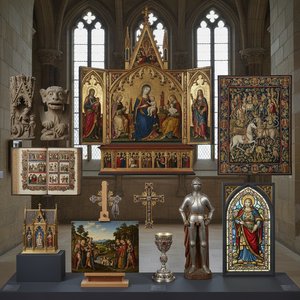
The true essence of Iverny’s artistry lies in his ability to marry the spiritual gravity of religious iconography with an almost tactile precision. His works, such as the Virgin and Child with Saint Stephen and Saint Lucy, demonstrate a mastery of the triptych format, utilizing layered compositions to guide the viewer's eye through a sacred narrative. There is a rhythmic quality to his execution, where the solemnity of the subjects is balanced by an exquisite attention to the textures of fabric, the luster of gold grounds, and the subtle modeling of human forms. This meticulous approach suggests an artist deeply influenced by the International Gothic style, yet possessing a forward-looking clarity that hints at a more profound observational realism.
Beyond the altarpieces, Iverny’s reach extended into the very fabric of civic life. He was a creator of ephemeral beauty as much as permanent monuments, executing pennants for the municipal ships of the Rhône and processional banners that would have danced through the streets during religious festivals. This versatility—moving from the intimate scale of a devotional panel to the grand, public spectacle of heraldic banners—reveals an artist who understood the multifaceted role of imagery in medieval society. His work was not merely decoration; it was a functional component of the social and spiritual architecture of his time.
Historical Significance and Artistic Mystery
One of the most captivating debates surrounding Jacques Iverny is his potential identity as the Master of Castello della Manta. Some scholars suggest that the same hand responsible for the breathtaking frescoes in the Piedmontese castle—noted for their heroic and idealized figures—might be that of Iverny. If this connection holds true, it elevates him from a regional French master to a pivotal figure in the broader European movement, linking the traditions of France with the sophisticated courtly art of Italy. This possibility adds a layer of profound mystery to his biography, suggesting an artist whose influence traveled far beyond the borders of Provence.
Though many of his specific works have been lost to the ravages of time, the fragments that remain—and the historical accounts of his lost commissions—continue to command respect. His legacy is found in the enduring strength of his surviving compositions and the way they continue to illuminate the transition from the medieval to the modern era. Jacques Iverny remains a cornerstone of early fifteenth-century art, a master whose name is synonymous with the delicate balance of piety, prestige, and unparalleled technical grace.
Questions & Answers
What other names is Jacques Iverny known by?
Jacques Iverny is also known as Yverni, Iverni, Jacobus Iverini.