Early Life, Family and Training
Born in Stockholm, Sweden, in 1828, Johan Edvard Bergh was the son of Severin Bergh and Emma Forsström. His parents worked as shopkeepers, providing a stable foundation for a young man whose path would eventually diverge from the commerce of his parents. His early education began at Maria Læromsskola, where he first began to cultivate the intellect that would later serve him in both law and art.
In 1844, he moved toward higher learning by entering Uppsala University. His initial pursuits were directed toward the natural sciences, a field that requires a keen eye for the intricacies of the physical world. However, the pull of the law proved stronger than the study of nature. He shifted his focus to legal studies, a decision that led him to earn a master's degree in 1849. This academic achievement paved the way for a professional life in the halls of justice, where he served as a notary at the Svea Court of Appeal and at Stockholm City Hall.
Artistic Training and Travels
After his early studies in Uppsala, the pull of the visual arts led him away from the legal profession and toward the great academies of Europe. His path was shaped by a significant three-year study trip that took him through Switzerland, Italy, and Germany. During this formative period, he sought out the masters of the landscape, finding his way to the Kunstakademie Düsseldorf. It was there, in about 1851, that he began to refine his eye under the guidance of the Norwegian romanticist Hans Gude. Such training provided him with a foundation in the dramatic and emotive qualities of nature, a skill he would carry throughout his life.
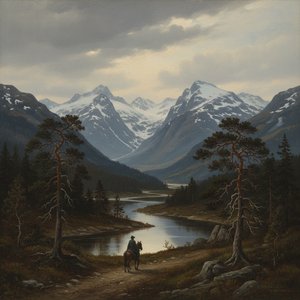
His education was not limited to a single school or mentor. He sought the wisdom of several distinct voices, absorbing the techniques of the German landscape and seascape painter Andreas Achenbach. He also studied under the Swiss landscape painter Alexandre Calame, whose influence likely contributed to his understanding of mountain and alpine scenery. These lessons were not merely academic exercises but were deeply connected to his movements through the continent. His wanderings took him through Geneva and Rome, and he later found himself in Norway, always searching for the right light and the right composition to capture the essence of the natural world.
Technique and Artistic Style
The brushwork of Bergh reveals a man deeply shaped by the traditions of the Düsseldorf School. His early training left a clear imprint upon his hand, as one can see the distinct influence of Andreas Achenbach and Hans Gude in the way he composed his landscapes. He learned to capture the weight of the natural world through their guidance, yet he did not remain a mere imitator of their methods. As his years passed, he moved away from the heavy shadows of his teachers to cultivate a style that was entirely his own, one that felt intimately tied to the soil of his homeland.
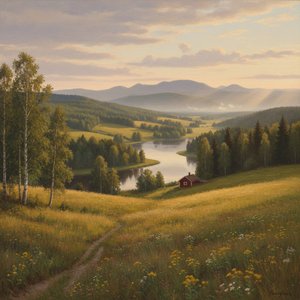
He turned his gaze toward the quiet corners of Sweden, seeking out the spirit of the northern landscape. His canvases often portray an idyllic version of nature, where the light seems to linger in smiling forest groves and among the slender trunks of birch trees. He possessed a particular talent for rendering the textures of the Swedish countryside, from the ruggedness of mountain motifs to the gentle, rhythmic lines of coastal scenes. There is a sense of peace in his depictions of small villages nestled within the greenery, capturing a sense of place that felt both specific and deeply felt.
His compositions often centered on the interplay between water and wood, frequently utilizing the presence of birches to guide the viewer's eye through the scene. Whether he was painting the dense shade of a forest or the open expanse of a coastline, his work remained anchored in the physical reality of the Swedish terrain. This devotion to his native landscape allowed him to transform simple natural observations into something that felt uniquely his own.
Key Works and Recognition
As his brush moved away from the formal constraints of his early legal training, Bergh began to find a profound connection with the Swedish landscape. His talent caught the attention of international circles, leading to a significant honor when he was awarded a gold medal at the Exposition Universelle in 1867 in Paris. This recognition marked a high point in his career, affirming his ability to translate the essence of his homeland into a visual language that resonated far beyond the borders of Sweden.
His compositions often sought to capture the quiet spirit of the northern terrain. During his middle years, he produced works such as Utsikt i Uri i Schweiz (1858) and Skogslandskap med vattenfall i Småland (1862), which reflected the influence of his travels and his formal training. As he matured, his focus shifted toward the specific textures of the Swedish coast and forests. He painted Fishing Village in Bohuslän (1867) and later produced Landscape Scene from the West Coast of Sweden (1873), works that solidified his reputation for depicting the local environment with sincerity.
The artist also found great success in portraying the simpler, more intimate aspects of nature. His later years saw him returning to motifs that felt deeply personal, such as the interplay of light through trees and the stillness of the woods. His portfolio includes several notable studies of the natural world:
- I barrskogen (1868)
- Under björkarna (1870)
- Björkskog (1876)
Later Years and Death
The final chapter of Bergh's life was marked by a sudden and heavy struggle against his own body. In 1874, an intracranial hemorrhage struck him, leaving him partially paralyzed and altering the course of his creative output. This physical hardship forced a change in his studio practice; unable to pursue the wide-ranging explorations of his earlier years, he began to repeat the popular motifs that had once brought him such success. The vitality that characterized his previous landscapes seemed to retreat, and his work never returned to its original level of quality following this illness.
Despite these personal tribulations, his legacy continued through his family. He was the father of Richard Bergh, who would grow to become a painter himself. The artist passed away in Stockholm in 1880, leaving behind a body of work that captured the changing light of the Swedish landscape before his strength failed him.
Questions & Answers
In which historical period did Johan Edvard Bergh work?
Johan Edvard Bergh worked in the 19th-Century period. The period situates the artist's activity in history.
What other names is Johan Edvard Bergh known by?
Johan Edvard Bergh is also known as Edvard Bergh, Edward Bergh, Johan Edward Bergh, إدوارد بيرغ, Юхан Эдвард Берг.
What are the birthplace and birth year of Johan Edvard Bergh?
Johan Edvard Bergh was born in Stockholm City in 1828.