A Legacy of Color and Form
Kenneth Campbell Lochhead was a profound figure in the Canadian art landscape, a painter whose journey through the realms of Surrealism and abstraction helped shape the modern identity of Western Canadian art. Born in Ottawa, Ontario, his early artistic foundations were laid through rigorous study at the Summer Art School at Queen's University, followed by formative years spent at the Pennsylvania Academy of the Fine Arts in Philadelphia and the Barnes Foundation. This diverse educational background provided him with a sophisticated understanding of both classical technique and the burgeoning modern movements that would later define his career.
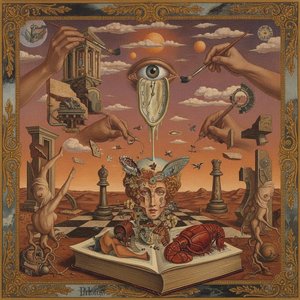
His artistic evolution is a fascinating study of movement and metamorphosis. In his early period, Lochhead navigated the evocative territories of Surrealism and abstraction, creating works that possessed a dreamlike quality. This era was marked by significant public commissions, including two notable murals—one for the airport in Gander, Newfoundland, and another for the Royal Canadian Legion branch in Regina. These works demonstrated his ability to marry surrealist imagery with large-scale, impactful compositions.
The Regina Five and Modernist Mastery
Lochhead’s significance extends far beyond his individual canvases; he was a pivotal architect of the Canadian modern art movement. As a member of the renowned Regina Five, he stood alongside contemporaries like Art McKay and Ron Bloore to present a new, bold vision of abstraction at the National Gallery of Canada in 1961. His involvement in the Emma Lake Artists' Workshops further cemented his role as a leader in the development of Post-Painterly Abstraction in Canada. This period of his life was characterized by an intense engagement with color field painting, where he explored the essential elements of light, space, and plastic form.
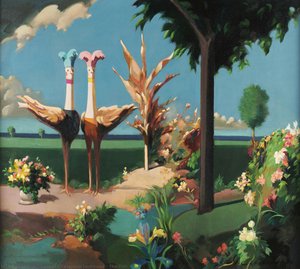
As his style matured, Lochhead’s work began to breathe with a unique rhythmic energy. By the late 1960s, he moved toward an abstract approach that utilized unpainted margins of canvas to allow colors to interact without crowding the composition. This technique created a sense of openness and vitality, where the boundaries between subject and environment could blur into a singular, harmonious experience. His later landscapes, such as the exquisite The Pair, showcase a masterclass in texture and color, where vibrant botanical life and soft light create a sanctuary of peace for the viewer.
A Life Dedicated to Art and Education
Beyond the studio, Lochhead was a distinguished educator and administrator whose influence reached generations of artists. His career was marked by significant leadership roles, including serving as the director of the School of Art at the University of Saskatchewan — Regina Campus and administering the Mackenzie Art Gallery. He held professorships at the University of Manitoba, York University, and the University of Ottawa, leaving an indelible mark on the academic study of fine arts.
His contributions to the Canadian cultural fabric were recognized with some of the nation's highest honors:
- Officer of the Order of Canada, awarded for his immense contribution to the development of painting, particularly in Western Canada.
- Governor General's Awards in Visual and Media Art, a testament to his enduring excellence as a creator.
- Royal Canadian Academy of Arts (RCA) membership, signifying his standing within the professional artistic community.
Through his dual legacy as a painter and a teacher, Kenneth Lochhead ensured that the evolution of modern abstraction in Canada would be both visually stunning and intellectually profound.
Questions & Answers
Where is Kenneth Campbell Lochhead from?
Kenneth Campbell Lochhead was born in Canada.
What are the birth city and country of Kenneth Campbell Lochhead?
Kenneth Campbell Lochhead was born in Ottawa, in Canada.
What are the birthplace and birth year of Kenneth Campbell Lochhead?
Kenneth Campbell Lochhead was born in Ottawa in 1926.
In which historical period did Kenneth Campbell Lochhead work?
Kenneth Campbell Lochhead worked in the Modern period. The period situates the artist's activity in history.