The Weight of a Single Legacy
Lambert Glandorf occupies a narrow, intense space in the history of Northern European art. His reputation does not rest on a vast body of work, but on the sheer historical gravity of a single commission. To understand Glandorf is to understand the intersection of German craftsmanship and the specific, violent history of the Baltic region. He was a painter of the sixteenth century, likely born in Lübeck, Germany, a city that provided the technical foundation for his later, singular achievement in Tallinn.
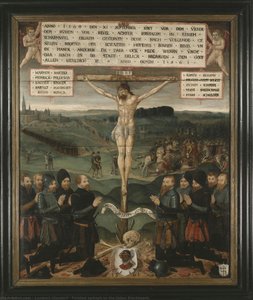
His importance is tied to a specific moment of crisis. In 1561, he completed a monumental epitaph for the Tallinn Brotherhood of Blackheads. This was not a mere decorative piece. It was a response to the deaths of ten members during a siege by Ivan IV of Russia in 1560. Because of this, Glandorf’s work functions as a primary visual record of a city in flux, capturing the skyline of Tallinn at dusk, dominated by the silhouette of St Olaf’s Cathedral.
Technical Precision and Stylistic Tension
Glandorf’s method reveals a mind caught between two eras. He worked with oil paint on wood panels, a medium that allowed for the sharp architectural detail required to map a city's skyline. His technique demonstrates a deliberate tension between the fading traditions of the Gothic period and the emerging humanism of the Renaissance. He did not rely on vague atmosphere; he used geometric precision to anchor his composition.
The visual impact of his work relies on several specific technical choices:
- The use of chiaroscuro to create a dramatic interplay between candlelight and deep shadow.
- A meticulous rendering of architectural features and the heavy folds of drapery.
- The application of atmospheric perspective to establish depth within the urban landscape.
This combination of skills allowed him to move beyond simple topography. He transformed a memorial into a complex study of light and memory, ensuring the piece functioned as both a religious object and a historical document.
Historical Permanence
The survival of the Tallinn Epitaph provides a rare, direct link to the Reformation period. While much of the artistic output from this era is lost or fragmented, Glandorf’s work remains a concrete reference point for the architectural landscape of sixteenth-century Estonia. He captured a specific view of the city that would never exist in exactly the same way again, making his contribution more about historical accuracy than mere aestheticism.
His legacy is defined by this permanence. He remains a figure of study because his work provides the visual evidence required to reconstruct the past. He did not merely paint a scene; he documented a moment of survival and remembrance that continues to anchor the art history of the region.
Questions & Answers
What aliases or alternate names does Lambert Glandorf have?
Lambert Glandorf is also known as Lambert Glandorp.