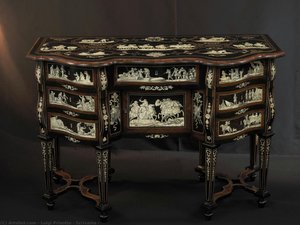
The Master of Marquetry and Woodwork
While history often reserves its brightest spotlights for the painters of the Baroque era, the legacy of Luigi Prinotto offers a profound window into the exquisite craftsmanship of Turin. Born in 1685, Prinotto was not primarily a painter, but rather an exceptionally skilled ebanista (cabinetmaker) and intarsiatore (marquetry artist). His life's work was defined by the meticulous manipulation of rare woods and ivory to create furniture that served as much as fine art as it did functional luxury. Operating within the vibrant artistic landscape of Italy, his hands transformed dense materials into delicate narratives of light and shadow.Artistic Development and Roman Influence
Prinotto’s creative journey was deeply intertwined with the shifting aesthetic tides of the early modern period. His mastery of intarsio—the art of inlaying different materials to create intricate patterns—required a level of precision that mirrored the complexity of the era's greatest painters. During his career, which flourished between 1712 and 1780, he became renowned for producing pieces characterized by a refined wisdom and a sense of sumptuous elegance. His work often adhered to established traditions while simultaneously embracing the decorative splendor required by the high courts of the time. The influence of broader artistic movements is palpable in the themes he chose for his wood inlays. Though his medium was wood and ivory, his compositions often echoed the dramatic spirit of the Baroque. He possessed a remarkable ability to execute fine details on even the smallest scales, creating miniature worlds within the grain of the timber. His reputation grew to such an extent that by 1721, he had earned the esteemed appreciation of the royal court, a testament to his ability to marry technical rigor with aesthetic grace.Legacy and Royal Patronage
The significance of Prinotto’s work is most clearly seen in the prestigious collections where his pieces reside today, such as the Royal Palace of Venaria. His craftsmanship was so highly regarded that he was able to secure significant commissions for the nobility, including works featuring complex scenes of festivities, hunting, and pastoral life. These pieces often utilized rare woods like rosewood and ebony, layered with ivory to create a luminous effect that mimicked the depth found in contemporary oil paintings. His contributions to the decorative arts of Turin left an indelible mark on the history of Italian craftsmanship. Through his ability to weave complex imagery into the very fabric of furniture, Prinotto ensured that the artistry of the ebanista would be remembered alongside the great visual masters of his age. His work remains a vital link to the sophisticated domestic and courtly life of the eighteenth century, embodying an era where utility and high art were seamlessly entwined.Questions & Answers
What are the birth city and country of Luigi Prinotto?
Luigi Prinotto was born in Turin, in Italy.
Where is Luigi Prinotto from?
Luigi Prinotto was born in Italy.
What are the birthplace and birth year of Luigi Prinotto?
Luigi Prinotto was born in Turin in 1685.
In which historical period did Luigi Prinotto work?
Luigi Prinotto worked in the Early-Modern period. The period situates the artist's activity in history.