The Alchemy of Illusion: The Artistry of Marion Delarue
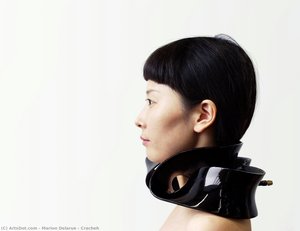
In the quiet intersection where the tangible meets the imagined, the work of Marion Delarue resides. Born in Paris in 1986, Delarue has cultivated a practice that transcends the traditional boundaries of jewelry, moving instead into the realm of wearable sculpture and conceptual adornment. Her artistic journey is one of profound transformation, where the wearer becomes a canvas for stories of myth, nature, and artifice. To encounter her work—be it a delicate headdress or an intricate brooch—is to enter a space where the distinction between what is organic and what is fabricated begins to dissolve into a beautiful, haunting ambiguity.
Delarue’s creative impulse was ignited in the intimate world of childhood, driven by a meticulous devotion to detail. This early fascination was famously nurtured through her relationship with her beloved doll, Héloïse, a figure that demanded precision and encouraged the first experiments in miniature creation. This foundational passion for the small and the significant eventually led her to formal academic rigor, studying at the École Supérieure des Arts Décoratifs de Strasbourg (HEAR). Her education was not merely a pursuit of technique but an expansive global odyssey; through exchange programs and residencies, she immersed herself in the ceramic, glass, and lacquer traditions of South Korea and the craft explorations of Estonia. These diverse cultural encounters infused her work with a deep reverence for Asian heritage and a mastery of materials that bridge the gap between ancient savoir-faire and contemporary critical thought.
Materiality and the Mimicry of Nature
At the heart of Delarue’s practice lies an obsession with the concept of transformation. She does not merely use materials; she interrogates them. Her work often seeks to mimic natural forms with such uncanny precision that the viewer is forced to question their own perception of reality. Through the skillful manipulation of substances like nacre and agate, she creates objects that appear to be living organisms or geological relics caught in a state of transition. This pursuit of "the real" through "the artificial" allows her to explore themes of identity and illusion, creating hybrid creatures and beads that mimic the very texture of flesh.
Her commitment to the life cycle of her materials is as much an ethical stance as it is an aesthetic one. Delarue prioritizes ecologically responsible sourcing, often finding beauty in the repurposed or the found. By selecting materials from ethical farms and breathing new life into treasures discovered in flea markets, she imbues each piece with a sense of history and environmental consciousness. This approach ensures that her sculptures are not just static objects of beauty, but vessels of ecological narrative, reflecting a broader contemporary concern for our relationship with the natural world.
A Legacy of Global Craft and Exhibition
The significance of Marion Delarue’s work is reflected in the prestigious international stages upon which it has been displayed. Her career is marked by a series of notable exhibitions that highlight her role as a leading voice in contemporary art jewelry. From the Musée des Arts Décoratifs in Paris to the Stedelijk Museum in Amsterdam, her pieces have challenged audiences within the world's most esteemed cultural institutions. Her presence at major industry events, such as the Schmuck fair in Munich and various international craft biennales in South Korea, underscores her influence on the evolution of contemporary adornment.
Delarue’s achievements can be summarized through several key pillars of her professional impact:
- Cultural Synthesis: The seamless integration of traditional Asian techniques, such as Korean natural lacquer and Chinese-inspired motifs, into a modern European sculptural context.
- Technical Versatility: A mastery over a vast array of media, including ceramics, glass, textile, wood, and precious minerals.
- Conceptual Depth: The ability to use wearable art as a medium for philosophical inquiry into the boundaries between authenticity and imitation.
- Global Recognition: A distinguished exhibition history spanning Europe, Asia, and North America, establishing her as a pivotal figure in the contemporary craft movement.
As she continues to live and work within the serene landscapes of the Perche nature park, Delarue remains an artist in constant motion, always seeking the next boundary to blur and the next material to transform.
Questions & Answers
In which historical period did Marion Delarue work?
Marion Delarue worked in the Contemporary period. The period situates the artist's activity in history.
What are the birthplace and birth year of Marion Delarue?
Marion Delarue was born in Paris in 1986.
What are the birth city and country of Marion Delarue?
Marion Delarue was born in Paris, in France.
Where is Marion Delarue from?
Marion Delarue was born in France.