The Architect of Light and Form
In the turbulent dawn of the twentieth century, a period defined by the shattering of old empires and the birth of radical new ideologies, Oleksandr Kostiantynovych Bohomazov emerged as a visionary architect of the canvas. Born in 1880 in Yampil, within the vibrant cultural landscape of what is now Ukraine, Bohomazov was far more than a mere painter; he was a profound theoretician and a pioneer of the avant-garde. His journey began not with the brush, but with the rigorous logic of mathematics and physics, studies undertaken at Kyiv Imperial University. This scientific foundation would later become the invisible scaffolding for his art, allowing him to dissect the physical world into its most fundamental energetic components.
The trajectory of Bohomazov’s soul was irrevocably altered by his time in Paris between 1907 and 1912. Immersed in the revolutionary atmosphere of the French capital, he encountered the fragmented geometries of Cubism and the kinetic energy of Futurism. These movements provided him with a new visual vocabulary, yet Bohomazov sought something deeper than mere stylistic imitation. He looked toward the work of contemporaries like Aleksandr Archipenko to understand how form could be deconstructed without losing its vital essence. His early works began to reflect this tension between the tangible object and the ephemeral movement, as he learned to translate the pulse of modern life into a language of intersecting planes and rhythmic lines.
The Evolution of Spectralism and Theory
As his career matured, Bohomazov moved beyond the structural constraints of Cubo-Futurism toward a more profound exploration known as Spectralism. This was not merely a stylistic shift but a philosophical pursuit. Influenced by the pioneering ideas of Mikhail Larionov and Wassily Kandinsky, Bohomazov sought to capture the very mechanics of sight itself. He became obsessed with the way light interacts with the eye, attempting to paint the energy that exists between the object and the spectator. In 1914, he solidified his role as a leading intellectual of the movement by writing his treatise, The Art of Painting and the Elements. In this seminal work, he analyzed the interaction between Object, Artist, Picture, and Spectator, setting the theoretical foundation for modern art.
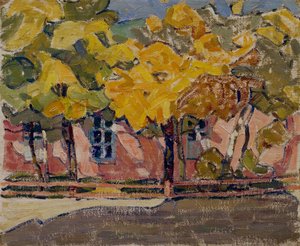
His mastery of various styles allowed him to navigate the complex landscape of the Ukrainian avant-garde. While his Cubo-Futurist period (1913–1917) focused on the rhythmic pulse of industry and urban life, his later Spectralist phase (1920–1930) delved into the ethereal. This evolution is beautifully captured in works such as Sawyers, painted in 1929, where he utilizes a painterly approach to emphasize texture and light, evoking the physical weight of labor through a striking contrast between earthy tones and a brilliant blue sky. Similarly, his 1912 work Street on Podil demonstrates his ability to transform a geographical location into a living, breathing organism, using an amber autumn glow to create a sense of temporal magic.
Legacy of the Ukrainian Avant-Garde
The historical significance of Oleksandr Kostiantynovych Bohomazov lies in his ability to synthesize scientific precision with avant-garde expression. He remains recognized as one of the key figures of the Ukrainian avant-garde scene, a period of intense social and political transformation. His contributions can be summarized through several defining characteristics:
- Theoretical Innovation: The creation of Spectralism and the establishment of a new visual language based on the mechanics of perception.
- Interdisciplinary Approach: The integration of mathematical and physical logic into the deconstruction of form and light.
- Cultural Leadership: His role as a central figure in the development of modernism within the Ukrainian landscape, bridging the gap between European influences and local vitality.
Through his deliberate brushwork and profound theoretical depth, Bohomazov captured the essence of an era. Whether depicting the collective spirit of manual labor or the vibrant, flickering light of a city street, his work continues to resonate as a testament to the power of the artist to redefine reality through the lens of light and energy.
Questions & Answers
What are the birthplace and birth year of Oleksandr Kostiantynovych Bohomazov?
Oleksandr Kostiantynovych Bohomazov was born in Yampil in 1880.
In which historical period did Oleksandr Kostiantynovych Bohomazov work?
Oleksandr Kostiantynovych Bohomazov worked in the Modern period. The period situates the artist's activity in history.
What are the birth city and country of Oleksandr Kostiantynovych Bohomazov?
Oleksandr Kostiantynovych Bohomazov was born in Yampil, in Ukraine.
Where is Oleksandr Kostiantynovych Bohomazov from?
Oleksandr Kostiantynovych Bohomazov was born in Ukraine.